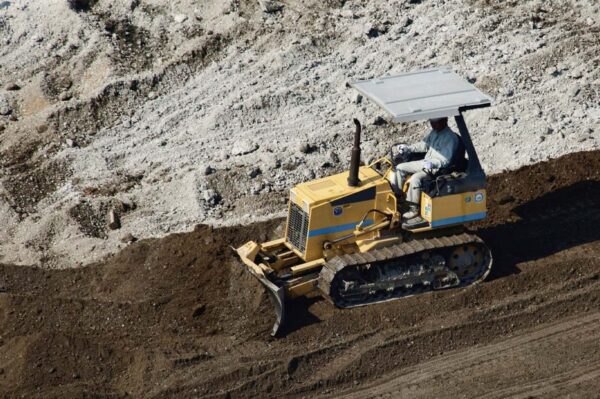
At a landfill construction site on the grounds of a former coal mine in Fukuoka Prefecture, X, a construction equipment operator, was run over by a bulldozer and injured.
X filed a lawsuit against the person who operated the bulldozer, the sub-subcontractor to which that person belonged, as well as the general contractor and subcontractors.
It could be said that one option for X, who is not a legal expert, is to file a lawsuit against all parties involved and seek a judicial ruling.
The ruling also took individual circumstances into account. For reference, I’d like to go through them one by one.
A Stalled Bulldozer and a Pile of "Bota"
X was a construction equipment operator and an employee of Y2, a subcontractor. The overall structure of this project was as follows: Y1 was the general contractor responsible for the landfilling work at the former coal mine site, with Y2 and Y3 serving as subcontractors under it. Furthermore, Y4, a sub-subcontractor, had been subcontracted by Y3 to perform the work. X, an employee of Y2, was conducting backfilling work at the former coal mine site using a bulldozer provided by his employer, Y2.
One day, when a bulldozer stopped working, X crawled under it to inspect it. However, while he was doing so, the bulldozer started moving on its own, and X’s arms and legs got caught in the tracks, leaving him unable to move.
Just then, Employee C from Y4, a subcontractor, happened to be passing by. Although the washed coal fines (non-combustible materials such as rock debris mixed in during coal mining) transported by Y4 had begun to pile up, the bulldozer in question remained stationary, and the operator was nowhere to be found. Believing this would hinder subsequent work, C moved the bulldozer. As a result, the bulldozer ran over X, who was standing below, and injured him.
X filed claims for damages against nearly all parties involved, based on the following grounds: against the general contractor, Company Y1, for employer liability regarding its employee A; against the subcontractor, Company Y2, for breach of the duty of care due to negligence in providing X with a defective bulldozer; and against another subcontractor, Company Y3, for employer liability regarding its employee B. Furthermore, X pursued claims against the sub-subcontractor, Y4, for employer liability regarding employee C, and against C himself, the operator, for tort liability arising from negligence in failing to verify safety.
Given these complex relationships, what rulings did the court issue regarding each company and individual?
Judgment on “Company Y1 (Prime Contractor): Employer Liability Regarding A”
Employee A of Company Y1 was giving instructions to subcontractor Company Y3 regarding the source, quantity, and destination of the materials to be transported. It was determined that these instructions were naturally necessary for the principal under a subcontracting agreement at a landfill construction site such as this one, where there are multiple sources of coal waste and the delivery destinations for processed coal and washed coal waste shift as construction progresses. Without these instructions, the subcontractor would be unable to perform the work.
However, it was concluded that since Company A’s instructions did not cover specific aspects of work supervision—such as the vehicles in operation, the personnel responsible for transport, or the nature of the work—and since instructions of this nature were insufficient to establish that Company Y1 was effectively directing and supervising C, Company A was not liable under the principle of employer liability.
Judgment in the Case of “Company Y2 (Subcontractor): Breach of Duty of Care for Safety”
Next, regarding the liability of Company Y2, where X is employed: Upon inspection of the bulldozer provided by Company Y2, no functional defects or abnormalities were found in the clutch or brakes. Therefore, the company was found not liable for a breach of its duty of care.
Judgment on “Employer Liability of Company Y3 (Subcontractor) Regarding B”
On the other hand, a different determination was made regarding Employee B of subcontractor Y3. Acting on instructions from Employee A of the prime contractor, Y1, Employee B provided on-site instructions to the sub-subcontractor, Y4, regarding the locations and quantities of materials such as gravel to be transported. Furthermore, after consulting with Employee A, B determined the specific schedule for dump truck operations, and B also provided daily instructions to Y4 regarding the required number of dump trucks and the details of the work to be performed.
For this reason, even though the relationship between Company Y3 and Company Y4 was based on a subcontracting agreement, it was determined that Company Y3 was, in effect, directing and supervising Company Y4’s employee C. Consequently, Company Y3 was found to be liable as the de facto employer of C.
Judgment on “Company Y4 (Sub-subcontractor): Employer Liability Regarding C”
C is an employee of Y4. Since the bulldozer in question was parked with no driver in sight, even though the washed coal intended for landfilling that Y4 had transported was piling up, C moved the bulldozer, believing it would interfere with subsequent operations.
Subsequently, C used this bulldozer to perform the task of pressing the water-flush button; although operating the bulldozer was not part of C’s regular duties, it was determined that the act was performed in the course of conducting Y4 Company’s business. Given these circumstances, it could not be said that Y4 Company had exercised due care; therefore, it was similarly held liable under the employer’s liability principle.
"C: Liability for Torts" and "Judgment Against X"
With regard to C, the person who operated the bulldozer, it was determined that he was at fault for failing to fulfill his duty to thoroughly check the safety of the surrounding area—including the area beneath the bulldozer—while operating it, given the unnatural nature of the maneuver.
However, it was also determined that X was at fault for crawling under the bulldozer without taking proper safety precautions, thereby causing the accident; as a result, 30 percent of the liability was attributed to X under the principle of contributory negligence. In other words, C was found to be 70 percent liable for the tort.
Judgment
X is at fault for crawling under the bulldozer without taking proper safety precautions, thereby causing the accident; 30 percent of the liability is attributed to X under the principle of contributory negligence. (December 25, Heisei 9, Fukuoka District Court)
By choosing to sue all parties involved, not only were individual judgments handed down for each of them, but X’s own share of fault was also determined. I imagine X must have felt a sense of closure and found the outcome satisfactory.