



Hello, everyone.
This is Enta.
The other day, was that person an employee of the client’s construction management company?
I received some feedback regarding the injection.
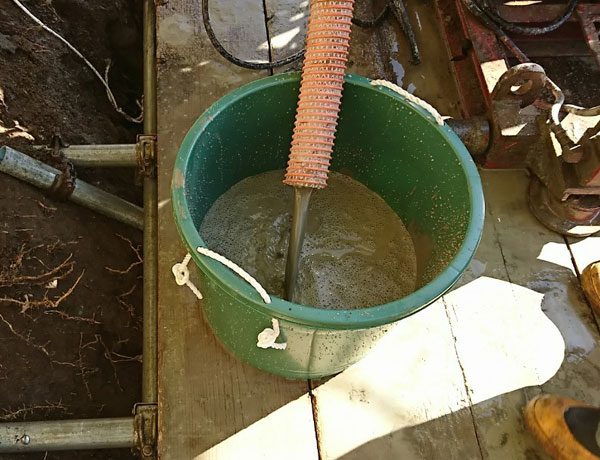
I'll explain this in more detail later.
1. Drilling Complete
2. Removing the inner rod
3. Inserting an Anchor
4. Injection of cement slurry through the injection hose (in-casing replacement injection)
5. Check for Overflow
6. Removing the outer casing (up to the anchored section)
7.Pressure Injection Please point it out here
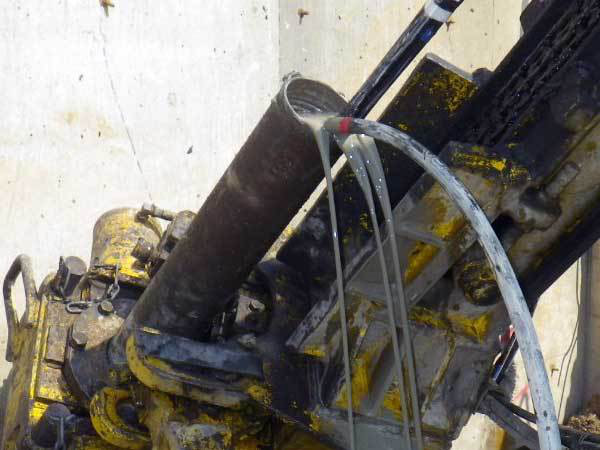
According to the Ground Anchor Association, the injection pressure ranges from 0.2 to 0.4 MPa.
However, in this case, the pressure did not reach 0.2 MPa. (In fact, it was only about 0.18 MPa.)
This is because it has come out of the casing and is no longer under pressure.
Since there's nothing we can do about it, I was about to wrap things up, but the older construction manager looked at me with a puzzled expression.
Since the level hasn't risen by 0.2, you're saying that it's standard practice to pump cement slurry from outside the casing.
I've never done anything like that before, and there aren't any such documents or guidelines, are there?
As soon as I said that, he got really mad... lol
He came across as high-handed the whole time, so I guess I didn't phrase things very well either, but I don't know... lol
It's been a while since I've seen someone so bossy, lol.
I certainly understand what you're saying.
However, once the cement has been thoroughly injected into the anchorage section, the free-length section is filled with cement.
Since this is Hokkaido, I don't have any specific data, so I can't be certain, but I seem to recall seeing somewhere that there's no need to be too concerned about pressure.
There are also papers that suggest the effect of pressure is minimal when it comes to clay layers and bedrock. (Not that it’s relevant, but...)
I make a whole batch of cement slurry, but depending on the location, waste can account for about 80 to 90 percent of it.
So when I said, “I don’t make that much cement slurry,” they said it didn’t matter.
So you're basically saying, "Just make another one," lol
Oh, it's Professor High-Pressure! What a comment—he doesn't give a second thought to on-site construction!
You can't just make a grout mixer in such small batches, so if you make too much and throw it away, you end up with a lot of trash, right?
It costs money, doesn't it? And it takes time, too, right? Is that really efficient?
That's what I'm thinking, but I won't say it—even for a construction manager, that's pretty bad, isn't it? lol
The client is on equal footing with the winning bidder, right? (Oh, wait—we’re just a subcontractor, lol.)
I suppose construction management isn't really about money or efficiency. It's simply about whether the work is getting done.
So, is that why there are so many demanding teachers? Even though the nice ones are really, really nice, there’s such a huge difference lol
Even if the pressure doesn't rise, we remove a few casing sections afterward and perform a follow-up injection.
By that time, any water that had seeped out had turned into cement slurry.
But by that time, I had already gone home and wasn't there to watch the construction supervision anymore (since it was past 5:00 p.m.) lol
Wow, I guess I ended up venting a bit.
If that construction manager comes by again, I'll try talking to him lol. I'm sure we both want to make this a great job site, right?
I wonder if we'll get along eventually?? lol
See you later.
The Effect of Grout Pressure Injection on Anchor Body Friction Stress



This is my first time leaving a comment. I always look forward to reading your posts.
I, too, work as a construction manager in a certain prefecture.
Since I don’t have any experience with anchor installations, this is just my personal opinion, but I think that as long as the final tension control is in order, that’s all that matters—there’s no need to go out of your way to check the pressure.
Pressure is, after all, just a matter of the “process” along the way, so I think that, from the government’s perspective, it ultimately comes down to the “result” (tension management) rather than the “process”…
Thank you as always.
That's true, though...
However, since many people who haven't studied the subject thoroughly tend to be reluctant to take on detailed responsibilities, I'll just follow the specs to the letter lol.
Well, that’s part of the job of a construction manager, so I won’t deny it.
Everyone has their own perspective, after all.
It's tough out on the job site, though~~~~ lol
If possible, it would be helpful if the construction management staff could come to a common understanding of construction management practices, wouldn’t it?
It’s not uncommon for Person A to say one thing, only for Person B to say the exact opposite.
"Which one is it, anyway?!" lol
Well, if you focus on control values, standard values, and specifications, it’s unlikely to become a major problem, but since construction managers are only human, their personal biases do come into play.
They actually get mad sometimes, lol. To be honest, it's a pain, lol.
We look forward to your continued support.
You have to figure out the officials’ personalities to manage things effectively. It’s tough, isn’t it? I totally get how you feel—since there’s no pressure applied from the outside of the grout casing. So far, I’ve managed to get by just talking my way out of it. But anyway, I have a question for Enta-san ^ – ^: When you switch to digital dial gauges for stress monitoring, don’t the officials find them more noticeable and easier to read, which makes it harder to prepare reports? Like when they take notes on the deflection measurements or sign off on them during inspections. Not that we’re doing anything improper with construction or management, but… don’t you run into problems when our stance—that “it’s OK as long as it holds the load”—clashes with the deflection values the officials noted down and the data in the reports? Digital gauges look cooler, but I stick with analog ones because I find it easier to prepare the paperwork. What do you think?
Thank you as always.
Even if it sticks out from the casing, it looks like this. I guess that's good enough! lol
Let's go in with confidence, lol
I think digital is fine, too.
That's because, let's say they wrote it down and went home.
Let's say the data doesn't fall within the upper and lower limits.
In that case, since you can just do it over, it's fine to simply report that you've redone it.
I told the construction manager, “Since that data didn’t fall within the range, please just leave it out.” lol
If you really haven't lost any hair, just be confident about it!
In some cases, PC strands may not stretch. For example, this can happen if milk has seeped into part of the free-length section.
As long as nothing's missing, I can come up with all kinds of nonsensical excuses! lol In the end, I can just say, "Nothing's missing."
It's totally fine to say, "It's fundamentally weird to have a test where you have to attach a dial gauge and take measurements outside, right?!" lol
It's OK to tell the government, “Look, the gauge wobbles even when the wind blows, right? The accuracy of the test is pretty questionable.”
If it does not fall within the specified range, stretch it to its maximum length in the presence of the construction supervisor, then return it to the initial load.
Check the difference; if it fits, that's fine, but if it doesn't, it's most likely because the measuring device is set up incorrectly.
By the way, since I plan to measure all strokes using a digital caliper (with an accuracy of 1/100) as early as the construction plan stage, I won’t be installing a dial gauge.
Well, if the general contractor really insists, I'll include it, but even if I do, the data I'll be using is from a digital caliper, lol.
I’ll explain this to the government office as well, but it is physically impossible to position the dial gauge exactly horizontally and vertically relative to the PC strands.
"That's why I use a digital caliper," I explain. "It gives more accurate measurements."
Now it's just a matter of relying on the engineers' report-writing skills!! lol
We look forward to your continued support.