

Hello, everyone.
This is Enta.
The other day, while looking through some old management data, I came across this lol
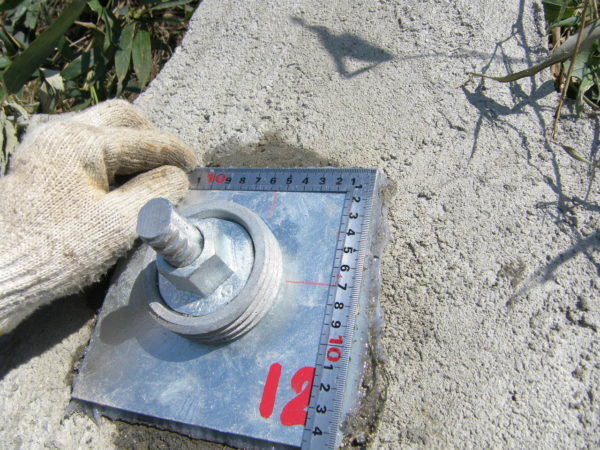
That brings back memories.
If you're wondering what this photo is of, it's a measurement of alignment errors, lol.
This is how we used to do it.
Mark the center of the frame with a red line on the corner washer.
This assumes that once the square washer is installed and the spherical washer is tightened, the rebar is definitely centered within the square washer!
Then, we measure the distance from the red line to the upper-right corner of the square washer—using that corner as the zero point—to determine the displacement.
Well, I suppose there are plenty of ways to do it, but these days, instead of going through all that trouble with such a complicated process, you can just use a bolt scale and get it done in one go.
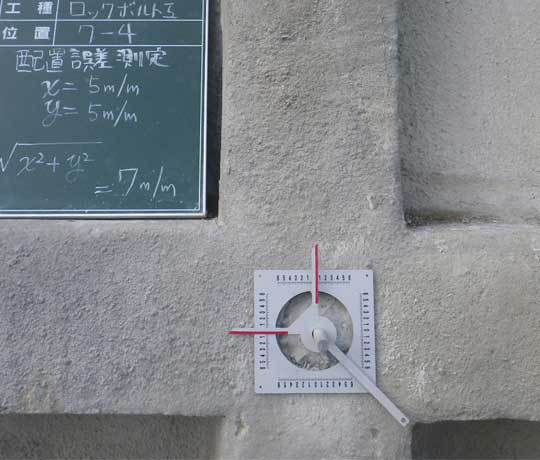
So, this is fine as it is, but,
Bolt ScaleとAnchor ScaleIt seems some people get this wrong.
If I had to point out a difference, it would be the size and shape of the scale plates.
The standard bolt scale plate is 200. (A plate with markings)
If you're looking for a larger size, we also offer size 300.
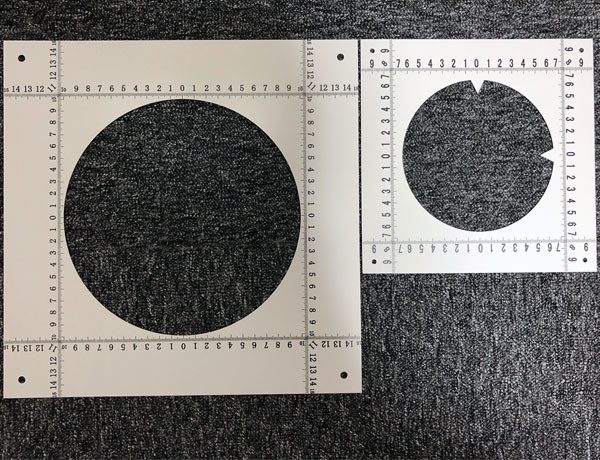
The shape shown in the photo above is a scale plate for a bolt scale.
Anchor scale refers to the measurement of positioning errors in ground anchor construction.
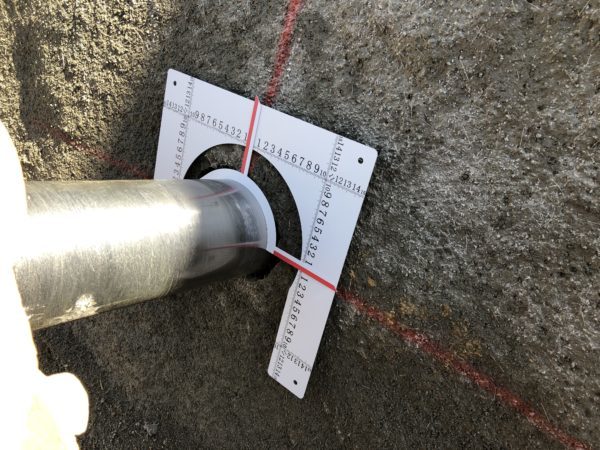
It looks like this.
The size is 300, but as you can see at a glance, the shape is fundamentally different.
Since the anchor scale is designed to measure positioning errors relative to the casing, it is measured after drilling is complete.
Since this was taken after drilling, the casing is already in place.
Since it would be difficult to install a scale plate there, it has been arranged in a U-shape as shown above.
Please be sure not to confuse bolt scales with anchor scales.
By the way, perhaps because Anchor Scale has been gaining more recognition lately, it’s been selling quite well.
Make construction management a little easier and more accurateI support this cause.
See you later.
Even hard-to-spot alignment errors are now a thing of the past