Hello, everyone.
This is Enta.
It's gotten a lot colder all of a sudden, so I've put on a neck warmer for now! (Around my neck)
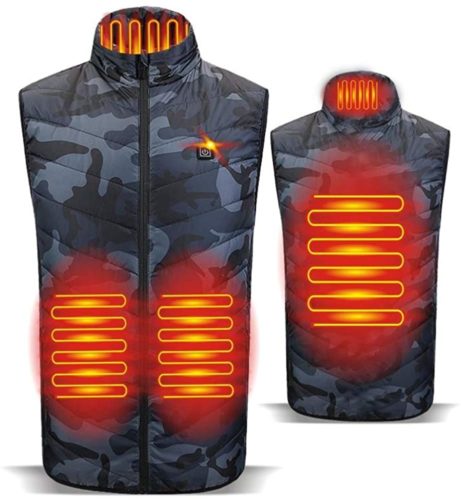
I'm planning to start wearing a heated vest starting next week!
But that's beside the point.
This is the final installment in our series on the basics of landslide prevention.
Cutting, Trimming, and Stitching
Did you remember? lol
Basic Principles of Landslide Mitigation Measures (Part 1)
Basic Principles of Landslide Mitigation Measures (Part 2)
Basic Principles of Landslide Mitigation Measures (Part 3)
Last but not least, here’s our specialty: sashimi!
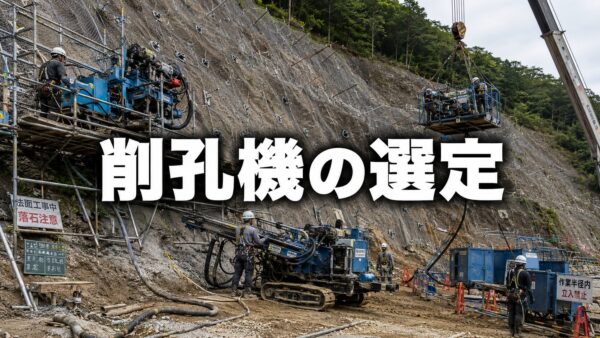
The driving work involves ground anchor installation and pile driving.
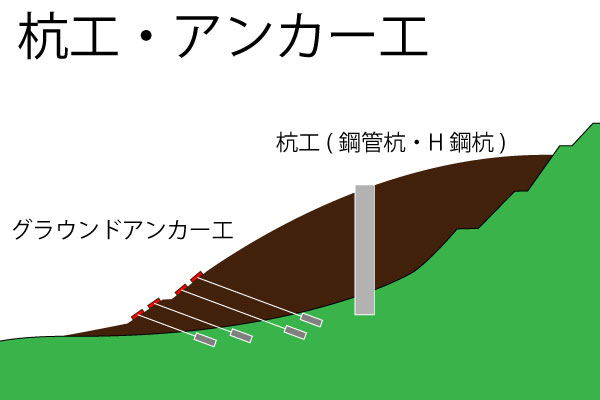
Pile driving is performed to counter relatively large landslides.
Based on our experience, we have installed steel pipe piles with a diameter of 1,000 mm, H-beam piles with a diameter of 600 mm, and deep foundation piles with a diameter of 2,000 mm.
The drilling process is similar for both methods, involving the use of a down-the-hole hammer or similar equipment to drill vertically.
For deep foundation piles only, excavation is performed by inserting tools such as hands or a mini backhoe into the liner plate.
Once the specified drilling depth has been reached, insert steel pipes, H-beams, or rebar cages, and then fill the entire space with concrete or a similar material.
We drive these into the ground at the horizontal spacing (distance) specified in the design, one after another.
That's all.
This is what stops the clumps of dirt from sliding down the mountain.
It's a very simple and easy-to-understand construction method, isn't it?
Needless to say, ground anchor work!
It's a construction method that firmly compacts the natural ground to keep it from shifting, isn't it?
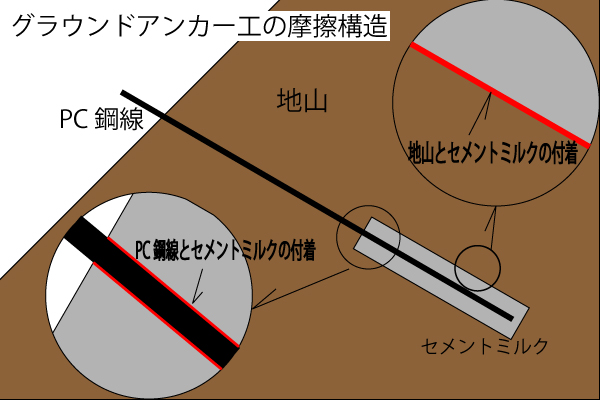
The anchorage is secured to a solid section of the natural ground, and prestress is applied by pulling the PC strands from the ground surface.
Although the way forces are applied varies depending on the type of material used for ground anchors, the basic structure is generally the same.
Load-bearing plates and retaining walls are commonly used to support the ground surface.
Occasionally, they are also used in gravity retaining walls and similar structures.
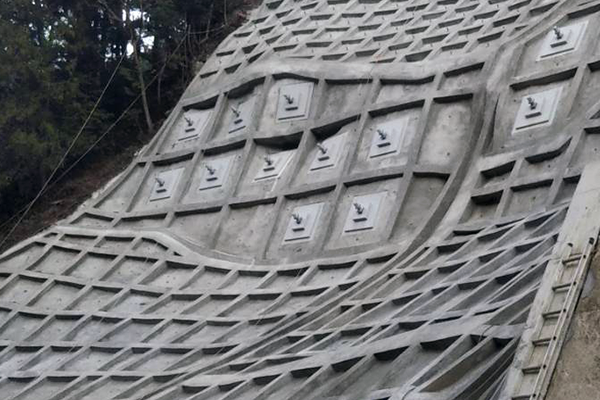
Cutting, Trimming, and Stitching
If you keep these things in mind while working on a project, it’ll make the job site even more interesting.
And by thoroughly understanding retaining structures and stabilization measures, we can build mountains that are less prone to landslides!
I think you'll really understand what I mean.
Why did the mountain we built collapse?
Why is the mountain under construction about to collapse?
Why is this retaining wall about to collapse?
I think you'll find it easy to understand.
And the answer to "How should we deal with this?" is pretty straightforward, isn't it?
Let's proceed with the construction while keeping the site layout in mind!
See you later
P.S.
This time, I received a very clear explanation on Twitter.
Thank you so much for allowing me to recreate it—essentially copying it exactly.
I’d love to freely borrow useful information like this! (I’ll ask for permission, lol)