Hello, everyone.
This is Enta.
Have you already gone back to your hometown for the Obon holiday?
I don't have a home in Kagoshima to go back to, so I hardly ever go back—how about you guys? lol
I think you'll be completely exhausted by the time you're ready to buy something, so please be very careful on your way home.
And for those of you who are out having fun, make sure to enjoy yourselves and recharge!
But that's beside the point.
In this post, I’ll be discussing “angles,” which are an inevitable part of the tensioning process in ground anchor construction.
I’ll explain, in a way that even beginners can understand, how to approach the situation on-site when the drilling angle and the slope on the pressure plate side don’t align perfectly.
I've been writing a series for beginners lately lol
I'm in the middle of writing this up because I'll need it at some point, lol.
What Is the “Angle” in Ground Anchor Construction?
In ground anchor construction, tendons (tensile members such as prestressed concrete steel strands) are inserted into holes drilled into the ground and then tensioned and anchored at the ground surface to stabilize the slope.
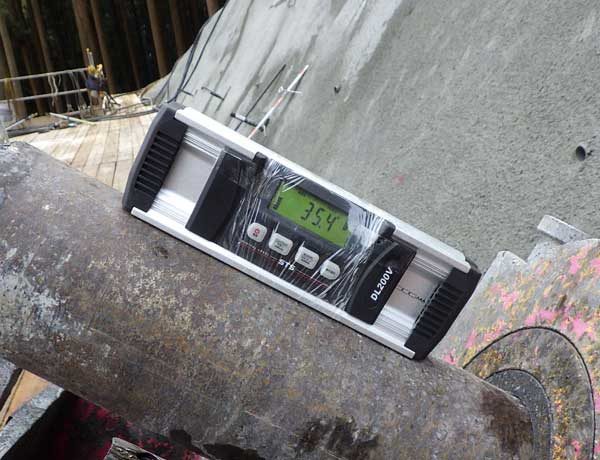
The key factor here is the relationship between the drilling angle and the angle of the support plate used to secure the tendon.
The basic principle of tension is “pull straight and secure straight.”
If the sum of the drilling angle and the angle on the pressure plate side equals 90 degrees, the set will go smoothly when tension is applied.
On page 98 of the Japanese Geotechnical Society’s *Standards for the Design and Construction of Ground Anchors and Explanatory Notes*, it is clearly stated that the allowable tolerance for the installation angle of the anchor head is ±5 degrees or less for standard prestressed steel strands.
The requirements are even stricter for continuous fiber-reinforced materials, which must be within ±2.5 degrees. (Fiber-reinforced materials are extremely rare—they’re not used in hot spring areas or anything like that—so I’ve never even seen one myself!)
In other words, if the angle falls outside this range of ±5 degrees or less, it will subject the tendons and anchors to unnecessary bending forces.
In other words, as long as it's 5 degrees or less!!?
That's the point.
And, this head angle isn't even listed as a maintenance item lol
Verify the relationship between the drilling angle and the slope of the pressure-bearing plate using numerical data
Since this might be hard to understand just from the text, let's look at some specific numbers.
For example, suppose the design drilling angle is 35 degrees and the slope angle on the pressure plate side is 55 degrees.
35 degrees + 55 degrees = 90 degrees
Since it’s exactly 90 degrees, you can leave the setting as is even when you’re nervous.
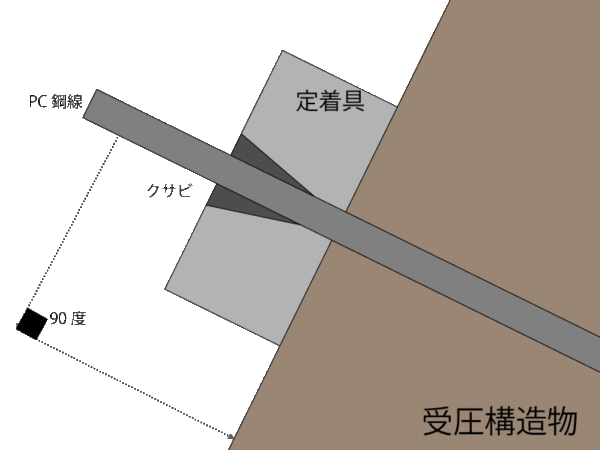
So, what about a case where the drilling angle is 25 degrees and the pressure plate slope is 55 degrees?
25 degrees + 55 degrees = 80 degrees
It's 10 degrees short of 90 degrees.
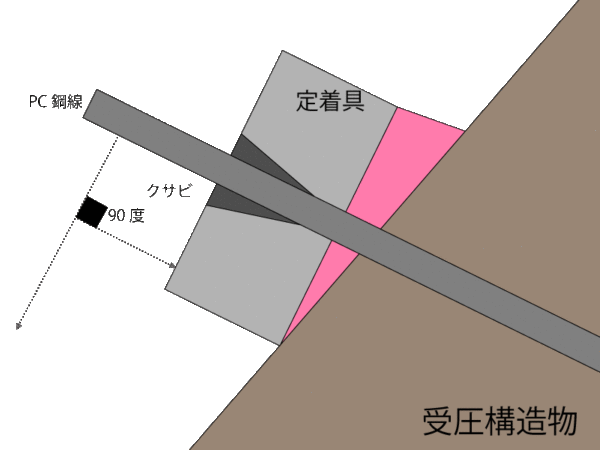
If you allow this 10-degree difference to affect your alignment, there is a high probability that you will exceed the head’s tolerance range of ±5 degrees.
Correcting Vertical Deviations Using the Angle Adjustment Base (Kakudo-kun)
This is when you use an angle-adjustable base.
One product I often see on site is called “Kakudo-kun.”
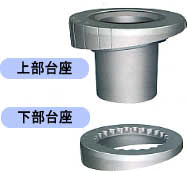
Specifications vary by manufacturer, but among the types commonly used on-site,
It can correct up to 10 degrees for both the upper and lower sections, and up to 20 degrees when combined.
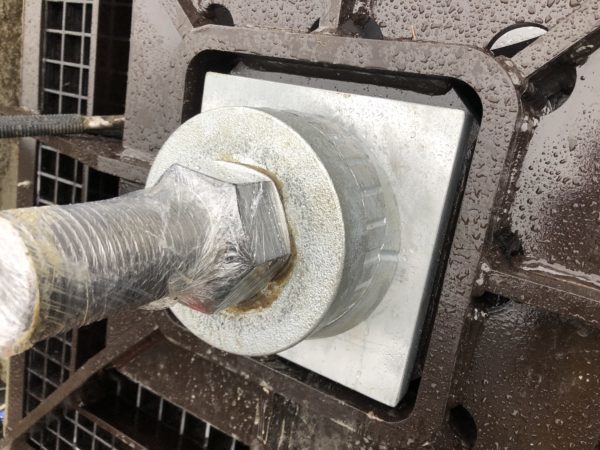
In the case mentioned earlier—where it was “10 degrees off”—this base is more than sufficient to correct the error.
However, the specifications that manufacturers claim are "possible" do not necessarily match the range of use that is practical under actual field conditions.
If the slope were exactly as designed, nobody would have any trouble, lol.
"Composite Angle": It Gets Much Harder Once Horizontal Angle Correction Is Applied
Up to this point, we have been discussing cases where the drilling angle is strictly vertical.
In actual field conditions, angles can occur not only in the vertical direction but also in the horizontal direction.
For example, suppose the vertical angle is 25 degrees, and a horizontal angle of 10 degrees is added to that.
Assuming the vertical angle on the pressure-receiving plate side is 55 degrees, as before,
55 degrees + 25 degrees = 80 degrees
Looking at the vertical direction alone, it is 10 degrees short, just as before.
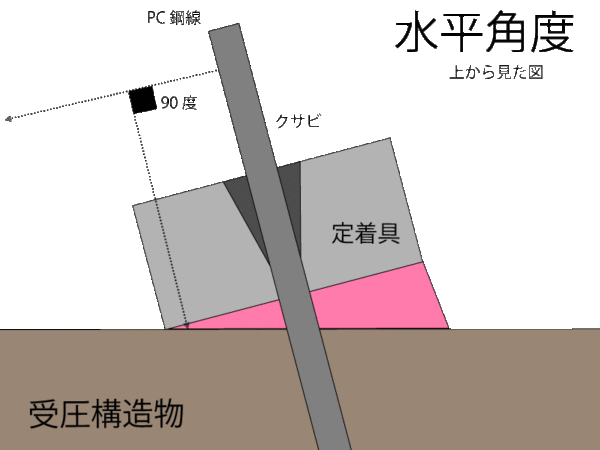
Since a 10-degree horizontal angle is added here, the total angle will be 20 degrees short.
To be honest, it's quite difficult to correct this using just an angle-adjustable mount like Kakudo-kun's.
The base has a two-tiered structure; the lower tier adjusts the vertical tilt, while rotating the upper tier adjusts the horizontal orientation.
However, when the upper section is rotated horizontally, the vertical correction value generated by the lower section rotates along with it, causing the effective correction value to drop to about half its original amount.
On top of that, the direction of the correction itself starts to drift. Composite angles are really tough, lol.
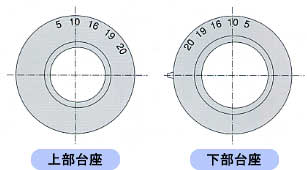
Basically, I want to apply a 10-degree downward correction.
First, set it to 10 degrees in that direction.
When I encountered this situation on site, I initially thought I could manage with just the base, but it didn't work out in the end.
When there are angles in both the vertical and horizontal directions, we recommend measuring the angles before beginning the tensioning work to confirm whether they fall within the range that the base can accommodate.
Ultimately, the angle of tension is far more often due to issues with the rock mass than to “drilling accuracy.”
I think the drilling accuracy is actually pretty high—at least at first, lol (since it goes up and down once you get inside).
However, when you cut into a mountain, the surface often ends up uneven—that happens more often than not.
The only type of soil that cuts cleanly is cohesive soil.
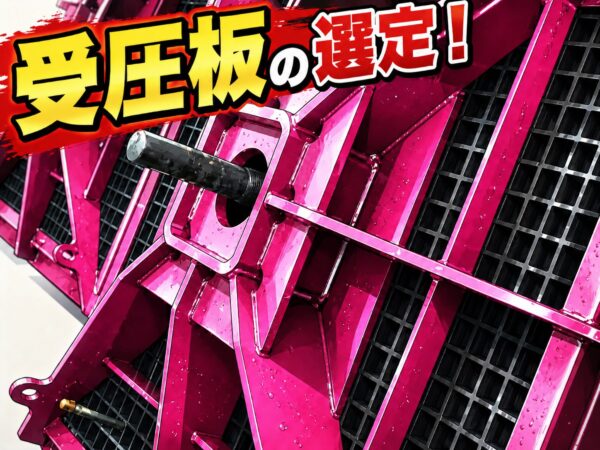
We install a load-bearing plate or formwork there to use it as a load-bearing structure, but if it can be adjusted with mortar, then,
If you make sure you can adjust it at that stage, you won't have to worry about it when you're nervous.
Alternatively, a steel product called a taper plateFSC Fujiwara IndustriesThey'll create it for you, so please feel free to contact them.
See you later.
The Purpose of Zabuton Frames | Revisiting Leveling and the Role of Load-Bearing Plates