Hello, everyone.
This is Enta.
The other day, a post like this became a hot topic.
I run a construction company. In about ten years, there won’t be enough workers in any trade. Stonemasons, rebar workers, scaffolders, paving workers, heavy equipment operators, plasterers, painters, formwork carpenters, earthwork laborers, and site engineers—every single one.
— Nobuyuki Kamasaka (@kouchihimeji) February 12, 2026
Whaaaaaaat?!
Thinking that, I did some research.
Summary of Projected Declines by Construction Industry Sector
Big Picture (Outlook for 2030–2040)
According to estimates by the Ministry of Land, Infrastructure, Transport and Tourism, if the number of new entrants to the workforce continues to rise at the current rate, the number of employed people could fall below 4 million by 2030.
The current figure is 4.79 million (2024), representing a decline of more than 3 million from the peak of 6.85 million in 1997.
Number of Employees by Occupation and Projections for 2035 (Listed in Order of Most Severe Decline)
Estimates based on the 2020 Census and data from the Research Institute for Construction Economics (2024–2035)
| Job Type | 2024 (Estimated) | 2035 (estimate) | Decrease Rate |
|---|---|---|---|
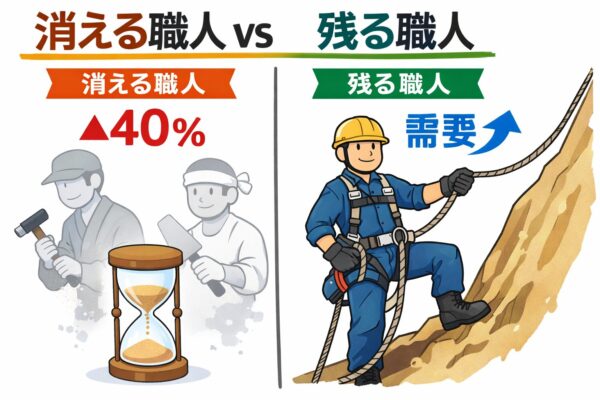
| Plastering | Approximately 49,000 people | Approximately 30,000 people | ▲40% |
| Carpenter | Approximately 253,000 people | Approximately 154,000 people | ▲40% |
| Reinforcing Steel Worker | Approximately 26,000 people | Approximately 17,000 people | ▲33% |
| Formwork Carpenter | Approximately 37,000 people | Approximately 28,000 people | ▲26% |
| Piping Technician(Piping Work) | Approximately 205,000 people | Approximately 158,000 people | ▲23% |
| Roofer | Approximately 112,000 people | Approximately 108,000 people | ▲4% |
| All Skilled Workers | Approximately 2.318 million people | Approximately 1,932,000 people | ▲17% |
Where exactly is it the worst?
🔴 Endangered Occupations: Plasterers and Carpenters
The number of plasterers, which stood at about 220,000 in 1985, fell to about 60,000 by 2020. The number of carpenters fell from about 800,000 to about 300,000.
There are only about one-fifth as many plasterers as carpenters, and there is concern that once the craftsmen aged 65 and older retire, there will be almost no one left who can do earthwork.
Let's make it perfectly acceptable to go without a frame and without a handle!
🟠 Severity Level: Reinforcement Workers and Formwork Carpenters
The population is aging.
There are few young people entering the profession, and by 2035, the workforce is expected to shrink to two-thirds to three-quarters of its current size.
(This is the issue of salaries being way too low for the level of technical expertise required! Personally, I think the general contractors are to blame.)
🟡 Alert Level:
Piping Work (Piping)
Although the total number is large, projections indicate that by 2035, one in four people will be gone.
🟢 Relatively okay:
Scaffolder (primarily a scaffolding worker)
The number of people employed as roofers has remained relatively stable. The trend shows that the number of young people entering the profession has remained steady compared to other occupations.
General Incorporated Association of Housing Doctors
Why "Plasterers and Carpenters" Are the Most Dangerous
- Due to a decline in demand caused by a drop in housing starts, salaries and job status within the industry have declined.
- The training period is long, and it’s hard to see a path to independence and earning a living
- The spread of prefabricated and industrialized housing is leading to a decline in the number of jobs in the industry itself
- Average age: Plasterers53.6 years old, the carpenter50.4 years old(Figures as of 2010)
What about a slope contractor?
Slope construction falls under the category of “Scaffolding and Earthwork.”
In terms of the classification of construction licensing categories, slope work isScaffolding, Earthwork, and Concrete Constructionis included in.
Since there are no statistics specifically for “slope workers,” we’ll analyze the data for related occupations, such as construction workers and civil engineering workers.
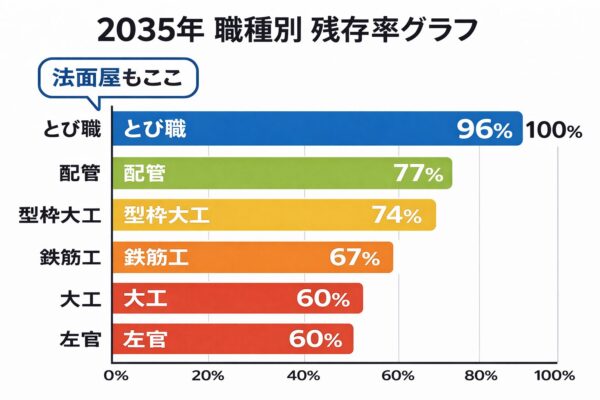
Employment Figures for Scaffolders and Civil Engineering Workers (Estimates for 2024–2035)
| Job Type | 2024 (Estimated) | 2035 (estimate) | Decrease Rate |
|---|---|---|---|
| Roofer | Approximately 112,000 people | Approximately 108,000 people | ▲4% |
| Civil Engineering Professionals | In the hundreds of thousands | Declining, but at a gradual pace | Relatively okay |
Compared to other occupations (Carpenter ▲40%, Plasterer ▲40%, Reinforcement Worker ▲33%),The rate of decline in the number of roofers is overwhelmingly slowThat's it.
That said, I actually think about 70% of them are scaffolders... lol
Why Are Slope Workers and Scaffolders "Better"?
(1) Demand will not decline—in fact, it may even increase
Due to global warming and climate change, the number of natural disasters has been rising sharply in recent years.
Slope stabilization work is one of the essential measures for preventing slope failures, and demand for it (as a disaster prevention measure) is expected to continue to grow in the future. (Based on various online sources)
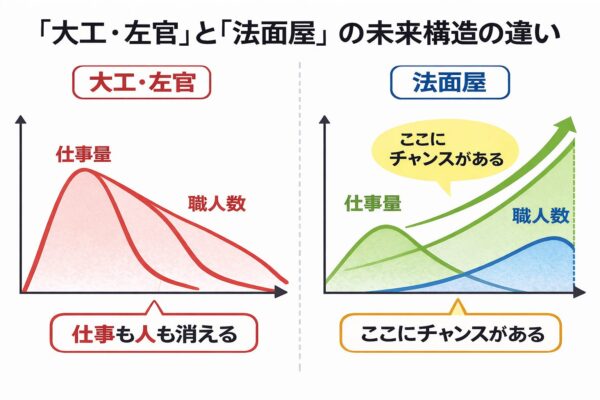
In other words, unlike carpenters and plasterers—where “a decline in work leads to a decline in the number of workers”—slope work isWe have more work but not enough staff.Direction. The structure is exactly the opposite.
② Highly specialized and difficult to replace
Currently, in the construction industry, experienced professionals who specialize in slope stabilization work are highly sought after.
It’s because they possess a high level of expertise and skills that allow them to be deployed immediately on the job. (To put it positively)
③ Not affected by housing demand
Since slope engineering is primarily focused on infrastructure, disaster prevention, and road maintenance, it is linked to public budgets and is relatively stable.
But I'm at the mercy of the national budget, lol
However, there is one thing that means we can't let our guard down just yet...
- Slope specialists make up only a small portion of the overall number of construction workers. The number of contractors in this field is small to begin with.
- The aging population is affecting slope maintenance workers as well, and the average age of these craftsmen is on the rise.
- Small businesses without successors are increasingly going out of business (the number of such businesses is on a downward trend).
- In the construction industry, securing a workforce—particularly skilled tradespeople such as carpenters and plasterers—has become a major challenge. Supply constraints caused by a shortage of skilled workers are expected to worsen in the future, and it is projected that construction investment will be reduced by approximately 9 trillion yen by 2030. Slope stabilization work will not be spared either...
"In the slope maintenance industry, demand continues to grow, but the number of workers is declining.
It’s not a decline where ”entire trades disappear,” like plastering and carpentry, but rather,There's work to be done, but not enough people—the number of companies capable of handling it is steadily declining.This is the situation that arises.
So, is this an industry where people who go independent and solidify their structure now will be able to survive in the long run?
That said, I don’t think the industry itself will disappear; I envision a future where carpenters and plasterers will make a comeback in different forms.
For example, something like what Sekisui House did the other day—hiring craftsmen directly as in-house employees!?
These days, whenever I hear that the number of artisans is declining, I really can't help but worry.
It looks like we’ll need to think things through carefully and act accordingly, keeping the future in mind!
What do you all think?
See you later.