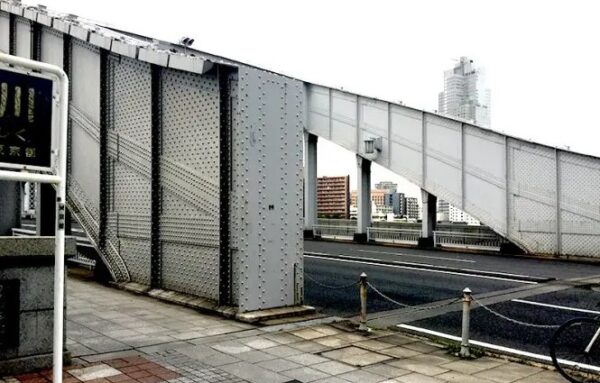
The Rivet Shop and the “Tokyo Olympics Ondo”
The second Tokyo Olympic and Paralympic Games will be held in 2021. The previous Olympic Games were held in Showa 39 (1964).
Deep in my ears, the song “Tokyo Olympics Ondo,” sung by the late Haruo Sanba, still lingers.
Looking back, this was precisely the period when on-site joints in steel structures were transitioning from “rivets” to “high-strength bolts.” Consequently, since the route of the first phase of the current Metropolitan Expressway was constructed in preparation for the Olympics, rivets were used for the on-site joints of most of its bridges and steel piers.
If you look up from beneath a highway, you can see rows of rivet heads at the joints. The workers who set these rivets are commonly called “riveters,” and the term is written in kanji as “鉸鋲工.”
Riveting Work That Poses a Risk of Death
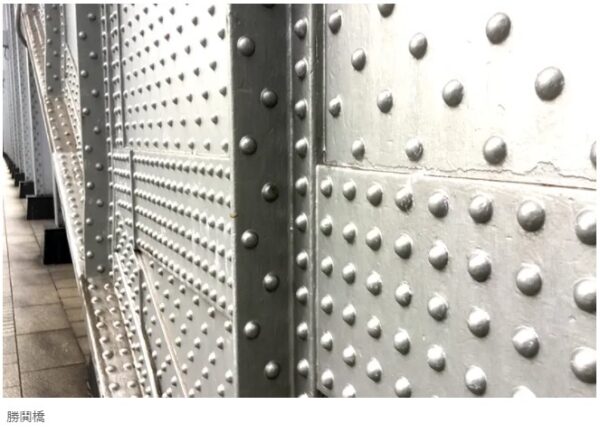
The riveting work was extremely grueling.
Since we’re handling rivets heated to 900–1,100°C, even the slightest mistake could result in severe burns—or, depending on where the rivet strikes, could even be fatal.
In addition, since this involves on-site welding work at steel bridge construction sites—and the work is performed at heights ranging from tens of meters to over 100 meters above ground level—there is also a risk of falling.
The same applies to steel frame construction.
Riveting work and slang terms for the vulva
To perform the riveting process, you must first heat the cold (room-temperature) rivet to approximately 1100°C, which is the optimal temperature for riveting.
On site, the top of a steel drum is typically cut off, and a firebox is set up at about one-third of its height. Coke is burned here to heat about 10 rivets arranged in a row. This furnace is called a “hozo” or “hoto.”
Incidentally, “hoto” is written with the kanji for “yin” and refers to the female genitalia. It is believed that “hoto” was corrupted into “hozo,” and is distinct from the “hozo” in the phrase “to bite one’s navel.”
The temperature is around 1,000°C when the rivets forged on this anvil turn a cherry blossom pink, so the craftsman picks them up with a pair of fire tongs about 1 meter long and, with exquisite control, tosses them to the exact spot where they’ll be riveted into the joint. It’s a truly magnificent sight.
The operator catches it using a funnel-shaped receptacle with a slightly larger handle, removes any scale from the surface, and inserts it into the rivet hole to be fastened using a pair of fire tongs.
Next, the end with the head is held in place on the anvil, and the operator holding the rivet hammer strikes the rod-shaped shank with the hammer until a hemispherical head is formed. Since the rivet is hot throughout, the impact causes it to expand and fill the entire joint hole.
The rivet hammer (commonly known as a “gun”) that was generally used on construction sites works by using compressed air to drive a piston back and forth inside a cylinder, and the resulting impact is used to drive the rivet into place.
There was a snap attached to the muzzle of the gun, which the piston would strike. Since the snap was only inserted a few centimeters into the tip of the cylinder, it would have been pushed out by the piston and flown off somewhere if left as is. For that reason, it was secured to the body of the gun with a thick piece of wire.
At least five people are needed—a rivet setter (who is the foreman or “boshins”), a receiver, a guide plate operator, a striker, and a bolt remover—but generally, a team of 5 to 7 people would work together.
Riveters hate rain!
"Roofer's won't come out if even a single drop of rain falls in the morning," the scaffolders used to say.
It’s true that if it starts raining while the riveting work is in progress, rain can seep in through the gaps in the base material where the rivets have been driven, which could cause the rivets themselves to loosen.
It would be unbearable to have to redo all that hard work after putting so much effort into it, so if it starts to rain, we’ll stop the riveting work immediately.
Also, as Mr. Tobi says, if it’s drizzling around 6 or 7 in the morning, we don’t go out to the job site. So, when the sun starts to peek through around 8:00 a.m., it’s a real headache—we get relentless pressure from the site supervisor and the general contractor (GC) to get to work quickly. This pressure escalates rapidly, especially if the project is behind schedule.
Crimping is impossible for amateurs!
As part of a major renovation project at a Japan National Railways (JNR) station (at the time), construction work was carried out on both the bridge and the steel framework.
So, as mentioned earlier, it had been drizzling since morning, and the riveters hadn’t shown up. At that time, the riveting foreman and the former blacksmith foreman—who was acting as the company’s manager—were in the office, and there was also a young man who served as both an office clerk and a cleanup crew member on site, so we decided the four of us would handle the riveting.
The master riveter uses his years of experience to heat the rivets. However, since he can’t quite get the hang of throwing them anymore, a young worker goes up to the tenon, takes the heated rivet, carries it along the scaffolding to the joint, and inserts it into the rivet hole.
My job was to hold the anvil, and the blacksmith’s master was in charge of striking it. We figured that as long as we made the right sounds, everyone would be satisfied, so we pretended to rivet the pieces together, but after about an hour, we were all completely exhausted.
Before long, a light drizzle began to fall from the overcast sky, so I took that as my cue to call it a day. Never before—or since—have I felt so tense or had my muscles get so stiff on a construction site.
The next day, I got a thorough scolding from the professional riveter, who said, “Why did you go and do something unnecessary like this? It just creates more work for me!” And that was the end of my amateur riveting attempt.
(To be continued)
From the God of Construction