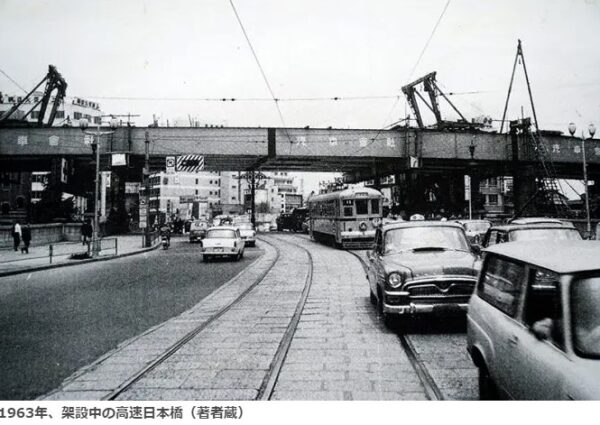
A Riveting Shop
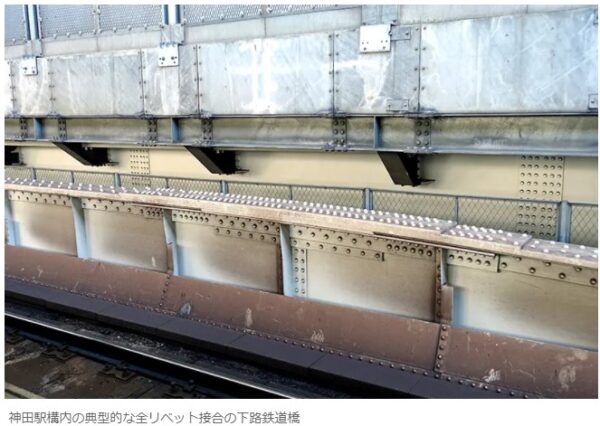
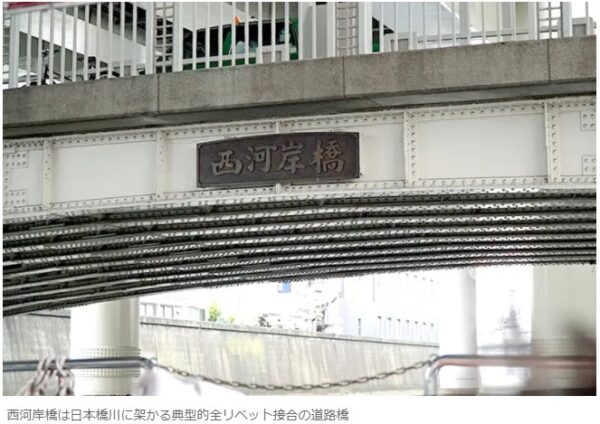
For most of the bridges and steel piers in the first phase of the Metropolitan Expressway project, the on-site joints were,Rivetis used.
The workers who set these rivets are called “rivet setters.”
This happened long before terms like “Work Style Reform” and “i-Construction” were even being discussed.
This time,Previous ArticleLet's talk about "Kashimeya" in more detail.
The Masterful Art of "Kashime-ya"
The foreman or lead craftsman at a riveting shop is, in most cases, a highly experienced veteran who specializes in heating the rivets (known as “yaki-bishi”). While mentally calculating the sequence of operations for the joint, he heats rivets of varying lengths in order to match the thickness of the plates being joined, judging the optimal temperature by the color of the heated rivets. He then picks up the one needed for the next step and tosses it toward the receiver (known as the “receiving rivet”).
The throwing distance can be as long as several tens of meters. Furthermore, while it would be ideal if the receiver were at the same height as us, due to the relationship between where the tenon is placed and the joint, the throw often ends up angled upward rather than horizontal.
(*Editor's note: If you've read this far and still don't understand,Previous Article(Please read this first before continuing.)
With steel frames, you’ll almost always end up throwing the material upward. Some furnace operators even say, “I’ll throw it up to the fifth floor.” Or, as long as the “catcher” tapped the funnel with their fire tongs to make a “clang-clang-clang” sound, some even boasted, “Even if I can’t see the catcher, I’ll get the funnel into their hands,” assuming there was a safety net in place. It wasn’t just talk—there were actually people who demonstrated this kind of masterful skill.
I was told that the basic rule is to throw the ball upward, and that throwing it downward makes it difficult to control and is dangerous.
According to older people, during the war, shipyards were constantly ramping up production, building ships day and night without rest, and there were reportedly many teams of riveters working to join the hull sections together.
He said that at night, the streaks of light cast by these many “burnt rivets” were as beautiful as watching fireworks.
The rivet holes are a real pain, too.
On the other hand, the person receiving the funnel must also be skilled; once the sound “clang-clang” is heard, the funnel must not be moved from that position.
As mentioned above, the smith relies on that sound to time his throws. He must catch the hot rivet as it flies toward him with a sharp, precise motion using the funnel, and in the next instant, he must tilt the funnel upward while cushioning the impact so as not to resist the rivet’s momentum. Otherwise, it will spill out.
The “rivet setter,” standing beside the receiver, removes the temporary bolts and drift pins set by the blacksmith, then uses fire tongs to grasp the hot rivet, remove the scale from its surface, and press it into the hole where it is to be joined.
Since driving in a rivet requires brute force, the work is generally done with the rivet pointing downward. Therefore, the person holding the rivet must push it from the bottom of the hole upward.
"Catching the rivet" really takes guts. After all, a chunk of iron approaching 1,000°C is flying toward you, so if the timing between the person striking the rivet and the person catching it isn’t perfect, the work won’t go smoothly, and you’ll end up in a dangerous situation. It truly requires perfect, instinctive coordination.
The target board also presents many challenges
The next step is to use the rivet setter. The riveting machine positions the snap against the pre-formed rivet head, then compressed air is fed into the machine to activate the piston, securing the rivet with a “thud.” Although the riveting machine is smaller than a rivet gun, the position of the steel pipe or steel bar clamped to the head is adjusted to ensure that the reaction force is absorbed at the rivet head.
In the case of bridges, while the joints on the upper flange can transfer reaction forces to the lower flange, the joints on the web have no point to transfer reaction forces. Therefore, bend the end of a 2- to 3-inch steel pipe about 10 cm from the tip into a loose Z-shape and attach a snap hook to the end. Then, a thick rope is run from near the top of the bend in the steel pipe, and a hook is attached to its end. This hook is hooked into a rivet hole at a suitable position that has not yet been filled, and the rivet head is pressed down using the principle of leverage. This tool is called a “Taiwan.”
There are many scenes featuring the Taiwan, and working with this Taiwan requires quite a bit of skill, andUsing not just their hands but their feet as well, it feels just like they're performing in an aerial circus.That was it.
When I asked a craftsman why it’s called “Taiwan,” he explained that it’s called “Taiwan” because it was invented by a Taiwanese person. Since riveters handle materials that reach temperatures as high as 1,000°C, the work is said to be unsuitable for Japanese people from a cold country; consequently, in the past, many of the riveters were Taiwanese, who come from a hot climate. They also had a variety of other ingenious tools.
As you crimp a joint, the area around it conducts heat and gets hot. With a standard open-web girder, this isn’t a concern since it’s exposed to the open air, but with a box girder, things can get pretty dire.
Since the gun is large and cumbersome to handle, it must naturally be fired from the outside of the joint; therefore, the striking block must be positioned against the inside of the box girder.
So, the worker first puts in earplugs and ties small cotton-filled quilts to both shoulders over his work clothes. If he doesn’t do this, he’ll suffer burns on his shoulders. After finishing the joint repair at one location, he climbed out of the manholeSmoke was coming from the cushion on the shoulder of the target board, and I was temporarily deafened.That was it.
I was really surprised when I saw this. I knew intellectually that the area around the joint would get hot during re-riveting, but in reality, I was working in such intense heat that it was enough to scorch a thick quilt!
Hammer (for driving in nails)
Riveting is truly physically demanding work. Workers stand on narrow flanges while holding heavy riveting guns and dragging air hoses as they perform their tasks. If force is applied incorrectly, the rivet head may tilt or become misaligned; in some cases, the recoil from the riveting gun could even knock the worker off balance, potentially causing a fall. Since the condition of the rivet head cannot be seen until the rivet is fully driven in and the snap is raised, this task also requires a high level of skill.
Furthermore, in cases such as joints in the lower flange of an I-beam—where the vertical dimension of the beam member is small, as with steel frames—since a hammer cannot reach the joint from above, a support plate is used to hold it down from above while the worker strikes it from the underside of the flange. In other words, this involves a “pounding up” technique, which also requires a tremendous amount of physical strength.
Before air tools were invented, it’s said that one person would hold the snap in place while two others worked together from either side, swinging large hammers to drive it in. Since this work had to be done all day long on high scaffolding, just hearing about it conveys how grueling it must have been.
People in the old days were truly remarkable. It was a long, long time ago—long before anyone even talked about things like “work-style reform.”
From the God of Construction