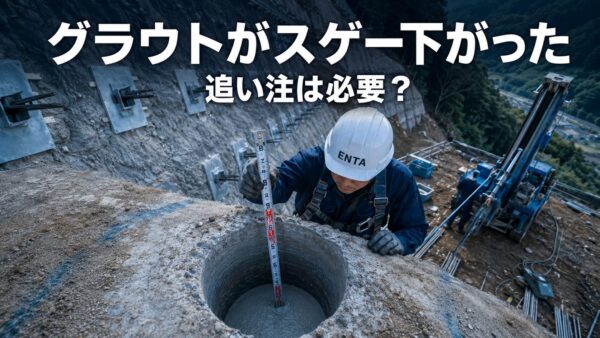
Hello, everyone.
This is Enta.
In this post, I’ll explain what to do if a ground anchor at this facility comes loose.
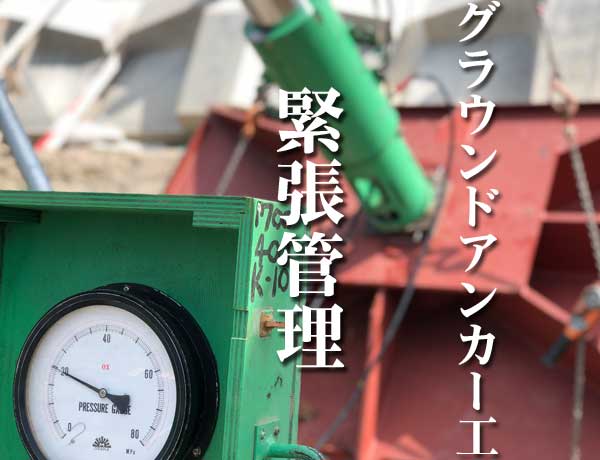
Suppose a ground anchor comes loose in a tension structure.
In technical terms, the expression “came off” refers to what is known as “adhesion failure.”
The approach depends on which part of the attachment has broken.
I’ve written about this topic many times before, so veterans of ground anchors might be sick and tired of it, but I’ll just skip over that part for those who aren’t familiar with it lol.
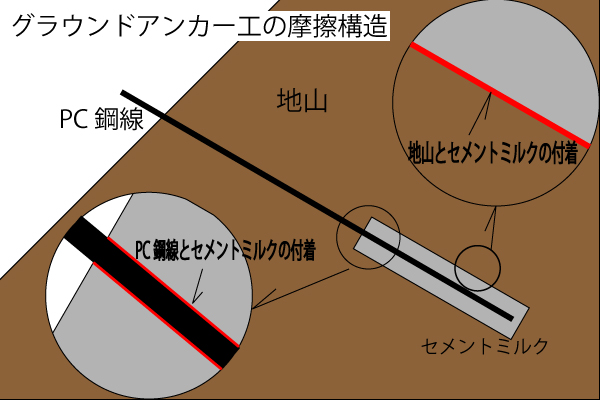
Ground anchors are tensioned through friction between the prestressed steel strands and the grout, and between the grout and the soil (anchorage).
Was the failure caused by a loss of bond between the grout and the prestressing steel strands, or a loss of bond between the ground and the grout?
This is where it gets important.
That's what we call troubleshooting, isn't it?
1. In the case of PC steel strands and grout: Was there oil on the PC steel strands? Is the grout’s strength too low?
2. In the case of undisturbed soil and grout: Is the grout’s strength low? Or is the undisturbed soil’s friction strength low? (Low circumferential friction resistance)
In Case 1, it’s highly likely that there was a construction error. However, this is also an area that’s difficult to verify or check. (The grout test specimens are showing good strength, lol.)
If the circumferential friction resistance (τ) in Case 2 is too low and the fastening length must be increased to ensure a secure fastening, this will require a design change. (Depending on how many fasteners came loose.)
This circumferential friction resistance (τ)—known as “tau”—is typically determined through basic testing and incorporated into design calculations; however, since not all sites allow for such testing, it is sometimes determined theoretically.
Furthermore, because the bedrock consists of interbedded layers (layers of different types stacked on top of one another), it can be difficult to make a definitive determination, so there are some cases where a general statement cannot be made.
As an aside, I think “it’s hard to generalize” is a really handy phrase—it’s the ultimate in ambiguity, lol.
So, if the anchor comes out, you’ll naturally start wondering, “How are we going to proceed with the installation, considering the possibilities mentioned above?” But if there’s absolutely no other place to install it, we’ll remove that anchor.
The only option is to lift it out little by little using a jack.
That’s assuming it comes out, but most of the time it gets stuck halfway and won’t come out, lol (the temporary ones do come out, though).
So, based on my experience, I start by drilling into the same hole with a steel-cutting bit, cutting through the PC wire while adjusting the angle as I go.
When drilling from a different angle, as long as you take the position and length into account and ensure that the anchor does not affect the bonding layer (i.e., does not overlap with the removed anchor), there will be no problem.
It's usually a matter of raising or lowering it by about 3 degrees, or swinging it from side to side.
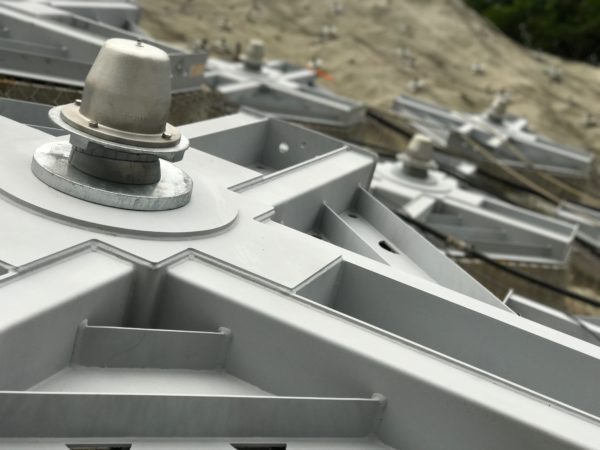
If you set the angle too high, the angle when processing the head will exceed 5 degrees, so that won't work. (It's OK as long as it's within 5 degrees.) It says so in the book, lol.
Normally, tilting the structure up or down would change the load, but since this is a reinstallation, let’s assume the load remains the same.
If you’re thinking, “No way, that can’t be right!?” you can recalculate the load for that specific area and reevaluate the anchorage load. (However, since that would require calculating the load-bearing structure and the total load as well, I’m not really that particular about it, lol.)
Please keep in mind that this also raises the question of whether to increase the embedment length, depending on the circumstances under which the anchor came loose.
Just as a general rule of thumb: if it comes out with a “pop,” it’s likely a failure of adhesion for the PC strand. If the load slips away smoothly even when applying pressure with a jack, or if the load doesn’t increase even when you raise the pressure, I suspect it’s a failure of adhesion with the ground. You can’t really generalize, though (lol). (I guess it comes down to experience?)
There's a YouTube video below. The sound the anchor makes the moment it slips out is "Pop!" lol
The appropriate response and reporting procedure will vary depending on how it came loose, but the basic approach is to redo the work!
In the case of construction errors, the contractor is liable; however, if the friction strength of the natural ground is insufficient, this is due to an error in the design estimates (theoretical calculations), so the matter will be discussed with the relevant government agency.
However, since design revisions are generally rare, this can be a challenging aspect.
See you later.