Hello, everyone.
This is Enta.
Only one month left in the year!
Let's stay focused!
The other day, I was looking into various spacers.
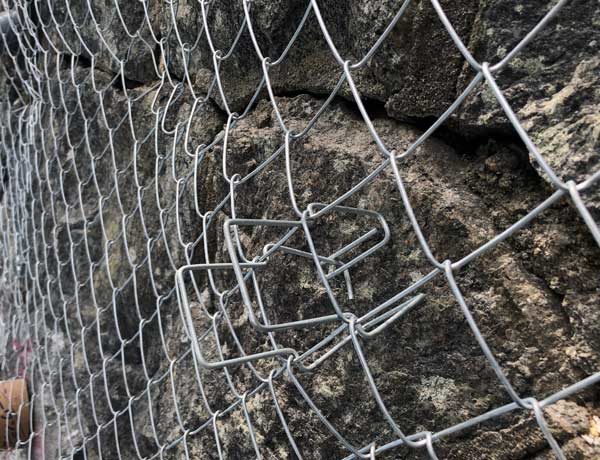
Spacers for slopes were originally designed for thickness control.
We still use it for thickness control.
The goal isn't for the last net to end up in the middle, is it?
Originally, when you draw lath onto that cross-sectional diagram of sprayed mortar and concrete, everyone would naturally place the lath lines right in the middle, wouldn't they?
Back then, if I was marking the positions of the lath on the drawings, I would have done the same.
That's because the one in the middle is easier to understand as a picture.
Before I knew it, the mesh had to be centered (as I was told during the inspection).
Sure, it’s true that the middle section is less prone to rust, but since it’s actually secured with anchor pins, part of it is attached to the natural ground, and
Most of the old mesh lath used for spray-applied coatings is rusted.
That said, since strength isn't a requirement for the mesh, there's no problem.
Also, regarding the current approach to spacers—based on something I recently heard at a Ministry of Land, Infrastructure, Transport and Tourism construction site—it was explained that installing spacers is considered a form of creative problem-solving in the context of as-built inspection.
In short, it was a product designed to ensure sufficient thickness.
This means I no longer believe it is necessary for the top mesh to be in the center.
However, as long as it reliably ensures that final result, that’s fine, but—No impurities allowedThat was the explanation.
The term "impurities" as used here refers to anything other than concrete or mortar that is of a quality equal to or greater than that of the main concrete structure.
| General Specifications for Civil Engineering Works, Ministry of Land, Infrastructure, Transport and Tourism (March Heisei 25)
1-3-7-4 Assembly Spacers used to ensure the required concrete cover for reinforcing bars must be made of concrete or mortar and must be of a quality equal to or greater than that of the main concrete. Please note that if you intend to use a spacer other than the one specified, you must consult with a supervising officer. |
| Standard Specifications for Concrete [Construction Volume: Construction Standards], Established in 2012, Japan Society of Civil Engineers
10.4 Reinforcement Assembly In these construction standards, the general rule is to use mortar or concrete spacers, taking into account strength, durability, and appearance. |
Similar things are mentioned in other sources as well, but,
In short, the spacers in the main sections should be made of concrete, mortar, or a material of equivalent quality.
So, if that's the case,Plastic ones can't be usedSo that's how it is. (Depending on how you interpret it.)
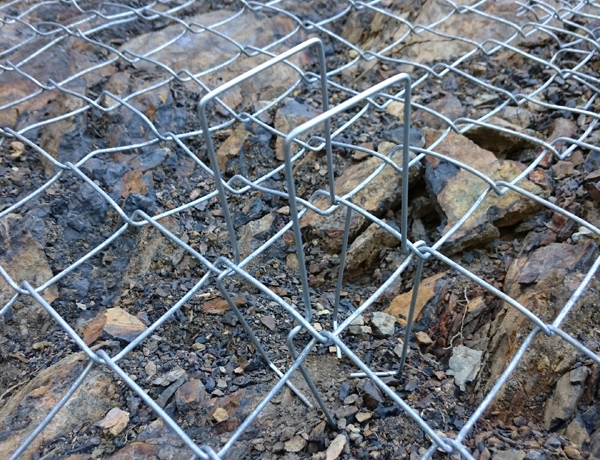
Plastic ones are cheap, lightweight, and don't get tangled, so they're easy to work with, aren't they?
Metal ones are a little more expensive than plastic ones, and they tend to get tangled, don't they?
While there are pros and cons, when it comes to construction management, steel is definitely the way to go—especially when you consider the potential issues that might arise later with government agencies or the general contractor.
It seems the era of plastic is coming to an end along with the period of rapid economic growth.
These days, steel has excellent performance, and there are many different types available.
When you think about it that way, the steel industry has probably been constantly evolving.
Our slope stabilization industry must also strive to be innovative.
To discover something new, you need to take on new challenges.
If we stick to the old ways, we’re headed for certain ruin.
See you later.
https://norimen.net/wordpress/wp-content/uploads/2020/11/9fba908babd97787c8fef14bea2d7dbe.pdf