Hello, everyone.
This is Enta.
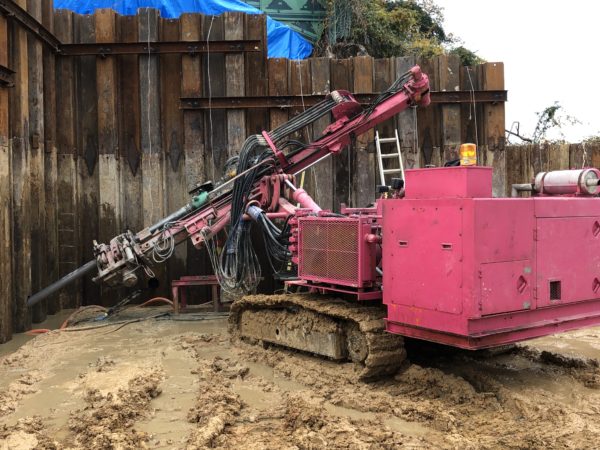
This is a job site where temporary anchors are being installed in three stages.
Temporary anchors have become very common recently.
That's right. I've recently started working on urban civil engineering projects too, so I've been riding along more often lol.
We have three temporary anchor installations scheduled by next year (including those currently in progress).
I'll outline some guidelines to keep in mind when planning a process.
For temporary anchors, the first tier is a lap joint.
Starting with the second time, there will be intervals between them, depending on the number of retaining walls and the volume of soil.
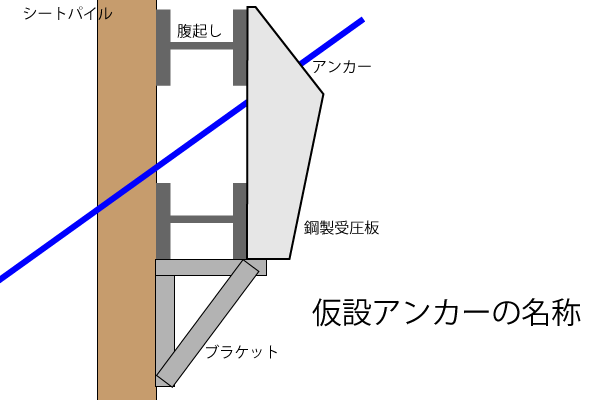
Drilling and Installation of Temporary Anchors
↓
Bracket Welding (Installation) and Flange Installation
↓
Installation of Steel Pressure Plate
↓
Anchor Tension
↓
Drilling
This is the general flow.
Although it depends on the scope of the project, I think allowing about three days for installation—from mounting the brackets to finishing the framing—should be sufficient.
If there are about 20 anchors, that's about right.
After the ground is compacted, drilling will resume. Depending on the soil conditions and other factors, this will take about four days at most (for approximately 20 anchors).
Generally speaking, the slopes where temporary retaining wall anchors are installed are either very loose and soft or clay-based.
So it's relatively fast.
However, in the case of clay-based soil, rain turns it into a mushy mess and causes major problems, so work such as soil removal is postponed.
After the soil is removed, it will take one day to dig the open-cut ditches and drill holes for the sheet piles.
Ultimately,After the initial period of tension, there is a gap of about 5 to 8 days.That's the point.
But what am I even going to do at work this week?
That’s how it goes, but it’d be great if I could go to another temporary anchor, though~
The biggest problem on site is downtime. The key is figuring out how to minimize it.
Lately, they say that once you let a construction crew go, they never come back (a general contractor mentioned this the other day, lol).
That's why the general contractor tries every trick in the book to keep them from leaving.
So, I’m trying my best to keep my promises as much as possible, and I spend my days keeping track of the schedule and the status of each job site lol.
Schedule management tends to be particularly critical during this period, so I think it’s best to build in a little extra time.
See you later.