Hello, everyone.
This is Enta.
Do you offer suspended drilling?
Haven't they been getting fewer and fewer lately?
We have one of those machines at home, too, but we just play around with it lol
Actually, if you use machinery for the work, it just doesn't work out as a second-tier subcontractor, lol.
It’s still better to just pay for labor and have the machinery and materials provided.
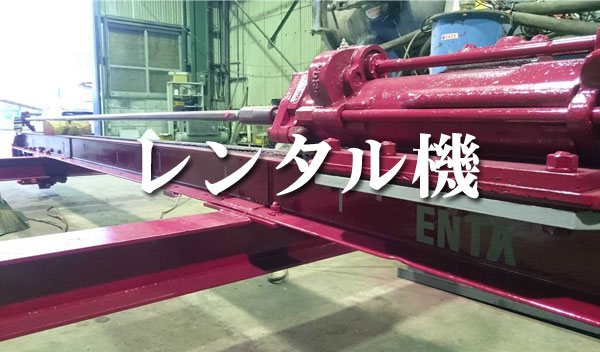
We keep the equipment in good working order so it’s always ready for use, so please let us know if anyone in the neighborhood would like to use it.
I'm renting it out. By the way, it's a Yamamoto Lock Machine YD135.
Instruction on suspended drilling, andI'll teach you all the installation methods.(If you're bored, lol)
If you're interested in doing construction work, please feel free to contact us.
But that's beside the point.
So, with that in mind, I’m going to write about the key features of a suspended core drill. (Did you just think, “What on earth is that supposed to mean?!”? lol)
Features and Hazard Identification of Suspended Drilling Machines
1. Use a crane.
2. Use a backhoe (BH).
3. The bore diameter is 65 mm.
4. For cost estimation, Site Conditions I apply.
5. Most models of hole-drilling machines use an air-powered mechanism and are driven by compressed air.
6. Some people refer to it as a “sky drill,” but it’s actually different from a suspended drilling rig.
7. We recommend a 190-horsepower compressor.
8. It's hard to apply a reaction force.
9. Vulnerable to clay layers and sandy soil.
10. Sensitive to changes in soil conditions.
11. Resistant to rock attacks.
12. Vulnerable to fracture zones.
13. Inserting rebar is quite a challenge.
14. The slope tends to get dirty during grouting (which makes cleaning difficult).
15. Cleaning the slime off the slope is a real hassle.
16. Drilling on rainy days tends to dirty the slope, causing it to become stained with soil (which may turn yellow and be impossible to remove).
17. In winter, the compressed air freezes, causing the unit to freeze. (This can be addressed with a dry compressor.)
18. The reaction wire may break.
19. There is a risk that the crane boom could come into contact with high-voltage power lines or other similar objects.
20. Leaves from trees can get tangled in the safety cables of a crane jib.
21. The anchor used for reaction force comes loose, causing the machine to tilt sharply.
22. Blown by the wind.
23. The air hose bursts.
24. Since it is the same as a rock drill, it requires rock drill oil, which drips onto the slope.
25. Sand can get lodged in the angle-adjustment lever block, causing it to come loose and the chain to slip out all at once.
26. The rod breaks.
27. Drilling time depends on the soil conditions, but it is relatively quick.
28. As we get more in sync with the operating team, relocation operations will speed up, and daily throughput will increase.
29. If you press too hard, the clay will clog the holes where air comes out.
30. There's a clear difference in drilling speed between veterans and beginners. (I can just hear someone saying, "Well, duh!")
31. Drilling actually requires some skill.
32. The double-pipe drilling machine cannot be used in a suspended configuration. (Because it rotates slowly but has high power, there is a risk that the entire unit will try to rotate.)
33. Since parts may come loose due to vibration, secure them with split pins, cable ties, or similar fasteners. Also, check them daily.
I feel like there's still plenty more, but for now, this gives you a general idea.
Although double-pipe drilling has become more common lately, it still happens occasionally, so we need the equipment.
See you later.