On June 8, the Japan Society of Civil Engineers issued a statement outlining the challenges of infrastructure maintenance—a growing social issue due to aging infrastructure—and proposing measures to address them. The statement is subtitled “Infrastructure Maintenance: Essential for the Present and the Future—A Roadmap for Overcoming the Challenges We Face.”
Notably, the report proposed, as measures requiring a nationwide effort, a fundamental overhaul of the contracting system and the establishment of a training framework—including the creation of a new certification system for “Comprehensive Infrastructure Practitioners” who would play a key role. Furthermore, the Japan Society of Civil Engineers announced that it would establish a new awards program in the field of infrastructure maintenance to recognize projects, technologies, systems, and individuals involved in maintenance.
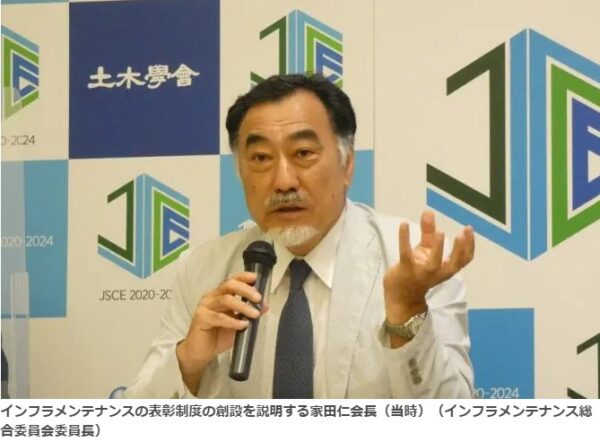
"The Japan Society of Civil Engineers has never before presented an award specifically for maintenance. We will establish an Awards Subcommittee within the Comprehensive Infrastructure Maintenance Committee, with Mr. Katsumi Ise serving as its chair, and this initiative will be implemented starting in fiscal year 2020. Based on the understanding that engineers involved in maintenance are like doctors and nurses in regions where structural deterioration is expected to progress, we would like to shine a spotlight on these individuals” (Chairman Ieda, at the time).
The reason infrastructure maintenance has garnered attention in recent years is, needless to say, the “Sasago Tunnel Ceiling Panel Collapse Accident” in 2012, which served as a major turning point. In Japan, there are approximately 700,000 road bridges, about 10,000 road tunnels, over 14,000 mooring facilities, and water and sewer systems totaling more than 1.1 million km in length. In this “age of infrastructure stock,” the Japan Society of Civil Engineers (JSCE) released the “JSCE Statement on Infrastructure Maintenance 2021” as a blueprint for overcoming the challenges it faces.
Toward a Contract System That Proactively Harnesses the Energy of the Private Sector
The statement outlined “specific measures to be implemented going forward to transform infrastructure maintenance” and, with regard to national policies, emphasized a fundamental overhaul of the contracting system.
Specifically, five proposals were presented.
- Active Use of the Technical Proposal and Negotiation Method for Maintenance and Repair Projects Where Specifications Cannot Be Finalized in Advance Due to Uncertainty Regarding the Condition of the Facility, etc.
- A shift to a design and cost-estimation system, as well as a bidding and contracting method, that goes beyond standard designs and construction methods to take site-specific conditions into account throughout the entire life cycle
- Utilizing the creativity and ingenuity of private-sector operators through long-term performance guarantees, construction contracting methods that include maintenance and management, comprehensive private-sector outsourcing based on performance-based contracting, and the “private-sector operator proposal system,” among other measures
- Securing “Community Guardians” through Outsourcing to Business Cooperatives and the Use of Framework Agreements
- Utilization of public-private partnership (PPP) approaches, such as DBO (Design, Build, Operation) contracts—which include maintenance, repair, and renewal—and concession agreements
The report argues that the national government should take the lead in designing these five policies, and that local governments should proactively adopt the new system.
"Until now, investment has not been considered from the perspective of the stock effect. Given its impact on economic activity, it should be included among the investment targets for regional banks" (Makoto Hisada, Vice Chair of the Comprehensive Infrastructure Maintenance Committee).
Proposal to Establish the Role of a General Practitioner for Infrastructure
The next point of focus is the creation of a new certification to serve as an “infrastructure general practitioner.”
Facility managers and engineers employed by local governments and other organizations are on the front lines, working directly with local infrastructure, and are responsible for emergency and initial responses when abnormalities occur. Furthermore, because they are thoroughly familiar with the characteristics, history, and operational history of local infrastructure and collaborate with technical experts, they play a key role in comprehensively understanding the condition of the infrastructure and formulating appropriate countermeasures.
The report identified the essential qualities required of general practitioners and primary care physicians in the infrastructure sector and emphasized the urgent need to establish a training system that supports these qualities through certification.
In this context, it was deemed effective to seek cooperation from large-scale operators managing infrastructure in the region—such as the Regional Development Bureaus of the Ministry of Land, Infrastructure, Transport and Tourism, NEXCO, and JR—while also establishing links with local universities and research institutions that serve as “specialist institutions.”
Meanwhile, the Japan Society of Civil Engineers plans to develop educational materials and establish a platform for disseminating and sharing information on regional infrastructure; specifically, it intends to hold web seminars on an ongoing basis.
“We will compile a collection of practical research papers with a particular focus on real-world applications. Furthermore, this will be a comprehensive collection that avoids falling into the trap of sectarianism by field—such as steel structures or concrete—and instead integrates the entire subject matter. A Subcommittee on the Editing of Practical Research Papers will be established within the General Committee, and Hiroshi Tsuchihashi will serve as its chair.” (Ieda)
"We plan to hold an infrastructure maintenance symposium on March 14–15, 2022. We will collect papers in advance, review them at the symposium, and publish the accepted papers in a proceedings volume. “We would like to begin accepting paper submissions before summer. We are currently exploring the possibility of presenting some form of award at that time,” said Mitsuyasu Iwanami, Secretary-General of the Infrastructure Maintenance General Committee.
Reinforcing the Public's Sense of Urgency Regarding Infrastructure Maintenance
Mr. Ieda spoke as follows about the purpose of this statement.
"Infrastructure maintenance is sometimes overlooked. There is a tendency within society to push maintenance work into the background as a behind-the-scenes function. While incidents like the Sasago Tunnel collapse do instill a sense of crisis, we must once again share this sense of urgency with the public, the government, and local authorities, and take the necessary actions. It cannot remain a behind-the-scenes function. The point is to bring it to the forefront.”
The Japan Society of Civil Engineers has also been conducting ”health checkups” for infrastructure maintenance. In 2020, we established a standing committee called the Comprehensive Committee on Infrastructure Maintenance and took steps to advance these efforts in an integrated manner, with the current president of the Society serving as chair. To date, we have held free web seminars for maintenance engineers working for local governments and construction companies in regional areas, starting with the basics: “What is infrastructure maintenance?”
"The purpose of this statement is to once again share with the public our sense of urgency regarding infrastructure maintenance; to discuss the specific policy measures that need to be taken; and to explain what actions the Japan Society of Civil Engineers will take."
From these remarks, one can discern the purpose behind the statement. It is to reaffirm a sense of crisis among the public and to bring infrastructure maintenance—which is sometimes viewed as a behind-the-scenes effort—into the spotlight.
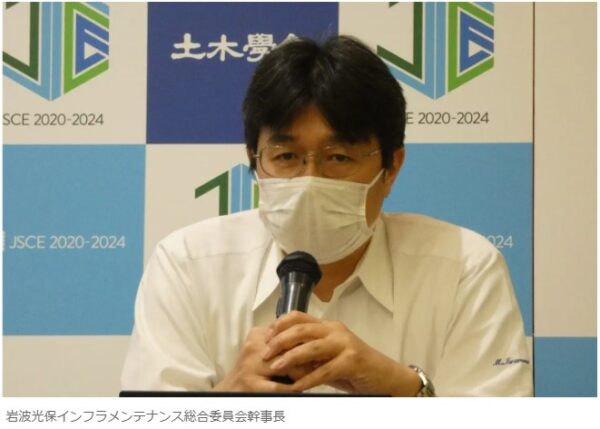
Next, Mr. Iwanami explained the contents of the statement, and Mr. Hikaru Nakamura, Chair of the Infrastructure and Health Subcommittee, gave a presentation on “The Current Status of Infrastructure Health Checks.”
“I think a major factor is how the environmental and social conditions in that region have affected infrastructure deterioration. In fact, it might be fair to say that the infrastructure is located in an area prone to deterioration to begin with. In regions prone to deterioration, we need to pay closer attention to maintenance and management, and the Ministry of Land, Infrastructure, Transport and Tourism should not simply apply a one-size-fits-all approach nationwide but rather implement policies that provide greater support to these vulnerable areas. It is also important to clearly communicate this to local residents so that we can secure their support.” (Nakamura)
The Japan Society of Civil Engineers has been publishing its “Infrastructure Health Check” reports since 2016, and is currently creating maps—with a particular focus on road bridges—covering areas ranging from prefectures down to municipalities. The Society plans to release accurate details, including these maps, in the future and, at the same time, issue a statement on behalf of the Society.
However, there is a major obstacle to infrastructure maintenance. This is because, in Japan—where the population is declining and the birthrate is falling while the population ages—the decline of rural areas continues. There are approximately 700,000 road bridges in the country, of which about 500,000 are managed by municipalities. While the role of “infrastructure general practitioners” is therefore quite important, there may be challenges regarding who will fill these roles. I asked a question regarding this point.
“The number of engineers in municipalities is on the decline. That’s why I don’t think it’s acceptable to view the role of ‘infrastructure general practitioners’ as something that should be handled solely by government agencies. Instead, we should adopt a perspective that industrializes infrastructure maintenance and entrusts it to skilled professionals. It would be desirable to leverage the capabilities of the private sector in maintenance as well and develop it into a professional field. What we need going forward is a ‘general practitioner’ for maintenance who goes beyond the fields of concrete and steel.” (Ieda)
”When you go to rural areas, you tend to see a shortage of workers. As a result, some regions also lack ”people, resources, and funding.' Therefore, rather than providing support evenly across the entire country, the key will likely be to focus support on the regions that need it most."
"Furthermore, one vision for an 'infrastructure general practitioner' is that they would serve as a point of contact for consultation and advice on any infrastructure issues that arise in each region. Existing certified professionals, such as concrete inspectors, are key members of this initiative," (Hisada)
"Preventive maintenance is the foundation of infrastructure maintenance."
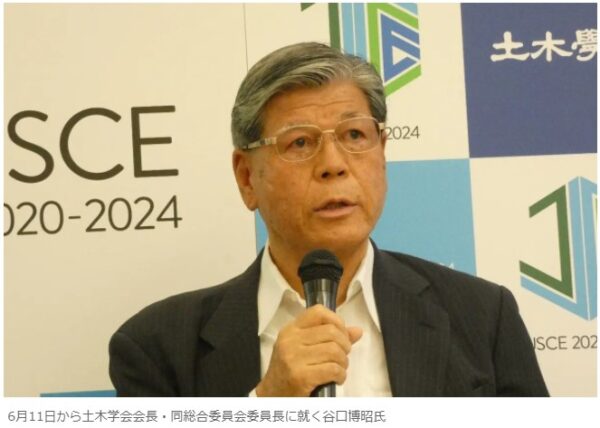
Finally, Hiroaki Taniguchi, who will assume the positions of President of the Japan Society of Civil Engineers and Chair of the General Committee on June 11, spoke about infrastructure maintenance and related topics. After graduating from the Department of Civil Engineering at the University of Tokyo’s Faculty of Engineering, he joined the Ministry of Construction (now the Ministry of Land, Infrastructure, Transport and Tourism). He served at the Kinki Regional Development Bureau and as Director-General of the Road Bureau before being appointed Vice Minister. He currently serves as Chairman of the Board of the Construction Engineers Center, a general incorporated foundation.
"I believe preventive maintenance is the foundation. While the concept is understood, it’s a difficult idea to put into practice. The reason is that, although we know preventive maintenance is cheaper and more cost-effective in the long run, the problem is that we can’t make it work within our current budget."
We will do our utmost to gain the government’s understanding on this matter. Given our limited financial resources, it will be necessary to set priorities among infrastructure and regions and carry out maintenance accordingly.
Next, in addition to costs, there is the issue of personnel. With recent advances in IT technology, it may soon be possible to conduct remote inspections of structures. It is important to make use of such technology.
Furthermore, the role of the private sector—which has been a topic of discussion for some time now—is also important, and I would like to use the term “private-sector support.” I would like to consider how we can move beyond PFI to determine what form of private-sector involvement is most desirable.
"In addition to these issues, I believe we are approaching a major turning point in terms of what civil engineering and infrastructure should look like overall, taking into account regional cooperation networks. I would like to deepen our dialogue with the public, present a comprehensive overview, and engage in discussion, all with a view to shaping the ideal future of our daily lives, economy, and society."
Will the concept of multi-skilled engineers become a reality?
The Japan Society of Civil Engineers’ recent statement on infrastructure maintenance was also an expression of its desire to share a sense of urgency with the public. Whenever a major accident occurs involving infrastructure, the media also highlights the crisis facing infrastructure, but unfortunately, this attention tends to be short-lived.
When considering the future of society, the declining birthrate and aging population are leading to a steady increase in “marginal villages,” and it is a difficult challenge to determine how to implement comprehensive, big-picture policies to address this issue.
In this context, the key point is that, alongside policy, the role of individual engineers is undoubtedly important. What caught my attention most was the Japan Society of Civil Engineers’ mention of the creation of a new certification called “Comprehensive Infrastructure Physician.”
Given the growing shortage of engineers, rather than saying, “I specialize in concrete, so I know nothing about steel,” isn’t there a need for engineers to become more versatile—to be able to handle both concrete and steel?
(From the God of Construction)