



Hello, everyone.
This is Enta.
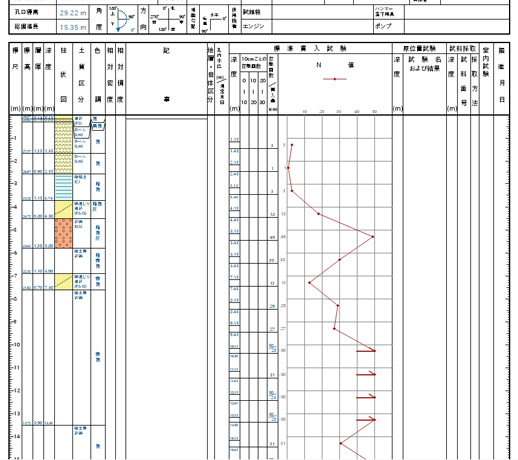
We design based on the columnar diagram, considering things like where exactly within which stratum to anchor the structure.
Naturally, cost-effectiveness takes priority.
However, there are quite a few cases where the layers that appear are somehow completely different from the actual strata.
Clay-based ones, in particular.
In terms of soil composition, even the silt layers tend to be more clay-like.
Even in sandy silt, there’s sometimes no sand at all lol
Given that, will the curing time be okay?
That's how it goes, lol
I actually get really worried that it might not come out.
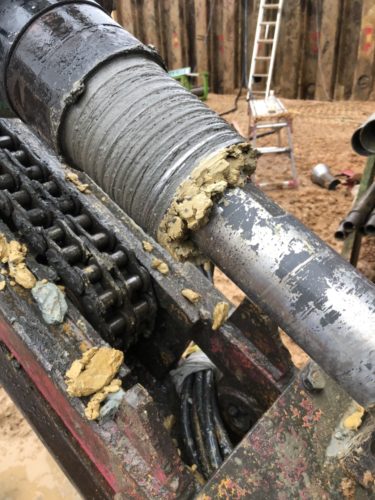
Well, if something goes wrong, we can just say, “We made a design mistake. We’ll redo it!”—that’s something we can say when we handle both the design and construction in-house.
However, when it comes to projects designed by consultants, things don't go quite that smoothly.
Consultants and government agencies will likely point out construction errors.
However, the reality is that construction errors are quite rare in simple installation methods such as ground anchor work.
Logically speaking, you dig a hole, insert the steel wire, and pour in the grout.
The key mistake here is that,
1. When inserting the PC steel strands, grease was applied over a wide area of the anchorage section.
2. A large amount of mud and debris had accumulated on the mounting section.
3. Defects in the epoxy coating on PC steel strands (Although manufacturers often deny this, the epoxy can actually peel off in some cases.)
When it comes to grout injection,
1. The grout is too thin; when mixing 8 bags per batch, only 7 bags are included.
2. Too much water
3. If the grout is too thick, dilute it with water.
4. For some reason, organic matter and other substances end up getting into the grout.
And so on, but the chances are very slim.
There simply aren't enough steps in the process to allow for mistakes even under supervision.
Since government agencies inspect and accept the deliverables provided by consultants, if they were to acknowledge the consultants’ mistakes,
This would effectively negate the work produced by the government agency.
Especially since we’re placing construction orders based on that. (It makes you wonder, “What was the design all about?”)
I'm not saying consultants are bad by any means, but,
Lately, it seems there have been many cases of consulting engineers misreading or misunderstanding soil properties. (I hear this a lot.)
It does seem quite different from the soil conditions at the construction site. (From a contractor’s perspective)
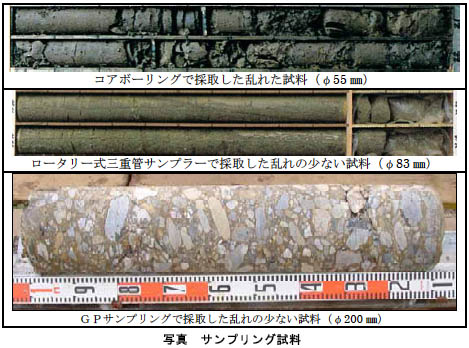
I can't exactly say I read it perfectly accurately, but I do find myself thinking, "Hmm, I'm not sure about that," more often than I used to.
On the other hand, it’s possible that the only construction projects left now are the ones in areas with that kind of unique soil composition, lol.
Well, anyway, changes in soil conditions really take a toll on contractors.
After all, there's a higher risk of it coming loose.
And there's a really high chance people will say it's a construction mistake, lol.
If it's going to come loose, it'd be easier to blame it on a design flaw if it came completely loose... lol
In that sense, it might be difficult to do work that isn't visible to the eye.
See you later.



Good evening. Are you supposed to determine the anchorage length and anchorage zone just by looking at this log? That sounds pretty tough...;; Based on the log above, it looks like it’s for soil rather than rock, so I think there’s very little information there. Are they even writing articles? Or are they deleting them? That’s something I’m curious about. Geological surveys can vary significantly depending on the skill of the drilling supervisor, and the results can also differ if someone who didn’t perform the drilling—or who doesn’t know the supervisor who did—creates the columnar diagram. If possible, I think it would be easier to organize your thoughts on the anchorage length and anchorage zone by examining the columnar diagram and core boxes (core photos) at the same time. It seems that some highly knowledgeable professionals at construction consulting firms have retired, so there appear to be some errors and misunderstandings.
Thank you for your hard work.
In our case, we have no choice but to base our design on the data we've obtained, so that's all there is to it.
The photo shown here is of a different location.
In practice, we make our determination based on the N-values from the columnar test and the soil properties.
This really depends on personal experience, so it varies from person to person.
It seems that construction consulting firms are also having a tough time lately, as many veteran employees are retiring one after another.
Well, as professionals in this field, we hope to be able to assist you with that.
I look forward to your continued support next year.