Hello, everyone.
This is Enta.
I received a question on my Ameblo blog the other day, so I thought I’d answer it.

"When the government asked, 'What is the basis for having 30 or more anchors per 100 square meters?',I've asked my seniors and looked it up online, but there aren't even any books on the subject...I've been looking into this from all angles, but I just can't figure it out!
"If you know, please let me know."
That was the gist of it.
Things like this have been happening a lot lately.
Since everything has been simplified to market prices, questions have arisen among those who are unaware of the actual details (especially young engineers)...
It’s in little things like this that it comes out, you know.
Our engineers in their mid-40s and older have lived through an era where every little detail—like loss rates—mattered.
So things are really easy right now!
It’s like, “Forget about the waste rate—it’s the market price per square meter, so how much is it per square meter!?”
Whether the materials needed to complete a 1,000-square-meter project are a lot or a little, it’s the market price!
I only get paid the market rate.
That's the same idea as what we discussed the other day regarding voluntary temporary housing.
Well, that would be a different story if the situation were really that dire and they’d already reached an agreement beforehand.
Back in the day, it was a real hassle just to inspect empty bags, wasn't it?
Huh? There aren't enough empty bags? Are you thinking, "Did I get the waste rate wrong??" lol

On the other hand, there used to be some literature that went into great detail, didn't there?
"Why did it turn out this way?" or something like that
But now, all those past reasons and numbers are completely gone, lol.
Back in the day, they were usually listed in the Ministry of Land, Infrastructure, Transport and Tourism’s “Yellow Book” on cost estimation, but now they’re only listed in the SP (Construction Package) lol
So, in this post, I’ll be coveringBooks that list the number of poursHowever,
It wasn't in any of the recent literature, lol.
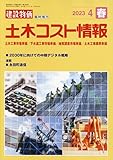
So, what's featured is"Civil Engineering Cost Information"That's right.
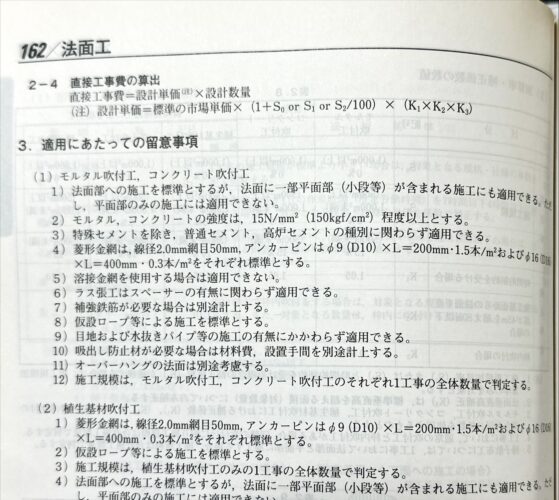
In the past, per 100 m², 150 φ9×200 and 30 φ16×400
It used to say that, but lately it's been per m2.
Civil Engineering Cost Information, April 2023 Issue

By the way, there's another one that has something written on it, sort of, which is,Guidelines for Road Earthworks and Slope StabilizationThat's it.
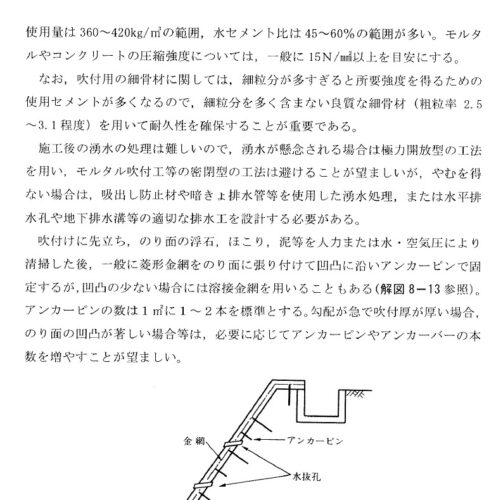
1 to 2 per square meter
If that’s 100 to 200 plants per 100 square meters, then combining the large and small ones should be just about right, right?
Guidelines for Road Earthworks—Cut Works and Slope Stabilization, Heisei 21 Edition


Incidentally, while verifying the number of anchors installed by the formwork crew is listed as a “verification item,” it is different from as-built inspection.
The key to quality control isJust the layers of the lasagnaSo please don't get that wrong.
It may be that such detailed figures aren't necessary anymore, but if the government agency isn't aware of them, the contractor needs to provide them.
Back in the day, government officials actually tended to know more about these things, though.
In any case, since recent literature sometimes omits minor details, older books are extremely important.
I feel like we've reached a point where you can't really get away with anything without that anymore lol (It's like, "What's that?")
It’s like, “Wait, so the government actually listens to what some old books say, but won’t accept the new methods being used today? lol”
It's a bit of a hassle because I have to make sure the past and present are consistent.
But that, too, is part of a director's job.
Rather than proceeding with construction based on the supervisor’s subjective views (his own assumptions or personal methods),
To build a solid foundation for your work, it’s important to thoroughly read specialized books.
It's a good idea to vaguely remember where you read it.
Also, I recommend acquiring as many older books as possible.
See you later.