

Hello, everyone
This is Enta.
We've been in the midst of a major cold snap for the past few days—how is everyone holding up?
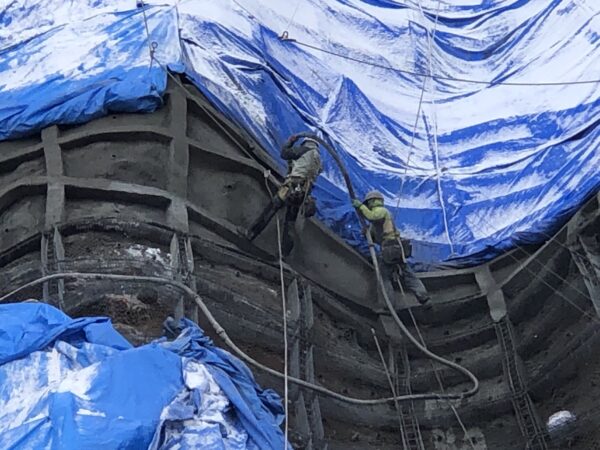
In Nagano, we are constructing nearly vertical retaining walls on slopes at -15 degrees.
The other day, heavy snow fell again in the afternoon, bringing work at the site to a halt.
The snow at this time of year is really a pain.
If you don't cover the entire structure with a tarp to protect it and prevent snow from getting inside the frame, it will significantly affect the quality of the formwork.
After all, we can't clear away all the snow, can we?
If you spray water onto a frame that has snow on it, the snow will melt and turn into water.
That means a cavity will form there.
What’s more, since the water-to-cement ratio increases in some areas, the strength of the mortar itself decreases, and the rebar will rust, right?
For this reason, we cover the area with sheeting to protect it, and we only expose the section to be sprayed that day for the work.
Although this construction method would be unthinkable in warmer regions such as Kyushu, it is the norm here.
Furthermore, at night, we burn briquettes at the base of the slope to prevent the temperature inside the tarp from dropping.
Mortar itself rarely freezes as long as its surface strength is sufficient.
It will have hardened to some extent within about five hours after spraying.
While it’s hard to generalize, when spraying in sub-zero conditions (especially at those temperatures…), the key to preventing freeze damage is
These are the temperatures of the hot water and sand, as well as the temperature after spraying.
Stop spraying around 3:00 p.m. and cover the area with a tarp by 4:00 p.m.
From 3:00 p.m. for about 5 hours until around 8:00 p.m., we burned briquettes inside the tent, and the temperature inside and around the tent was
As long as the temperature doesn't drop below zero, it almost never freezes. (Well, almost, lol.)
5 hours after sprayingBased on my experience, I think that’s a good rule of thumb.
So, with the exception of a few areas, it hardly ever freezes in the Kyushu region, right?
Even we, who live in Nagano, hardly ever freeze using this method.
If you add antifreeze there, it's more likely to freeze.
Just think about it for a moment.
If impurities get into the cement as it is setting (during the hydration reaction between water and cement), the temperature drops.
This means it will take longer to see results.
Antifreeze can be hit or miss, so please take great care when applying it.
If possible, please prepare test specimens with and without antifreeze and conduct compressive strength tests on them.
It'll probably stay the same, or the antifreeze should actually show a lower reading, lol.
If it doesn't change, there's no point in including it, right?
I think many people avoid doing this because of the preconceived notion—fueled by the fear that the engine will freeze if they don’t add antifreeze—but please give it a try at least once.
I’ve been through this before, so I’ll do the work without adding it. Or rather, because antifreeze just seems so sketchy!! lol
It’s still going to be cold for a while, but let’s just make sure to stay safe!
Construction work can be dangerous, especially in areas where it snows.
The rope freezes, so the lollipop slips.
Let's proceed with the installation with the utmost care!
See you later