Hello, everyone.
This is Enta.
Every few years, there's a design that's a little weird, lol.
That's because we're installing ground anchors using a rotary drilling rig.
It is also known as a spindle-type drilling machine.
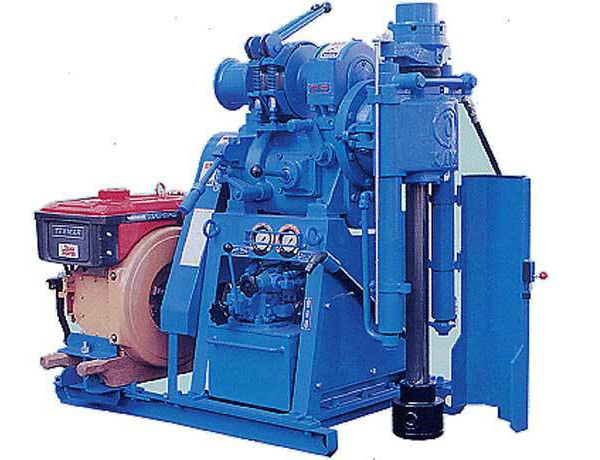
Nowadays, these are drilling rigs used for grout injection, soil testing, and—in the case of large-scale equipment—for drilling large-diameter piles using down-the-hole hammers.
And then the consulting firm’s design comes back telling us to drill holes for ground anchors.
I imagine there are all kinds of consultants out there, but the period during which we were drilling with this drilling machine was roughlyThat was 40 to 50 years ago!
In a way, I can’t help but wonder, “Is this person pretty old if they’re bringing this machine here?” lol
Sometimes we do drainage drilling, too.
There's nothing we can't do—as long as the hole stands on its own after drilling.
But it’s not every day you come across a mountain where a hole stands on its own.
When a borehole is said to be self-supporting, it means that even after the casing is removed following drilling, the borehole remains intact and stable.
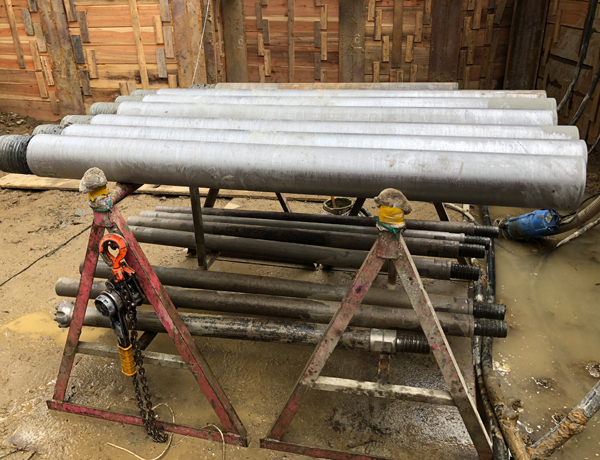
This is the casing.
After removing the casing, we insert the anchor body, but,
If mud or other debris adheres to the anchor body’s embedment length at that time, it may interfere with the anchor’s performance.
For this reason, double-pipe drilling is the standard method for ground anchor construction.
Since drilling is generally performed using the double-pipe method, a rotary percussion drill is used.
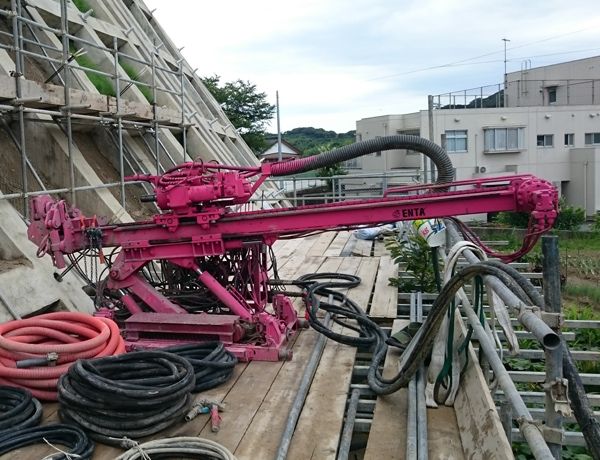
This is the skid-type system.
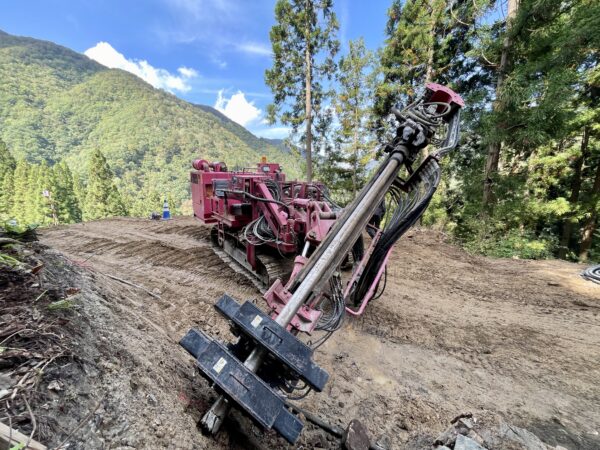
This is a crawler-type rotary percussion machine.
This drilling rig is essential for ground anchor construction.
Incidentally, drilling with a rotary drill takes about 10 to 25 times longer than with a standard drill. (Based on cumulative time)
To all consultants.
Rotary percussion drilling is the standard method for drilling holes in ground anchor and drainage well construction.
If you're really stuck, please feel free to ask for help. (We get a lot of questions like this.)
We often get inquiries about construction on small lots or moving heavy equipment.
When we get a design on site that doesn't fit the current situation, it ends up requiring a design change right from the start, which is a pain lol.
If we’re going to do this anyway, we might as well choose the right equipment from the start—that way, the rest is up to the contractor.
See you later.