
Hello, everyone
This is Enta.
Today, I'm going to talk about self-drilling rock bolts lol
Self-drilling rock bolts
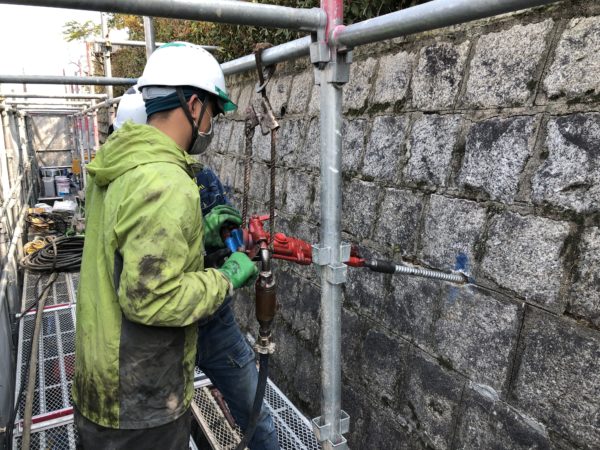
A self-drilling rock bolt is a rock bolt consisting of a bit, a rod, and a coupling, and
It is primarily used as a temporary rock bolt in locations where the borehole wall cannot remain stable on its own.
In some cases, it has recently come to be regarded as the standard approach.
A Story from Long Ago
In the past, self-drilling rock bolts were used for permanent installations.
As for why it ended up deviating from the original plan, the truth is...Unstable injectionThat's how it was.
The contractor claimed that the work had been completed.
A while back, I used to say that myself.
In reality, there were quite a few areas where I wasn't sure if the solution had been injected properly.
Then, during an audit somewhere, that instability was uncovered, and,ProhibitedIt became (the National Highway Agency, I think?).
The Difficulty of Self-Perforation
The biggest challenge with self-drilling rock bolts is the drilling process.
Since this is used on a mountain where the natural slope isn't stable, it's only natural that the slope would collapse.
We'll continue drilling while flushing out the slurry.
Whether drilling by hand or with a machine, when the shank adapter is removed upon completion of drilling, the rod may wobble, orIf it hits the borehole wall, the wall will collapse.
Injection
Even if it hasn't crumbled, the injection is performed through the hole in the rod itself.
If the drilling is not done properly, the hole will be blocked, making injection impossible.
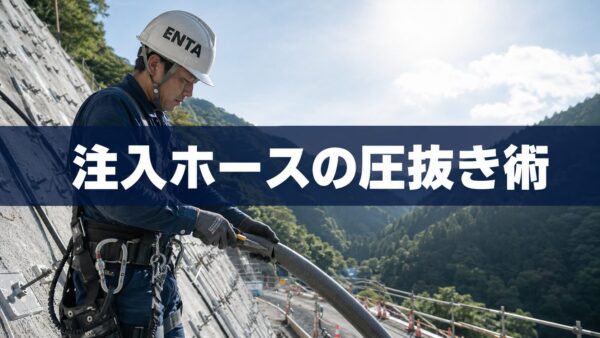
Since the injection hose isn't secured in place, it's not possible to inject from the tip.
That means the only option is to inject it through the mouth.
The key to injection is the deepest pointThat's why. If we can't do that, we won't even be able to verify that the injection took place.
This is the main source of the difficulty.
If we inject from the deepest point and cannot confirm the return flow, we will only be able to inject partially.

Criteria for Decision-Making During Drilling
As long as slurry is being discharged during drilling, it can be determined that the rock mass is self-supporting.
However, if the number of these Kriko (slimes) drops drastically or they stop appearing altogether, it means the system has collapsed.
At that point, the surgeon pulls the rod up; after pulling it up, they reinsert it and check the clasp.
I know I'm repeating myself, but ultimately, self-drilling tends to press forward regardless of whether slime appears or not.
Be careful when the Drilling Slime isn't around.That's it.

Key Points for Installing Self-Drilling Rock Bolts, etc.
- Ensure that the slime is being discharged during drilling.
- In the case of red clay, for example, it stands on its own quite well.
- The natural ground must be able to support itself to some extent until grouting begins.
- Be sure to check the air flow through the rod once drilling is complete.
- If you make the counterbore slightly larger, the tip is less likely to get clogged.
(Risk of backflow when digging a water ditch through the peat section) - Rock with a N-value of 10 or less due to cliff cones or severe weathering is already nearly impossible to work with.
- After injection, jiggle the rebar back and forth as much as possible to promote adhesion with the cement slurry.
- Any contractor who says, “Self-drilling rock bolts are pretty easy,” is lying.
- Contractors who use self-drilling rock bolts in temporary structures are well aware of this.
- Recently, self-drilling rock bolts with a plated finish have become available.
- With an iron drill bit, you can't drill holes unless the rock is extremely soft.
- Bits with cutting edges can drill to a certain extent, but the rod breaks as soon as it hits bedrock.
- Contractors who are familiar with self-drilling rock bolts always keep a good supply of spare shank rods on hand.
- The contractors using swivels to drill water wells might be pretty experienced, huh? (The air pressure is strong, too.)
- Surprisingly few contractors have swivels for rock bolts.
- If you force it, the rod will snap over and over again.
- For manual excavation, the limit is about 2.5 meters (based on calculations).
- If possible, I wish it would just go away (a cry from the heart)
- Contractors who say drilling is easy are sketchy.
- If you can't inject it, it's just a piece of rebar sticking out.
See you later.