Hello, everyone.
This is Enta.
What Is a Rush Job? | Meaning as Used on Construction Sites
"Rush construction" refers to,Construction work that pushes forward day and night, including on holidays, significantly shortening the originally required construction periodThat's what it means. "Tukkan" itself is a military term from the Meiji era that means "to charge into enemy lines," so it does have a pretty heroic ring to it, doesn't it? lol
In the construction industry, this provision is invoked under these circumstances.
- Cases where the earlier phases (earthwork, foundation work, etc.) are significantly delayed, causing the later phases (slope work, paving, etc.) to fall behind schedule
- Cases where the road opening date or facility opening date cannot be changed and must absolutely be met
- Cases Where "Just Get It Done Quickly" Is the Motto in Disaster Recovery
Since we're a slope-construction company, almost every time..."The one who has to clean up the mess for the entire project"That's right. The ripple effects of a three-month delay in earthwork are being felt entirely during the final month of slope stabilization work. That's why, in the slope stabilization industry, rush jobs are moving beyond being just "common" and are becoming "the norm."
There's a part of one of our job sites where work is still going on today.
According to my timesheet, I've been working nonstop for the past month.
It's a busy workplace where there's no time to rest.
I really feel terrible for our employees.
Once this job is done, I'll let you take it easy for a bit.
Hang in there until the end of this week!
And while this is a problem at this particular site—or rather, it’s a trend you see at every site—
In the end, the slope contractors are the ones who have to clean up the mess for every project!
What's more, when you go to large construction sites run by major general contractors, slope stabilization work is considered ancillary work.
Since it's not part of the main construction work, it's being overlooked.
I’m not sure if they’re simply not taking the delays in the earthwork seriously, but when it comes to our subsequent slope work, we’re put under intense pressure to rush to meet the deadline.
I suppose there are cases where the opening date is fast approaching or the construction deadline is looming.
But surely there were things you could have done earlier?
It shouldn't be the slope contractor's fault that the project is behind schedule.
It's not a matter of whether or not to include the number of people.
Isn't it because of lax process management?
Are you managing your processes effectively?
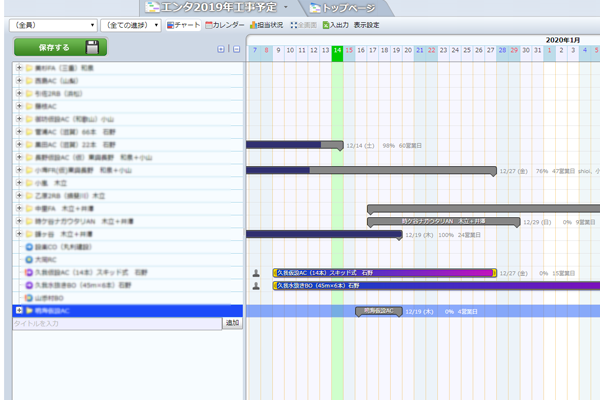
Slope contractors operate according to their own unique project management processes.
It's not right to say things like "That's too slow" or "Add more staff." (Well, I suppose some places are slow...)
Even if you increase the number of players, if there are people who just play for fun, it reduces efficiency and ends up costing money unnecessarily.
And at sites like that, it’s usually a vicious cycle where they just keep demanding lower prices, lol.
A while back, at a construction site where I was the construction manager, I told the branch manager of XX Construction, “We’re cutting corners to meet the deadline, so that’s why it’s so expensive, right?” and he totally lost it lol.
If it were a site involving only slope work, there might be a way to handle it if the construction schedule is carefully planned, but,
If there are dependencies on other trades, you must ensure that their work is completed first; otherwise, slope work simply cannot be completed.
I want you to understand that the slope contractor bears absolutely no responsibility for the failure to compact the soil.
And if you absolutely want it packed tightly, it’s definitely going to cost you!
It's obvious at a glance why the same construction work costs more.
Construction companies pay at least 1.35 times the regular wage for overtime work, such as working late, and for work on Sundays.
Since that amount is paid out of the contract price, the construction company is absolutely required to pay its employees.
If it's a job where you know from the start that you'll be working overtime every day and on Sundays,
A budget of approximately 1.3 times the labor costsPlease talk about it.
Machinery costs are approximately 1.1 times the original amountI think so. (Machines wear out, too.)
Contractors should also recognize that this approach is standard practice for general contractors.
And it’ll end up putting a strain on other projects, too. Please keep that in mind as well.
If you think that's too expensive, then you'll just have to give up on the construction schedule. (Not that I could ever do that, lol.)
That's how it works.

It’s because there’s a reward that I can work hard and stay motivated.
"The payment for this job is super cheap, and,
On top of that, I work two hours of overtime every day and have to work on Sundays—I don't get a single day off.
"But your pay will stay the same as usual, so do your best! ♡"
No matter how many times people call you a "cute girl," it still gets on your nerves, doesn't it?
If an old guy like me said that, wouldn't you want to quit your job, too?
It goes without saying that employees who perform construction work should be paid according to how well they do their jobs.
After all, we're doing the kind of rush job that no one wants to do.
And the construction company is, after all, taking on that level of risk and incurring those expenses.
If we can manage that well for the sake of our mutual goals (interests),That's what I think.
The Negative Connotation of "Rush Job" | Why Is It Used in a Negative Sense?
Although “rush job” is a neutral term in the dictionary, in practice...99 percent negative connotationIt is used in this context. The reason is simple: most rush jobs are the result of “the fallout from inadequate management of upstream processes.”
For example, a conversation like this.
- "That construction site turned into a rush job..." → The reply is, "Oh, I'm so sorry to hear that."
- "We built the house in a rush" → Used as a byword for shoddy construction
- On social media: “The release of [XX] was rushed” → A metaphor for something riddled with bugs, sloppy, and half-baked
In other words, the term “rush job” itself"As a result of prioritizing delivery deadlines over quality, something is being sacrificed."It carries a certain nuance. That’s why it’s never written in official documents, and it’s not something we want to say publicly—we don’t want to admit that we “rushed through it.”
However, from the perspective of those on the ground, whether or not it will turn into a rush job isI have a pretty good idea before it starts. If you attend project meetings, you’ll find plenty of sites where things have been looking dicey for the past three months. If someone had taken action at that point, we wouldn’t have ended up in a rush job—but time and again, the opportunity was let slip by. That’s why, on-site, the term “rush job” evokes a mix of anger and resignation.
That was kind of a heavy topic for a Sunday, lol.
Since it was right at the very end of the fiscal year, it was a typical kind of story.
If you can take a break, be sure to rest well; if you can’t, you’re probably tired, so please be extra careful!
5 Disadvantages of Rush Construction | The Costs a Slope Engineer Has Seen Firsthand on Site
Aside from the fact that “it costs money,” there are several other drawbacks to rush construction that are evident on-site. Based on my experience as a slope engineer, here are five that I find particularly problematic.
- Accident rates are skyrocketing: The combination of accumulated fatigue, stress, and night shifts has led to a sharp increase in human error. In fact, when employees work consecutive days off, the quality of their "KY" activities declines, making accidents more likely to occur.
- Construction quality declines: We tend to make choices like cutting corners on the curing time for sprayed mortar or not waiting for anchor grout to set—essentially choosing “not enough time = compromising quality.” This leads to rework later on, which ultimately costs even more time and money.
- An employee is quitting: This is the most painful part. Young employees are the first to leave companies that are constantly working under tight deadlines. From a management perspective, the damage caused by losing talent is greater than the financial loss on the front lines.
- The machine breaks down: Working on Sundays and running equipment at night takes a toll on the drilling machines, compressors, and spray machines. In my experience, repair costs for machinery skyrocket to two or three times their usual amount right after a rush job is completed.
- It causes inconvenience to other work sites"If we concentrate our personnel and machinery on that site," delivery dates at other sites will be delayed. This triggers a chain reaction of rush jobs across multiple sites, creating a vicious cycle that exhausts the entire company.
Even with all these drawbacks, we sometimes take on rush jobs anyway. That’s because, in the end,"Is it worth the price?"That’s the bottom line. If we set the budget at 1.3 times the labor costs and 1.1 times the equipment costs—and can actually pay employees their overtime wages—then we can maintain the resolve of the frontline staff.
To put it another way, rush jobs that aren't properly compensated areYou must not take it onThat's right. First the employees break down, then the machines, and eventually the company itself collapses. I really think we can't give in on this point.
See you later.