Hello, everyone.
This is Enta.
I wrote about the drilling angle used in dewatering borehole construction.
What is the concept of angle in dewatering drilling?
In that regard, I received a question about the warping of the casing holes.
I’d like to use that material as a basis for my thoughts.
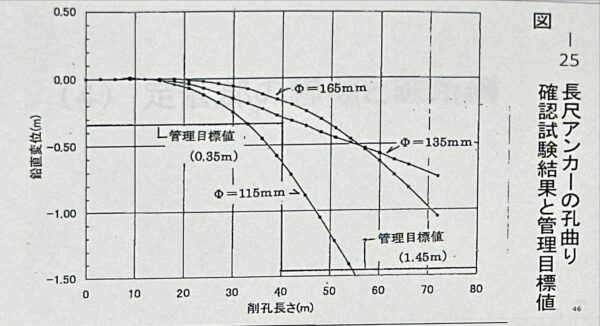
It appears that the study used casings measuring 115 mm, 135 mm, and 165 mm.
In reality, I think it depends on the soil type, but I believe the holes are more likely to bend if the soil is soft.
You might think that if it's hard, it would be harder to turn, right?
You can see that all the casings run almost straight up to about 20 meters, and then begin to curve once they pass the 30-meter mark.
Since the casing bends mainly due to its own weight, the more you drill upward from the horizontal,
So, you're saying that drilling becomes difficult around the 30-meter mark, and the drill bit tends to get caught in the rock.
Assuming a drop of about 1 meter at the 60-meter drilling stage
Even if we assume that the borehole drops 1 meter for every 60 meters drilled at a 3-degree upward angle,
(60 m × tan 3°) = 3.14 m – 1.0 m = 2.14 m
This means it is approximately 2.1 meters above us.
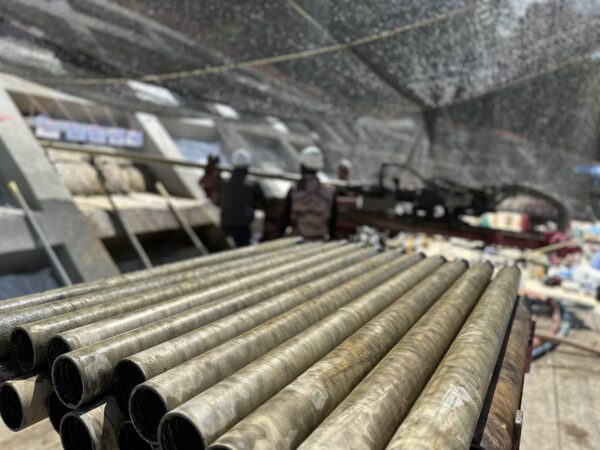
However, this applies only when using casing that is 115 mm or larger, so,
I think it would be a little shallower with a 90 mm casing.
This document is,
Research Advisor, Comprehensive Research Institute for Elevated Roads
Professor Masayuki Okuzono, Honorary Member of the Japanese Geotechnical Society and the Japanese Society of Applied Geology
I received the materials.
Normally, you could use a 90-mm casing, insert a gyro sensor, and check a few spots to get a general idea, but,
It doesn't make any money, lol
Well, I think it's fine—I figure it'll be easier to make predictions if we have some rough data.
See you later.