



Hello, everyone.
This is Enta.
I heard that the drainage well project I drilled and supervised last month has been completed lol
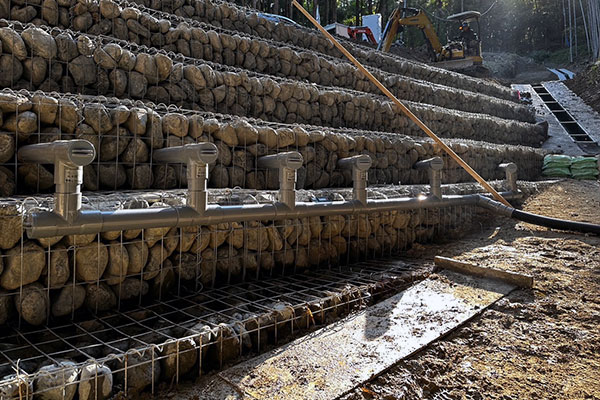
The final result looks really great—it's beautiful, isn't it!
Each borehole is just under 30 meters long, and the drilling angle is 7 degrees.
I always think that there’s really no need to frame it that way.
Wouldn't about 3 degrees be enough, even at the most?
It’s true that various sources list the range as 5 to 10 degrees, so I suppose the designer had no choice but to follow that.
But then again, why did they set it to 7 degrees, then??
I don't think there's any clear reason for that to happen.
When the drilling angle is set to horizontal (zero) and a 30-meter borehole is drilled,
If the borehole is drilled at a 7-degree upward angle, the elevation of the 30-meter tip will be approximately +3.7 meters.
(30 m × tan 7°) = 3.68 m
Do we really need to raise it by 3.7 meters??
In that case, wouldn't it be better to set it to about 3 degrees and drain the water from a lower level?
That's what I think.
At 3 degrees, it's approximately 1.6 m
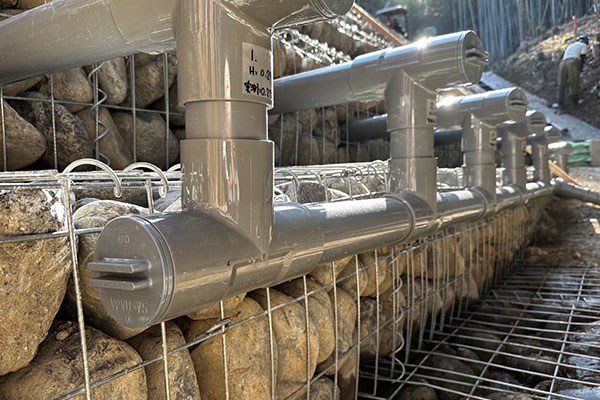
When the soil reaches saturation, water gradually accumulates from below.
When it comes to the concept of creating a slope, many people assume that rainwater flows down from above into the natural ground and then enters the pipe from above.
Since water flows in from beneath the drainpipe,
Based on experience, dewatering drilling operations should, if possible,A multi-stage approach is more effectiveI'm wondering, "So what?"
A multi-tiered design, like a catch basin, is the most ideal.
Water flows even without an incline.
I don't think there's a problem as long as the angle is between zero and 3 degrees, and I'm wondering if there might even be a way to drain water downward physically.
In the case of downward flow, can the degree of saturation of the native soil serve as a reference point? (If water comes out near the mouth, that’s where the water is currently located.)
Well, I’d like to come up with new construction methods that challenge current conventions and put them into practice.
Other than that, it's just the old literature getting in the way, lol.
See you later.


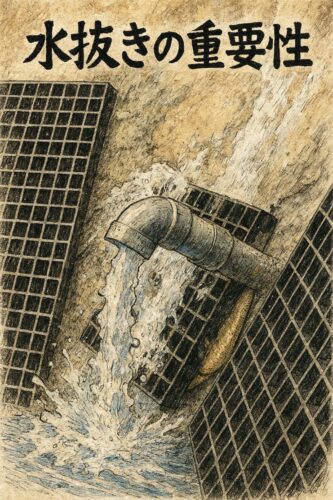
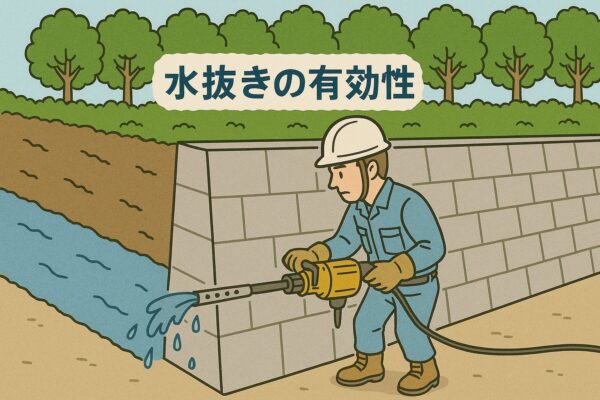
It's neat and tidy, isn't it? lol
This is the first time I've seen a structure connected with horizontal pipes!
I always enjoy reading your posts. I found this one on the drilling angles for dewatering boreholes particularly interesting. It’s true that various references mention angles of 5 to 10 degrees. It’s not like we’re on “Chiko-chan’s Scolding,” but I do wonder why that is. I recall—though it was about 40 years ago—during landslide prevention work in Nagaoka, Niigata, when we were constructing drainage boreholes arranged in a fan pattern with an average depth of about 80 meters per borehole. An engineer from a certain consulting firm explained that the reason for setting the angle of inclination at 5–10 degrees was to account for the downward deviation of the borehole at the tip. Compared to back then, the capabilities of the machinery we use today have likely improved significantly, so perhaps it’s not something we need to worry about too much. However, could you please tell me again how we should approach this issue when dealing with long-span boreholes?
Thank you for your hard work.
It's true that the tip dips below the hole.
So, posting it might be one option to consider.
The reason it drops is the weight of the casing.
So it looks like it's trending downward to the left.
But how much will it actually drop?
Come to think of it, I’m pretty sure I have some materials on that, so I’ll write about it in my next blog post.
The machine's performance hasn't really changed much over the years, has it? lol