

Hello, everyone.
This is Enta.
This time,I’d like to compare the three leading companies in slope stabilization.
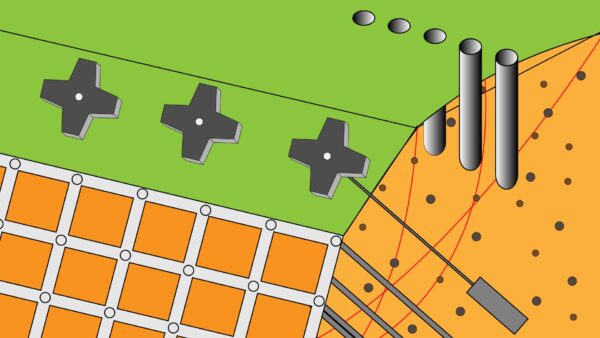
(It took me a whole hour to draw this picture... lol)
A construction method often mentioned as a countermeasure against slope disasters such as rockfalls and landslides,
"Reinforcement Bar Insertion," "Ground Anchor," "Retaining Pile"
Commonly known as the "Big Three" of deterrence engineering!!
All of them“Stabilizing the ground”Although the purpose is the same, there are significant differences in the conditions for use, features, and cost.
In this article, I’ll explain the differences between these construction methods, when to use each one, and key design considerations.
This is just a rough overview intended for newcomers, so please take it as a general guide ^^
🔧 Quick Comparison Chart
| Item | Reinforcing Bar Installer | Ground Anchor | Retaining Pile |
|---|---|---|---|
| Main Purpose | Soil Reinforcement (Increased Shear Resistance) | Adding Friction to a Sliding Surface | Containment of the Entire Landslide |
| Main Structure | Steel Rods + Cement Slurry Filling | PC steel strand + anchor + tension (cement slurry) | Piles (RC or steel pipe) driven deep into the ground (with mortar) |
| Main Target Audience | Rockfalls and Small-Scale Landslides | Medium- to Large-Scale Landslides | Large-Scale Landslide |
| Utilizing Tensile Force | None (own weight + friction) | Yes (apply tension) | None |
| Construction Equipment | Suspended, Skid, Hand-dug | Rotary Percussion (Skid Crawler) | Pile Driver (Large-Diameter Boring) Down-the-Hole Hammer |
| Maintenance | Virtually unnecessary | Regular Tension Measurements Are Necessary | Pretty much impossible (difficult to check underground) |
| Cost | Relatively inexpensive | Medium to High Cost | High cost |
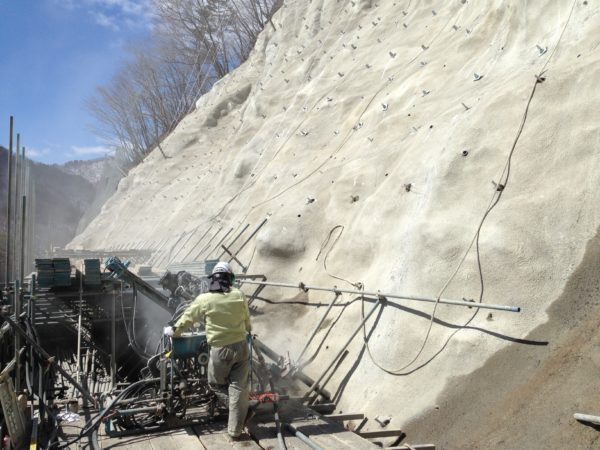
① Reinforcing Bar Installer (Self-drilling Bar/Lockbolt)
Overview:
A construction method that involves inserting steel bars (rebar) into a slope and securing them with cement slurry (grout) to enhance the integrity of the natural ground and improve its shear strength.
Features:
-
"Passively" reinforcing the natural ground without applying tensile force
-
More effective for preventing "slope failures" than landslides
-
Designed for relatively shallow slip surfaces and cracks
- Designed for surface landslides and relatively shallow landslides; acts as a pseudo-retaining wall
Advantages:
-
Low cost
-
Can be installed using a light-duty drilling machine or by hand, making it suitable even for tight job sites
-
Requires virtually no maintenance
Disadvantages:
-
Limited effectiveness (not suitable for deep slip planes)
-
Reinforcement using only the structure's own weight and friction
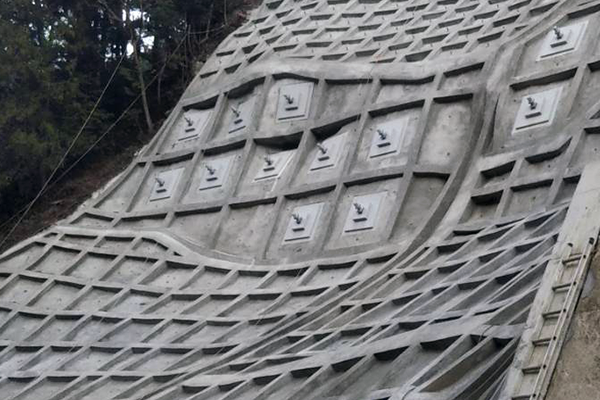
② Ground Anchor
Overview:
A construction method in which anchor elements (prestressed steel strands) are inserted deeper than the sliding surface to apply tension and “pull” on the surrounding rock to stabilize it.
Features:
-
Active Construction Methods
-
Effective even on medium- to deep-depth slip surfaces
-
Applying tension produces “immediate results”
Advantages:
-
Can handle deep sliding surfaces
-
Can be used in combination with other construction methods (e.g., retaining structures such as retaining walls + ground anchors, etc.)
-
The effects can be quantified, and there is a high degree of design flexibility
Disadvantages:
-
-
High cost.
-
It is necessary to maintain and manage tension (e.g., in measuring devices); recently, particular attention has been paid to managing the head.
-
A dedicated drilling rig with a capacity of approximately 1 to 18 metric tons is required; there are restrictions on construction.
-
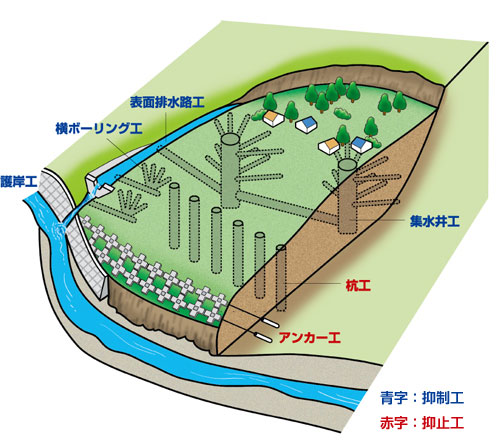
③ Retaining Piles (Pile-Type Landslide Prevention Structures)
Overview:
A construction method that involves driving steel pipes or reinforced concrete piles perpendicular to the landslide slope to physically “block” the landslide
Features:
-
Containment of the Entire Landslide
-
Prevent movement by utilizing the pile's bending and shear resistance
-
Adopted as a long-term measure
Advantages:
-
Highly effective at preventing landslides and capable of handling large-scale landslides
-
Low maintenance (basically maintenance-free)
-
The stabilizing effect is physically evident
Disadvantages:
-
Extremely expensive
-
Large-scale construction (requires large-scale drilling machines, down-the-hole hammers, and geological surveys)
-
Difficult when there are many underground obstacles
🏗️ How to Use Them in Practice
| On-Site Situation | Recommended Construction Methods |
|---|---|
| Reverse-Curl Construction for Reinforcement and Excavation on Landslide-Prone and Weathered Slopes | Reinforcing Bar Installer |
| To reduce the number of rebar insertion operations, given the deep sliding surface and large displacement | Ground Anchor |
| Large-Scale Landslides That Require Comprehensive Monitoring | Retaining Pile |
| Cases Where Combination with Other Methods Is Necessary | Anchor + retaining wall, or anchor + pile, or pile + catch basin, etc. |
📝 Choose based on ease of installation and the type of surface!
-
Small-scale, shallow → Reinforcing Bar Installer
-
Medium-sized, mid-rise → Ground Anchor
-
Large-scale and deep → Retaining Pile
I think as long as you have a general sense of the atmosphere, you'll be fine.
You'll learn even more by actually working on-site.
Once you take a close look at the actual sites and read the books thoroughly, you’ll find yourself completely immersed in the fascinating world of civil engineering!!
See you later.