Hello, everyone.
This is Enta.
Are you performing pressurization work?
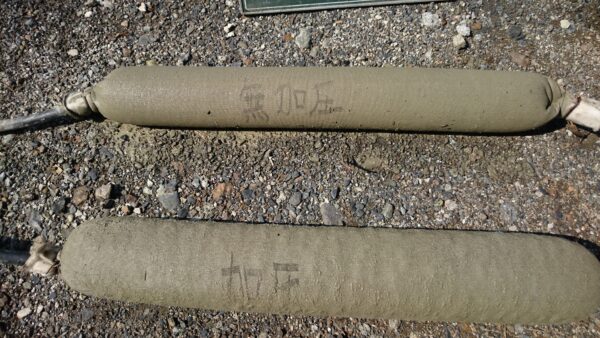
Well, I've always said that compression doesn't really do much, but why does that come out of my mouth?
Since the conversation turned to that, I thought I'd give it a try.
Drill the holes as usual, and insert ground anchors, rebar, and other materials.
Then you'll inject it, right?
In some cases, it’s a dip-coating process, but for now, the material and grout are already in place.
Then, pull the casing out all the way to the anchorage section.
Next, we'll apply pressure.
Before that, please take a look at the drilling casing and bit.
This applies to a bore diameter of 90 mm.
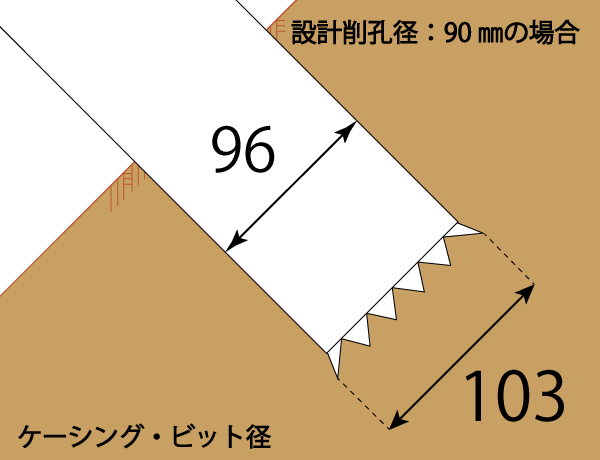
The casing is 96 mm.
The bits are approximately 103 to 105 mm long.
There is a clearance of approximately 7 mm to 10 mm. (About 3 mm to 5 mm on each side.)
It’s about 20 percent larger than the bore diameter.
Circumferential friction also increases accordingly. (This makes it harder to slip out.)
✅ For φ90 (90 mm diameter):π × 90 ≈ 3.1416 × 90 = 282.74 mm
✅ For φ103 (103 mm diameter):π × 10³ ≈ 3.1416 × 10³ = 323.59 mm
The circumference of φ103 is approximately “1.44 times larger (14.44% larger)” than that of φ90.
Well, just take the circumferential friction as a rough guide, lol.
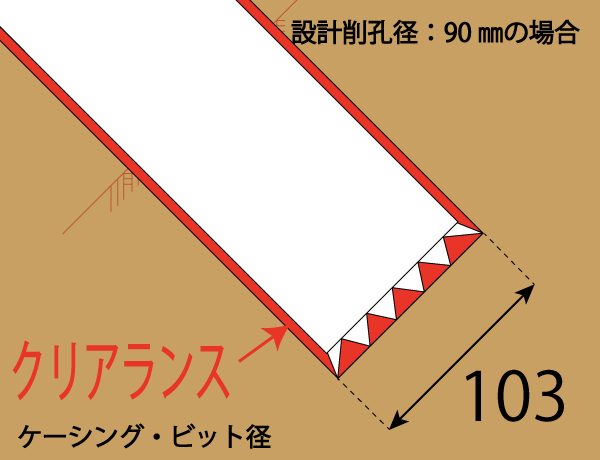
In order to drill a hole and remove the casing, the hole must, of course, be larger than the casing.
This is common knowledge, but I'll write it down for those who don't know.
When inserting a 10-mm-diameter rebar into a hole, even if you drill a 10-mm hole, the rebar will not fit into it.
A hole with a diameter of 10 mm or more is required.
This means that clearance is absolutely required.
Let's get back to the injection.
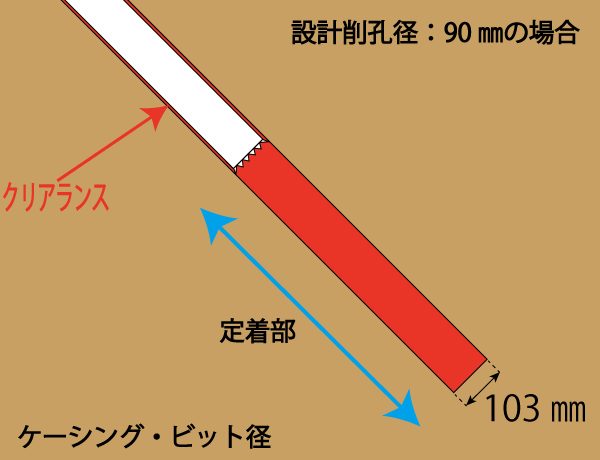
Pull the casing back to the anchoring section, then inject the material and pressurize it.
At that moment, the clearance section of the surrounding rock at the dotted line portion of the casing (the free-length section) collapsed, and
If the casing is in close contact with the surrounding rock, pressure will be applied.
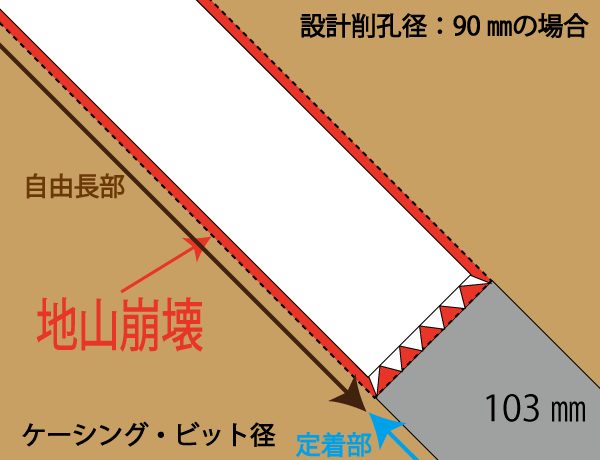
However, if the natural ground remains intact without collapsing, the pressure will escape through the weakest point.
That means it comes out from the outside of the casing, right?
Well, this is pretty obvious, but I hear there are some people in charge who just don't get it sometimes? lol
So, please consider pressurization as an optional feature.
It would be nice if it worked, but even if it did, it would relieve pressure (rather than maintain it), so it wouldn't really serve the purpose of pressurization.
When pressure is applied, my imagination runs wild—I picture it seeping into the natural ground—but that’s impossible.
This is because the cement slurry has a coarse particle size, no matter how much pressure is applied to the ground.
This is the approximate particle size.
-
Cement slurry (cement particles)
→ Approx. 1–50 μm(Particle) -
Soil (clay particles)
→ Approx. 1–5 μm(Particle) -
Water molecules (H₂O)
→ Approx. 0.000275 μm (= 0.275 nm)(Molecule)
You can see that cement slurry, which has larger molecules than soil, couldn't possibly be forced in under pressure, right?
If this were bedrock with joints or cracks, the fluid would seep in; conversely, that would mean it wouldn’t come back up even if injected.
Applying pressure may indeed serve to expel the air inside and ensure that it is filled properly, but
To begin with, adding cement slurry puts weight on the base plate, so...
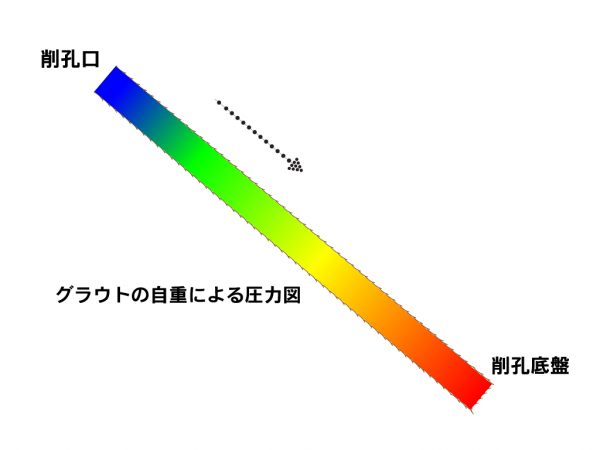
The deeper you go, the higher the pressure gets, doesn't it?
See you later.