Hello, everyone.
This is Enta.
Recently—or rather, since last year—we’ve been receiving a huge number of inquiries via the internet, but,
I'm doing my best to handle this, lol
But that's beside the point.
What Is a Vegetation Engineer?
Today, I had the opportunity to talk about various things with someone, and,
I got the impression that many people don't really understand the construction methods.
So, the question this time is: Why are we doing this greening project?
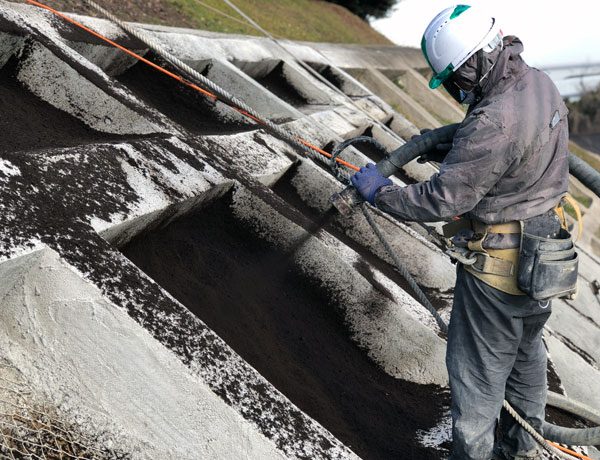
It's not just because it's in the design—why is it included in the design in the first place?
Let's think about that.
Types of greening include:
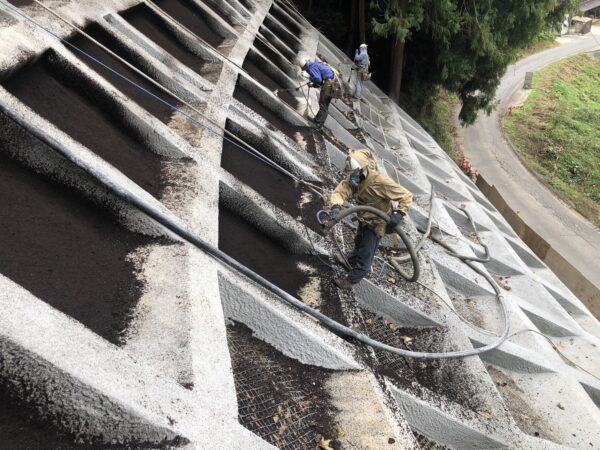
Seed-Spraying Work: Flat areas and gentle slopes (such as slopes on golf courses and other large-scale landscaping projects that are nearly flat)
Soil Blowing Work: 1 cm or more (gentle slopes to slopes with a gradient of approximately 10%)
Vegetation Substrate Sprayer (formerly known as Thick-Layer Substrate Sprayer) 3 cm and up
Vegetation Mat Installer (For Soil Types and Slopes Suitable for Vegetation Growth; Fertilizer Included)
Vegetation Sheet Installation (Similar to mats; no fertilizer)
There are various factors to consider, but we design our solutions to suit the on-site conditions.
The fundamental premise underlying those conditions is that,
The Purpose of Stabilizing Slopes Through Early Vegetation EstablishmentThere is one.
This refers to stabilizing the slope, but the slope itself is bare ground.
If left bare, the slope will be exposed to wind and rain, causing erosion. (In the case of a slope with vegetation.)
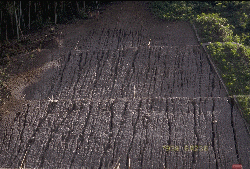
It just keeps getting eroded and crumbling away. Little rocks keep falling down, lol.
To prevent that from happening, we will plant vegetation to protect the surface.
If the timing is right, grass and other plants will sprout and grow vigorously in about a month.
Subsequently, native and other woody plants in the surrounding area will begin to grow and become established; the ultimate goal of the greening effort is to promote the growth of native species.
On sites where the sole objective is vegetation restoration, grass and the like are used because rapid growth helps stabilize the surface layer of the slope.
In the case of open-type systems, such as those that combine legal frameworks, the legal framework ensures compliance, so the pace of greening is not a concern.
Open-Type and Sealed-Type Frame Structures
By the way, since there’s a two-year warranty against defects for the landscaping,
If you are unable to carry out the landscaping, you may be required to take corrective action two years later.
However, there are some areas where landscaping is simply not possible from the outset, and if this is indicated in the design, it must be changed immediately.
Of course, there needs to be a valid reason for this, but let's take a look at the surrounding slopes to confirm.
The Sole Warranty Against Defects for Slope Stabilization Works
This time it was about greening, but next time...
See you later.