

Hello, everyone.
This is Enta.
In a recent post, I was talking with someone at the job site about landscaping.
The True Purpose of Vegetation Engineering
So, we were talking about whether there have ever been any slopes where nothing grows or germinates.
That story was quite interesting and reminded me of wood chips.
In this post, I’ll explore why vegetation engineering doesn’t take root.
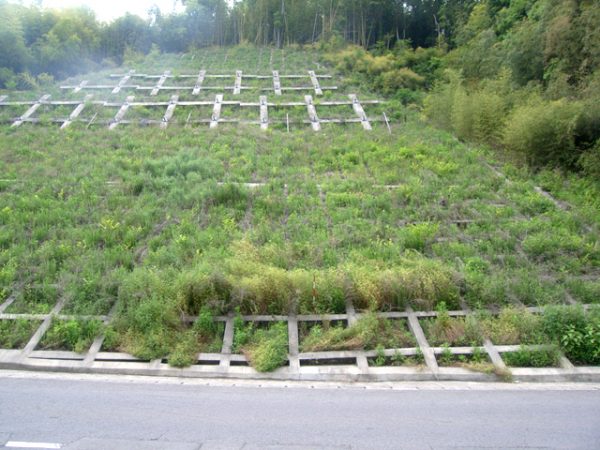
First, I’ll list the reasons why it doesn’t grow. (In no particular order)
1. Low rainfall
2. Soil types unsuitable for landscaping
3. The slope is steep
4. Lots of seeds
5. Too much fertilizer
6. Too much glue
7. No sunlight
8. Fermentation of the substrate has not progressed
9. The beast eats it all up
Is that about right?
Well, there are probably still more, but most of them should fall into these categories.
I'll explain each one individually.
1. Low rainfall
This varies quite a bit by region.
It often happens that while it’s raining heavily on that side of the mountain, it doesn’t rain at all on this side. The clouds hit the mountain and don’t make it over to this side.
When planning seed mixtures, you can control germination to some extent by adjusting the on-site conditions for the seeds.
2. Soil types unsuitable for landscaping
This is a fundamental issue, but things like bedrock and clay are just out of the question.
There used to be things like rock face greening, but I wonder how that’s going these days.
3. The slope is steep
It is often the case that seeds will not germinate if parts of the slope are too steep.
There's just nothing you can do about this. If it won't grow, it won't grow.
If you already know this, please tell the city office that nothing will grow there even if they try to plant it!
If I keep a meeting log on file, maybe I can avoid liability for defects??
For that part, mortar or similar materials are also acceptable.
4. Lots of seeds
There was a time when people used to grow as many as 10,000 stalks per square meter, and it was considered ideal to have the pasture bursting with grass.
These are the dark days when the inspector will call you out if your hair hasn't grown out in a big burst by the time of the inspection, lol.
When they all sprout at once, they quickly deplete the soil of nutrients.
Then, as winter approaches, almost all of it withers away, and it stays that way for several years.
It looks like it's growing, but it's actually dead grass lol. Eventually, it rots, and if the spot gets plenty of sunlight, the soil will start fermenting again,
Since good soil will form, there is a possibility that it will grow back. It will take a certain number of years.
5. Too much fertilizer
This results in what is commonly known as "fertilizer wilt" or "fertilizer burn."
Generally, when promoting greening, people use fast-acting fertilizers, and I think products like "All 15" are the most common.
We also use slow-release fertilizer to ensure a continuous supply of nutrients.
Even with just a small amount of fertilizer, the seeds will germinate to some extent. A moderate amount is sufficient.
To be continued tomorrow.
See you later.