Hello, everyone.
This is Enta.
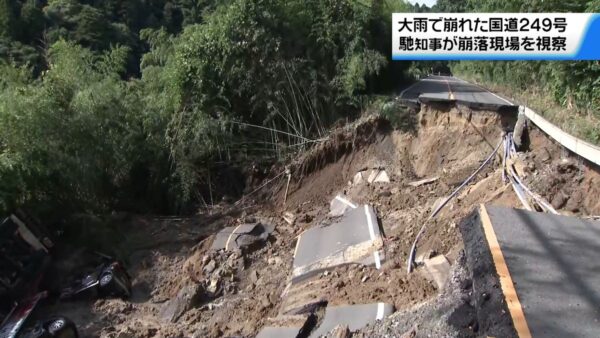
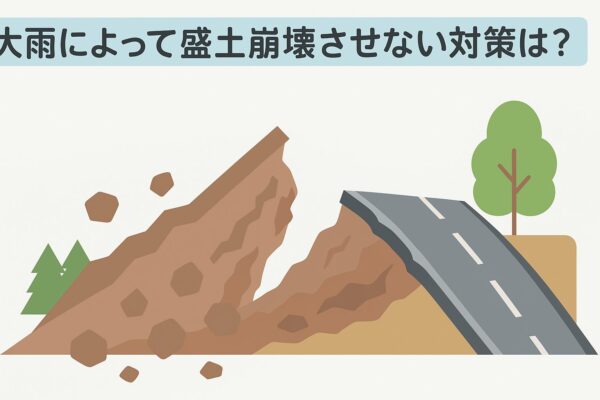
Did you see the news about National Route 249 in Ishikawa collapsing due to the heavy rain the other day?
Nakanoto Civil Engineering General Office, Shigekazu NotoDirector
"There was an earthquake, so I wonder if a crack formed in the mountain and that's why the watercourse changed."
"I wonder if the water that seeped into the embankment was one of the factors that caused the collapse."
You know that, don't you?
That it was caused by water.
But that's not certain.
That’s because we don’t know where the waterways are, and anything that can’t be quantified is considered a waste of taxpayer money.
While I find this to be a very commendable way to use tax dollars—in a sense—
The current design approach is that we can't spend money on things we understand but can't quantify or predict.
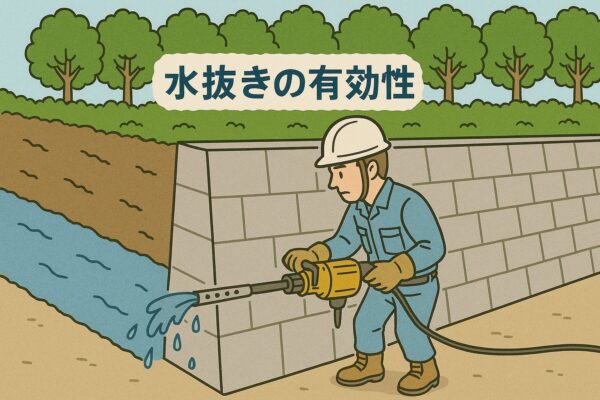
When constructing an embankment, be sure to install drainage boreholes at least 4 meters deep toward the mountain side (natural ground)!
I think this alone made a big difference in the results.
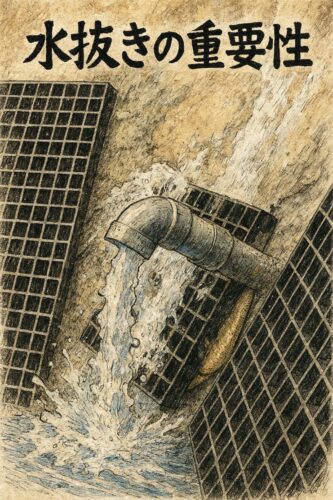
Just look at the results of the recent water drainage—it’s obvious, isn’t it?
It was because of that that it didn't collapse.
Even after the work was done, there was a heavy rain. (It rained really hard at that job site in Noto!)
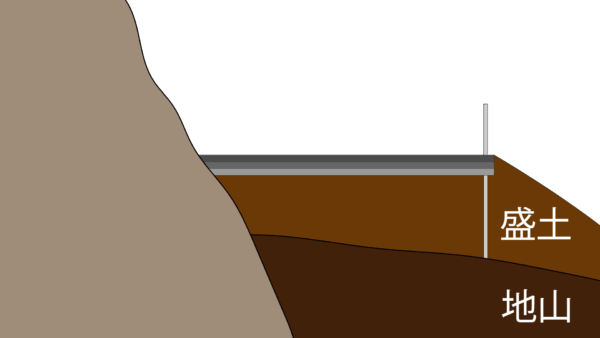
It looks like a typical road construction project, where they're building the road by adding fill to the natural ground, right?
If the ground on the left side facing the mountain is unstable, it is often necessary to install reinforcing bars or ground anchors here.
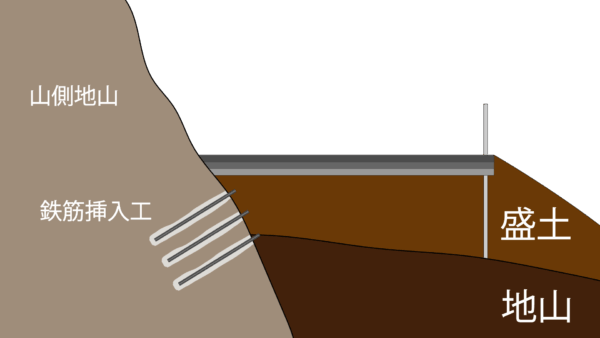
For example, something like this.
Conceptually, this is a temporary rebar insertion process.
However, when you actually cut into the mountain, water comes out.
I don't know if it was the moment the Mizumichi changed or if it was water that was already there.
However, water will definitely come out.
When it rains heavily, it’s sure to come out right where it was cut! (It was temporarily exposed.)
Under the current construction method, water from the natural ground is managed by installing a material to prevent suction (to prevent soil erosion) on the mountainside and creating a permeable layer of crushed stone to channel the water into an underground drainage ditch.
Since there are still quite a few areas that aren't damaged, I think this approach is effective both in terms of cost and installation.
However, I don't think this approach works anymore when it comes to the localized heavy rains we've been seeing lately.
So what are we going to do?
I have only one idea: draw water directly from the mountain!
This is the only option.
No matter how the mountain's waterways change or whatever else happens, if we divert water from the drainage boreholes, we can prevent the mountain from collapsing.
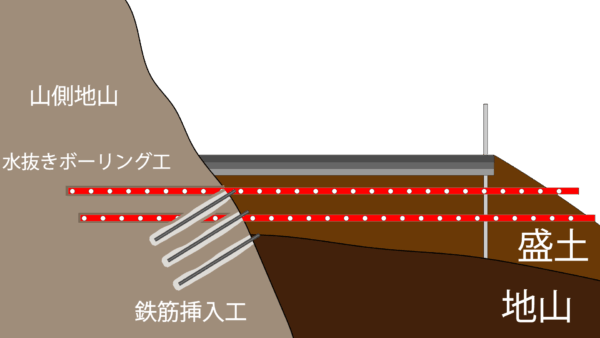
Here's what it looks like.
Actually, a drainage rock bolt would have the same effect, lol.
Reinforce the natural ground while draining the water from the back!
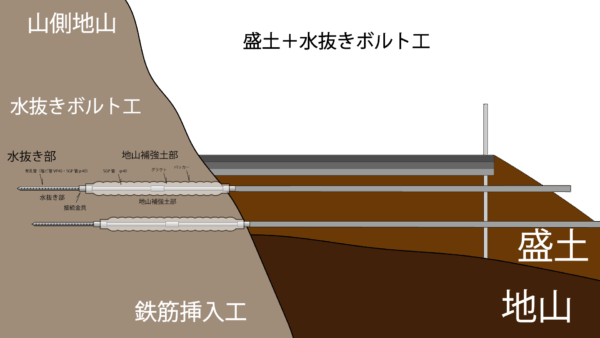
Water from the embankment is important, but the most important source is the water coming from the mountains.
When heavy rain falls, it is only natural that enormous excess pore water pressure will gush out from the natural ground.
How do we get rid of it!?
I think that's the only option.
And I wonder if that isn't the cheapest way to do it.
See you later.