Hello, everyone. This is Enta.
This isn't really related to the job site today, but for us small and medium-sized construction companies,A Matter of Life and Deathw
You've been hired.
Every year around this time, people tend to quit.
In April, new graduates and mid-career hires joined the company, and just as I was thinking, “Great, we’ve got another great group of people this year!”—
There are times when people keep quitting one after another.
Statistically speaking, the number of new applications from job seekers (those looking to change jobs) increases the most duringApril。
And when job hunting really gets underway, that’s when people tend to quit en masse.June–JulyとSeptember–OctoberThat's it.
Why June and July, you ask?
Some people will quit once they get their summer bonus. That's the reality.
"This isn't the right company for me," "I can't work with this boss," "It's not what I expected."
The new employees who joined in AprilA good milestone at the end of three months (end of June)And then I'll quit.
I'll quit again at the end of the sixth month (end of September).
This happens every year.
This is the reality of the job market.

To begin with, how many new graduates actually quit their jobs?
According to the Ministry of Health, Labor and Welfare’s “Survey on Job Turnover Among New Graduates (March Reiwa 4 Graduates),”
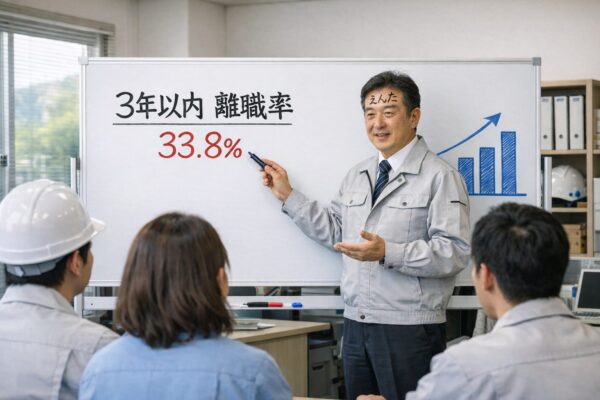
After Starting WorkTurnover Rate Within 3 YearsHere's how it looks.
- College graduate:33.8%
- High school graduate:37.9%
In other wordsOne in three people quit within three years.That's the point.
Did you know this?
In the construction industry, there is potential for even greater growth.
That's because the construction industry has such a strong image of being physically demanding, dirty, and dangerous. (It's way too strong!)
It doesn't end with hiring.
We have to make sure that the people we hire want to stay with this company.
But that’s actually something that starts even before the hiring process begins, isn’t it...
By the way, the attrition rate among new graduates within their first year (across all occupations)
The one-year attrition rate for graduates from March Reiwa 4 is as follows. (Data from the Ministry of Health, Labor and Welfare)
| Education | First-Year Turnover Rate |
|---|---|
| College graduate | 12.1% |
| Graduate of a junior college or similar institution | 19.3% |
| High school graduate | 17.9% |
| Junior high school graduate | 32.9% |
Do you know where job seekers look?
This part is super important lol
Here is a ranking of the media channels that job seekers actually use.
(Data from the Ministry of Health, Labor and Welfare’s “Employment Trends Survey” and multiple private research firms)
- Job search sites (Indeed, doda, Mynavi, etc.)
No. 1 in usage rate. It stands out for its large number of job listings and excellent search functionality. 51.21 TP3T cited “a large number of job listings” as the reason. - Recruitment Services (Career Placement Agencies)
Specializes in salary negotiations and confidential job openings. Targets mid-career professionals and candidates ready to contribute immediately. - Corporate Website and Career Site
This has a significant impact on the decision to apply.About 70 percent view itThere are also survey results that indicate this. - Hello Work
The decision rate for this recruitment channel fell to 15.11 TP3T (2023). However,The utilization rate remains at 73.41 TP3T...is high.
In other words"There are many viewers, but they aren't very influential when it comes to the final decision."That's the situation. - Job Listing Magazines and Flyers (Print Media)
60.3% is used for its convenience. However, usage among younger people is declining rapidly. - Social Media, Word of Mouth, and Acquaintances
This is becoming increasingly important during the final verification phase.
Looking at this, it seems that human movement...A Steady FlowYou can see that there is one.

Job Listings Magazine → Social Media → Blog → Website
Don't you intuitively understand this flow?
First, you might find yourself thinking, “Maybe I’ll look for a job,” after browsing job listings in magazines or on websites.
Next, I check social media to see what the atmosphere is like at this company.
Then, on the blog, we’ll take a closer look at questions like “What kind of mindset do the CEO and employees have?” and “What’s the company culture like?”
Finally, check the company's track record, size, and reliability on its website to decide whether to apply.
This,Exactly the same as a series of purchasing actionsThat's just how it is.
- Social Media = Handing Out Flyers (Spreading the Word, Raising Awareness)
- Blog = The company's culture, philosophy, and the perspectives of the CEO and employees
- A website is the company itself
Companies that are organizing their information in line with this trend, and
A company that only posts job listings on recruitment sites and does nothing else.
It goes without saying which one I'd like to apply for, right? lol
So, what should we—as small and medium-sized construction companies—do to keep up with this trend?
In my next post, I’ll write about practical hiring strategies tailored to the construction industry.
See you later.