Hello, everyone.
This is Enta.
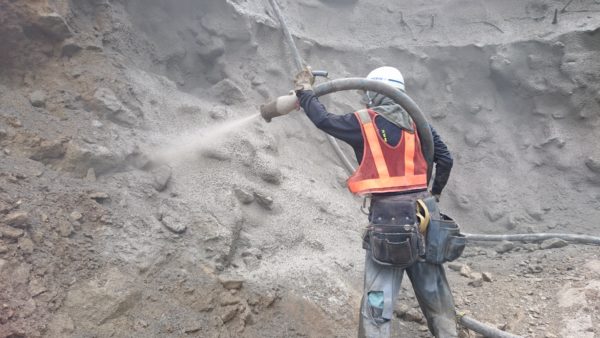
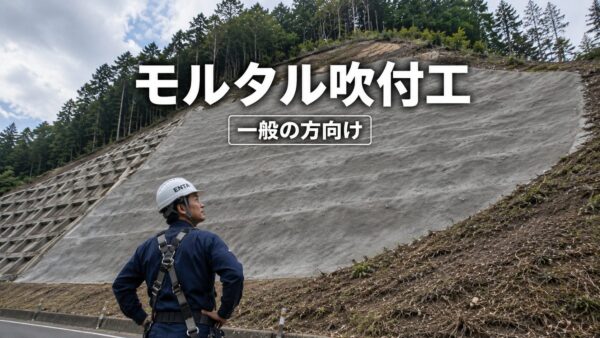
The process for sprayed mortar work begins with slope cleaning, followed by lath installation, and then sprayed mortar application.
Depending on the quantity, it takes about twice as long for formwork installers to complete the job as it does for sprayers.
There is only one way to shorten the construction period for this spray-applied method.
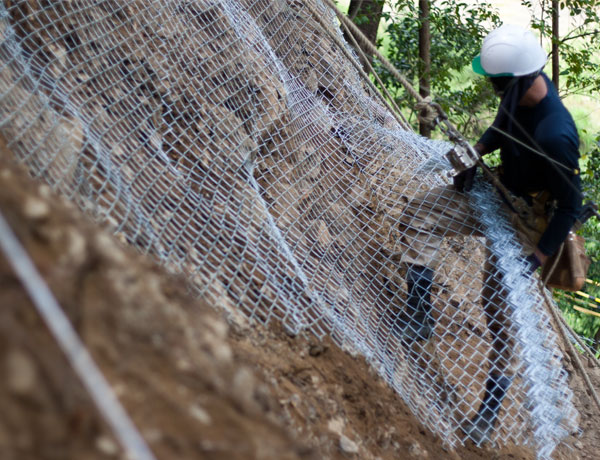
That means we won't be doing the kind of last-minute installation work described above, lol.
"Huh? What are you talking about?!"—I'm sure some of you are thinking that, but it used to be surprisingly common.
In today's terms, that would be a construction method that incorporates polypropylene fibers.
While it’s often used these days as a creative solution for crack-preventive materials, it used to be the mainstream construction method.
I think this was especially common in mountainous areas where it was difficult to install the last layer.

The website of K.F. in Osaka also has quite a bit of detailed information, so please check it out.
So, how does the installation work for fiber optics?
That's what the general contractor and government agencies often tell me.
First of all, please think about it carefully.
The backing mesh is, after all, just a mesh used to maintain continuity—it’s there to prevent sagging and to make it easier for the material to adhere, right?
We are not fundamentally seeking strength in the rebar mesh used for rebar placement.
By adding fiber, you can maintain continuity. It's the same thing.
Even so, people are still using last-minute patches as usual, lol (stuck in the past).
It's not necessarily a bad thing, but if that were eliminated, the construction schedule would be shortened significantly.
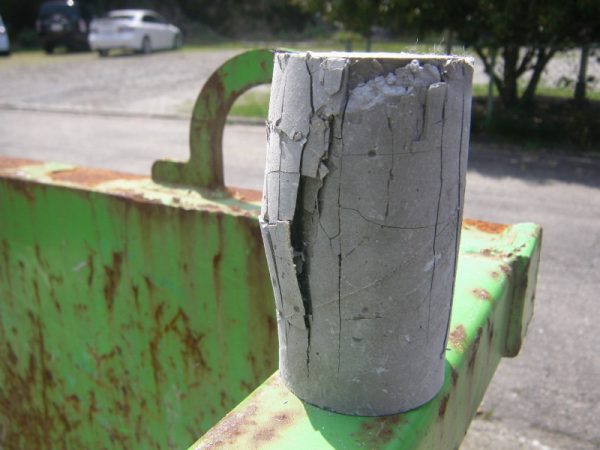
This photo shows grout with fiber added.
Don't test specimens made from high-strength cement slurry usually shatter when subjected to a compressive strength test?
That's why adding fiber dramatically increases toughness like this.
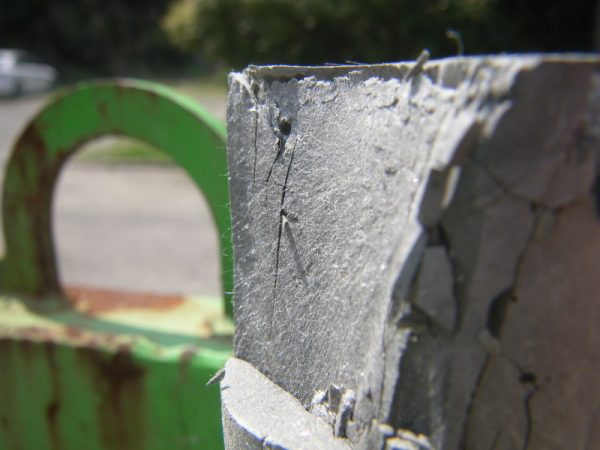
Here's a close-up.
Since this fiber is quite fine, it becomes fluffy like this.
The exact same results can be expected for both sprayed mortar and sprayed concrete.
To begin with, if you ask where this fiber reinforcement came from,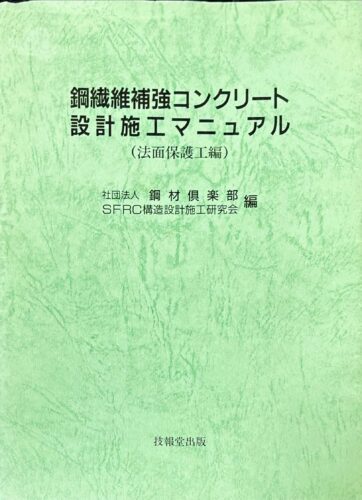
There is a book titled *Steel Fiber Reinforcement Manual* (last published in 1995).
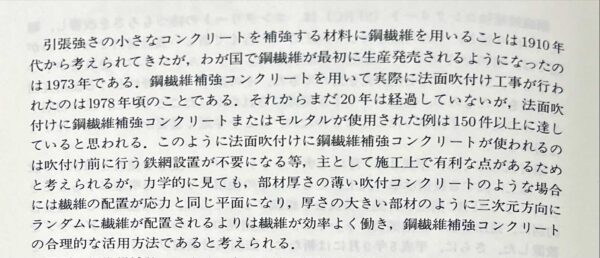
It says that spray application began around 1978.
It appears that these steel fibers have evolved and have now been replaced by polypropylene fibers.
There is solid evidence to support this, and fiber spraying has a proven track record of successful installations; in fact, one manufacturer’s fiber product was previously registered with Netis. (It may no longer be listed.)
Well, I suppose there are some aspects that are a hassle for government agencies to explain, but I think there are quite a few successful examples in each prefecture.
Furthermore, the biggest advantage of this fiber-spray method is that it eliminates the need for lath installation, allowing spraying to begin immediately.
The Best Choice for High-Priority SituationsThat's right!
We can respond immediately to job sites where you want to start spraying and covering the surface as soon as you say so.
While the use of mesh reinforcement is likely a traditional method, I actually feel that sprayed fiber reinforcement could also be considered a traditional method. (It has a history of 43 years this year.)
The rest is just a matter of how to talk to the government officials.
I think it's actually pretty common among older engineers.
See you later.
About Anti-Cracking Agents (Part 1)
About Anti-Cracking Agents (Part 2)
About Anti-Cracking Agents (Part 3)