Hello, everyone.
This is Enta.
In this article, we'll estimate the daily work volume based on the amount of cement used in sprayed mortar.
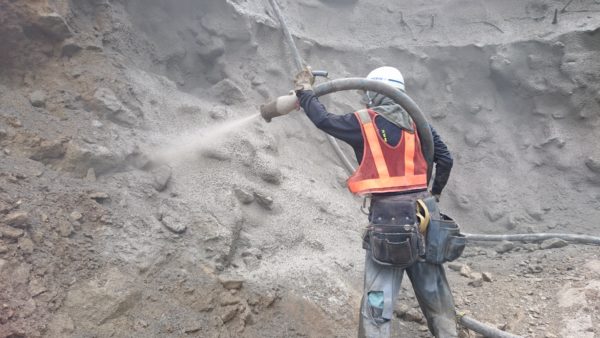
First, the following are the basic guidelines for sprayed mortar. (Cement quantity per 1,000 m²) No waste
| Area (m²) | Thickness (cm) | Amount of cement per 1 m³ (kg) | Amount of cement per bag (kg) | Number of bags (bags) |
| 1000 | 10 | 420 | 25 | 1680 |
Area × Thickness × Amount of cement per 1 m³ of mortar = Total amount of cement
Total amount of cement ÷ Weight of one bag of cement = Total number of bags of cement
Substituting the above into the equation,
1,000 m² × 10 cm × 420 = 4,200,000
Since we're converting from centimeters to meters, we divide by 100.
4,200,000 ÷ 1,000 = 42,000 kg
This is the total amount of cement (kg)
Divide this by the amount of cement per bag.
42,000 ÷ 25 = 1,680 bags
That’s how it works.
This is a basic concept in math, so please make sure to remember it.
------------------------------------------------------------------------
For example, if 100 BT (batches) are applied per day
(*Note: "Batch" refers to the number of times the material was dispensed from the spray machine's hopper and the number of times it was mixed. 100 BT × 2 bags = 200 bags used.)
1 BT = 50 kg (2 bags)
What we know is that,
Amount of cement used: 50 kg × 100 BT = 5,000 kg
Thickness: 10 cm (0.1 m)
Amount of cement per cubic meter: 420 kg
So
5,000 kg (amount of cement used) ÷ 420 kg (per 1 m³) ÷ 0.1 m (thickness) = 119.0476 m² (area)
Just split it toward the back. I started by cutting it that way.
The key is to make sure you don't mix up the units.
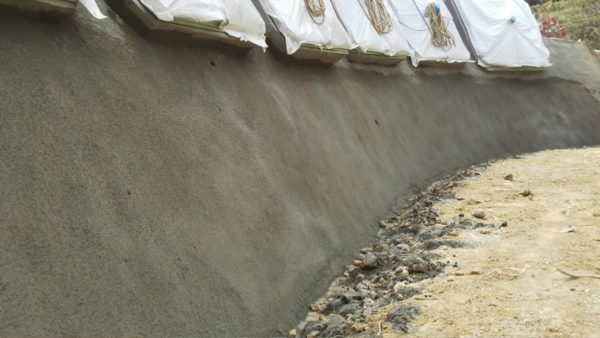
Also, if the actual quantity installed is less than what was specified in the design, it means there was a significant amount of waste.
If the plan was to cover 59.523 m² with 100 bags, but 100 bags only covered about 45 m², that would mean there was a loss of about 30%.
Causes of loss include sand, thickness, and unevenness of the subgrade.
Tomorrow, I'll try writing about legal framework calculations.
Even for a craftsman, how much work do they get done in a day?
Thinking in terms of area rather than the amount of cement used will save you money.
Try to think about how much trading volume you generated in a single day.
See you later.