Hello, everyone.
This is Enta.
This time, we'll be calculating quantities for steel framing.
I was thinking the other day—should I start by explaining how to calculate the basic amount of cement?
With that in mind, I thought I’d write about how to calculate material quantities for basic formwork this time.
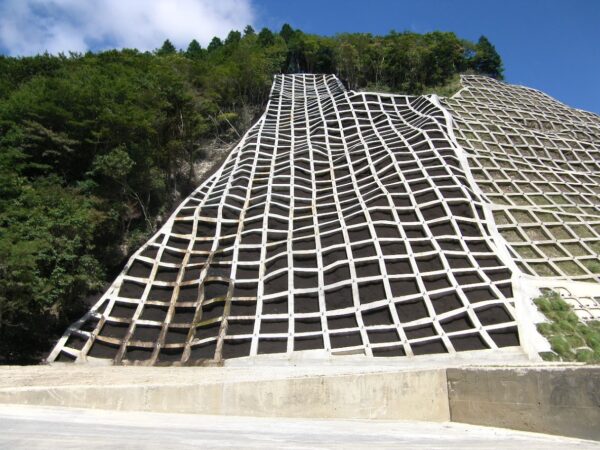
First, the basic premise
| Frame Cross-Section Dimensions (mm) | Length of Work (m) | Amount of cement per 1 m³ (kg) | Amount of cement per bag (kg) | Number of bags (bags) |
| 300 | 1000 | 420 | 25 | 1512 |
For now, I'll do the calculations based on a legal limit of □300.
Install 1,000 meters of it
Convert the legal limit of 300 to meters.
So that's 0.3, right?
So, first, we'll calculate the number of m3 units within the legal limit.
0.3 × 0.3 (cross-sectional area of the formwork) × 1,000 m (length) = 90 m³
Multiply this 90 m³ by the amount of cement per 1 m³.
90 m³ × 420 kg = 37,800 kg
That gives us the total amount of cement.
If you divide this by the amount of cement per bag, you'll get the design quantity to be used on site.
37,800 kg ÷ 25 kg = 1,512 bags
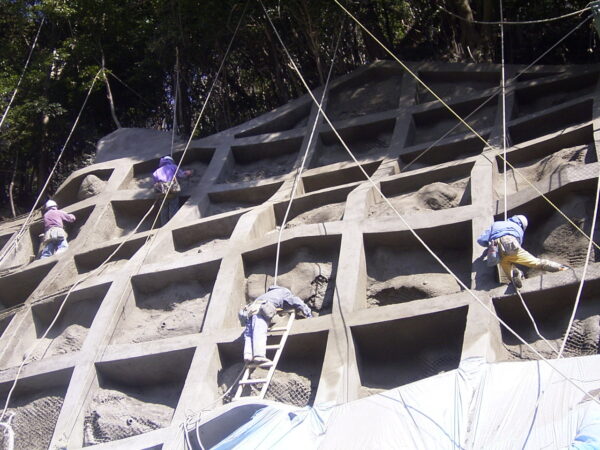
However, in areas where the natural terrain is very uneven or the sand quality is poor, we estimate a loss rate of about 20% to 40%.
Based on the conditions mentioned earlier: 1,512 kg × 1.2% surcharge = 1,815 bags
Please adjust your approach according to the conditions on site.
It's a backward calculation.
Assuming that 100 BT was applied on-site,
1 BT = 50 kg (2 bags)
What we know is that,
Amount of cement used: 50 kg × 100 BT = 5,000 kg
Frame Size: 300 mm (0.3 m)
Amount of cement per cubic meter: 420 kg
5,000 kg (amount of cement used) ÷ 420 (amount of cement per 1 m³) ÷ 0.3 (vertical dimension of the retaining wall) ÷ 0.3 (horizontal dimension of the retaining wall) = 132.275 m (length of the retaining wall)
That's how it works.
As I mentioned the other day, if progress is behind schedule, it means the projected losses are higher than expected.
For example, a sprayed concrete formwork system with a □300 grid for 1,000 meters
Approximately 20,000 yen per meter at market rates
So, 1,000 m × 20,000 yen/m = 20,000,000 yen for the construction work (this is strictly for labor only).
If 132 meters are constructed, the daily output for that day would be 132 m × 20,000 yen/m = 2,640,000 yen.
That's how it works.
The amount remaining after subtracting labor and material costs from this figure is the profit.
By always keeping costs in mind during construction, you’ll come to understand many things.
See you later.
Calculating Reinforcement for Formwork (Part 3) | Formwork Cross-Beam Reinforcement