Hello, everyone.
This is Enta.
I kept adding to it as I looked up various things, and it ended up getting really long...
Next time, give me a call when you have some free time lol
As I was writing this, I kept thinking, “This is taking forever!” lol
Since this might end up being a bit rambling, just take it as a joke this time.
Also, since it seems that ordinary readers are reading my work quite often these days, I’m making an effort to write in a way that’s easy for them to understand, which is why I sometimes use a roundabout style of writing.
Debate on Slope Stability in the Context of Deforestation and Mega-Solar Development
When I look at the news or social media,
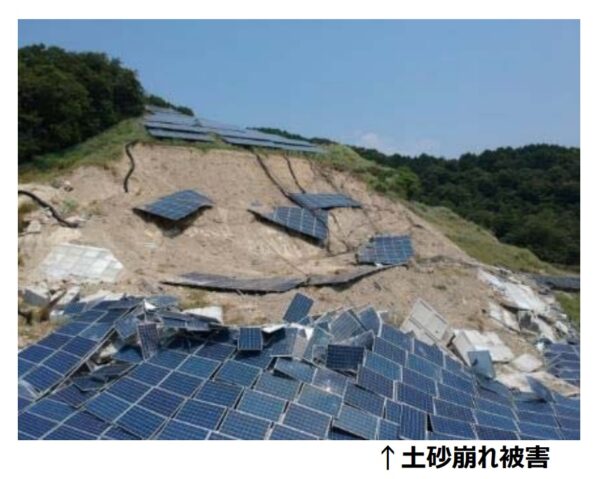
I really do see a lot of critical comments like, “A landslide happened because they cleared the mountain to build a mega-solar plant,” or “The mountain is collapsing because they’re cutting down trees and destroying the natural forest.”
Generally speaking, it seems the common perception is that when trees disappear, the mountains lose their ability to retain water, and the ground can no longer support the water, causing it to collapse.
It’s true—if you were shown footage of solar panels that had been completely destroyed after a torrential downpour, anyone would think, “See, it’s because we cut down the forest.”
However, when we slope engineers take a serious, close look at this issue from the perspective of civil engineering and actual design practice, we can clearly see mechanical contradictions and hydrological factors that cannot be explained by mere emotional “forest conservation arguments” alone.
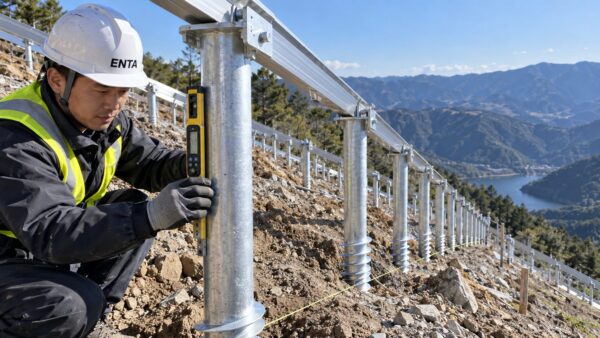
At actual job sites, large metal screw piles are driven into slopes at very close intervals to secure the mounting structures for the solar panels.
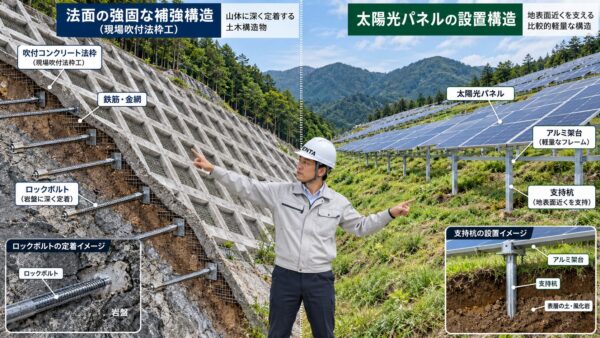
This construction method is actually very similar, from a structural and mechanical standpoint, to the "rebar insertion method" (such as rock bolting) that we routinely use on-site to enhance slope stability, isn't it?
From a purely theoretical engineering perspective, the shear strength and friction on the slope are actually higher than they were when the trees were still there, so the safety factor for the slope is positive rather than negative.
Basically, I just find myself thinking, "It's reinforced, right?" lol
Despite this, why are there still a constant stream of reports of landslides caused by heavy rain at actual mega-solar construction sites?
Did it collapse because the tree was cut down, or was there another reason?
In this post, after explaining the mechanical reinforcement mechanisms that screw piles provide to slopes, I thought I’d take an objective look—based on engineering evidence—at the hydrological risk factors that can instantly and completely negate those reinforcement effects, as well as the importance of drainage planning in practical applications. lol
I saw some news about solar energy and it suddenly piqued my curiosity, so I ended up asking the AI questions for an entire hour.
After discussing various things, we ultimately concluded that we didn’t know, but for now, I’ll write about the process as well.
Mechanisms of Mechanical Reinforcement of Natural Ground Associated with Screw Pile Installation
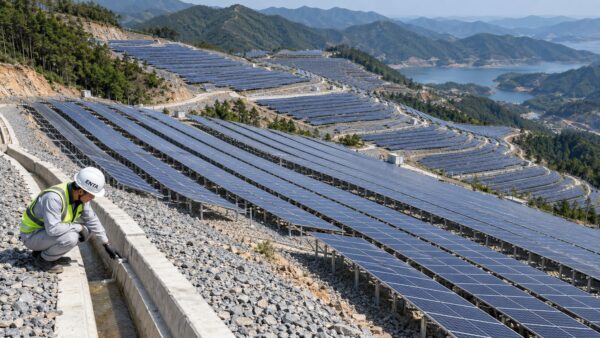
At mega-solar sites, screw piles—which consist of steel pipes with spiral blades attached to their tips—are widely used as foundations for mounting structures.
A review of the specifications for piles commonly used in general reveals that the standard specifications are an outer pipe diameter of approximately 70 mm to 76 mm and a length of approximately 1.5 m to 3.0 m.
A key feature of these screw piles is that they are driven into slopes to a depth of approximately 1.5 to 3.0 meters and are arranged in a regular pattern with an extremely dense spacing—typically around 1.7 to 2.5 meters—in most practical design applications.
When you see these layout dimensions and density, I bet many of you will recognize them, right?
That's right, that's it!!
There are surprisingly many similarities between the design standards for “rebar insertion work”—a method commonly used to prevent surface collapses on slopes—and what we’re actually doing lol.
We've done this kind of work—installing these screw piles on slopes—about twice in the past, so I know exactly what you mean.
In the “Guidelines for Road Earthworks—Slope Construction and Slope Stabilization,” if we examine the section on “Empirical Methods” for the rebar insertion method, it is described as a design method that achieves overall slope stability by densely arranging reinforcement elements—generally 1.5 m to 2.0 m in length—across the entire slope, thereby integrating the soil mass above the anticipated slip line with the reinforcement elements.
When evaluating slope stability mathematically, the “soil shear strength equation”—based on Coulomb’s law, a fundamental principle of soil mechanics—serves as the foundation for all calculations.
τ = c + σ tan φ
In this equation, τ represents the shear strength of the soil, c represents the cohesion of the soil, σ represents the normal stress, and φ represents the angle of internal friction.
When these reinforcing bars and steel pipe piles are densely inserted in a grid pattern into the natural ground, the deformation caused by the slope’s tendency to slide generates intense tensile forces and shear resistance within the piles themselves.
Consequently, from a mathematical standpoint, we can consider that the pseudo-cohesion (c) of the soil has increased dramatically. (Strictly speaking, in terms of the slope.)
By neatly arranging piles in a regular pattern to firmly grip the surrounding soil, the entire slope can be transformed into a single, robust concrete structure—a phenomenon commonly known as “pseudo-retaining wall (reinforced soil mass).”
Furthermore, the mounting structures installed on the slope and the numerous solar panels arranged on them have a certain degree of continuity and considerable dead weight (up to about 20 kg/m²).
From the perspective of soil mechanics, placing an appropriate amount of weight at the top of a slope directly increases the vertical stress (σ) on the soil.
As a result, the force pressing the soil particles together may increase, potentially acting like a "compacted fill"—a phenomenon known as the "P-effect"—that enhances frictional resistance!?
Thus, based solely on the “design calculation” figures—such as pile driving density, member pull-out strength, shear strength—as found in “design calculation reports”—it seems to follow a surprisingly coherent and logical line of reasoning: rather than having a negative impact on the natural ground, the construction of mega-solar plants actually provides a mechanical reinforcement effect (a positive impact).
Well, when it's windy, the wind load does tend to pull upward (upward pull), lol.
The Problem of Slip Surfaces and Structural Stiffness That Nullify the Calculated Reinforcement Effect
Why does a slope—which, in theory, “should be stronger and act as a makeshift retaining wall than it did when trees were growing there”—slide down so easily in reality?
The first reason lies in the relationship between “where the slip surface is assumed to be” and “the length of the pile.”
As someone who works in the field, I'll be honest here, lol
When you look at the design drawings and calculation reports for rebar installation, the slope is neatly divided into “moving soil masses” and “stationary soil masses,” and the calculations show that the reinforcement penetrates the slip surface and is firmly anchored to the stable soil behind it.
Looking at this, it’s easy to imagine that there’s a clear boundary underground, with hard bedrock lying just below it, isn’t it?
However, that's not how things actually are on the ground.
In most cases, the rebar is embedded in soil of similar composition from top to bottom.
Even if you dig, there isn’t a line drawn saying, “The ground below this point is stable,” and to be honest, no one knows where the slip surface is.
So, what exactly are "moving soil masses" and "stationary soil masses" in design terms? The concept is to draw a slip line in calculations based on the assumption that "sliding will occur here," and then ensure the required anchorage length in the area behind that line.
It’s not that the ground is physically separated; rather, we’re checking to see if the length of the reinforcement is sufficient relative to the assumed slip line.
This is the key difference between this and a mega-solar plant.
Reinforcement bar installers determine the length by first establishing at least a “projected slip line” and then verifying through calculation that the anchorage length extends beyond that line.
On the other hand, the length of screw piles used in mega-solar projects is primarily determined by their ability to withstand the weight of the panels and the pull and push forces caused by wind; in most cases, it appears that their length has not been evaluated with regard to potential slope slippage. (Or, conversely, are they actually designed with that in mind?)
As we saw earlier, screw piles typically range in length from about 1.5 meters to 3.0 meters.
In surface landslides, which frequently occur in Japan's mountain forests, the slip surface is typically located approximately 2 to 3 meters below the ground surface, and in some cases, as deep as about 5 meters.
What would happen if the actual slippage occurred at a depth of 2.5 meters below the ground surface, but the piles had only been driven 2.0 meters deep?
Since the pile is simply embedded in a solid block of soil, “the screw pile, the aluminum mounting frame above it, and the solar panels—all of them, together with the block of soil—will slide down” the slope as a single unit.
As long as the length of the portion extending beyond the sliding surface is zero, no matter how neatly and evenly spaced the pile heads may be, the pinning effect—which holds the natural ground in place—simply cannot take effect.
Of course, even for a rebar installer, the same thing can happen if the actual slip surface differs from the anticipated slip line.
However, I do think there’s a big difference in whether or not you’re considering the length based on your assumptions.
Furthermore, differences in the “rigidity” (stiffness and strength) of the structure itself also have a significant impact.
On slopes where full-scale rebar installation is being carried out, the work is almost never limited to simply placing the rebar.
In general, slopes are secured by connecting "on-site sprayed concrete formwork" or "load-bearing plates" to apply pressure across the entire surface of the slope and restrain it.
This prevents soil and other materials from spilling out due to rain or soil pressure, right?
On the other hand, what about the mounting structures for mega-solar plants?
That structure is primarily a lightweight frame made of aluminum or thin-walled galvanized steel, designed solely to support wind loads (such as wind pressure from typhoons) and the weight of the panels themselves. It was not designed from the outset to have the rigidity necessary to absorb civil engineering “earth pressure” (the force exerted by soil pressing in from the sides) across its entire surface and to stabilize the slope.
Apparently, it's about 20 kg per square meter at most.
Therefore, even the slightest uneven soil pressure on a portion of the slope could easily cause the mounting frame to twist or the bolted joints to break, resulting in deformation.
If the frame becomes deformed even once, the continuity that held the piles together to form a “pseudo-retaining wall” will be lost.
As a result, the exposed soil in the gaps between the piles (spaced 1.7 to 2.5 meters apart) loses its support and begins to collapse individually, causing it to seep through the spaces between the piles and flow out along with the muddy water.
Considering the Water Retention Function of Forests and Rainwater Management Using Solar Panels
When discussing the mechanisms of slope failure, the presence of “water (hydrological mechanisms)” is the most decisive factor—and the one with the greatest destructive power—even more so than these mechanical strength balances.
As a fundamental principle of soil mechanics, soil exhibits its highest strength when it is dry—that is, when it contains no water—or when it has been properly drained.
Conversely, when excess water penetrates the soil and causes it to become saturated, the strength of the slope decreases dramatically—in the blink of an eye.
Regarding Coulomb's law, which I mentioned earlier, when water enters the soil, this involves introducing the concept of effective stress.
The formula for shear strength (τ) that takes water pressure into account is as follows. (From a textbook, lol)
τ = c + (σ − u) tanφ
The "u" that appears in this equation is the "pore water pressure," which is the main factor in this problem.
This is the pressure exerted by the water present in the spaces between soil particles as it tries to expand outward.

*It's soil particles, not potatoes!*
As the equation shows, when large amounts of rainwater seep into the ground and the pore water pressure (u) rises, the value of the effective vertical stress (σ – u)—which is a subtraction—decreases progressively.
A decrease in vertical stress means that the interlock between soil particles weakens, resulting in a loss of frictional resistance.
When pore water pressure rises to its limit due to events such as sudden, intense downpours, the weight from above (σ) and the water pressure (u) cancel each other out, resulting in a net value approaching zero; the soil particles completely separate, and the frictional force becomes zero.
In other words, the entire slope turns into a liquid (thick, muddy water) and starts sliding down.
It is often said that the “water conservation function” (natural dam effect) of forested areas helps prevent a sudden rise in pore water pressure.
According to a report from the Forestry Agency, the layer of leaf mold on the forest floor and the fine roots that spread throughout the soil serve to temporarily store rainwater and allow it to seep into the ground “gradually over time.”
Since the development of mega-solar projects involves the use of heavy machinery, as well as tree felling and “root removal” (pulling out the roots), it is likely that this function will at least be weakened.
So, what happens when solar panels are installed there?
I often see people say, “Because the panels repel rain, water can’t seep into the ground, which is dangerous,” but I think we need to take a step back and consider this more objectively.
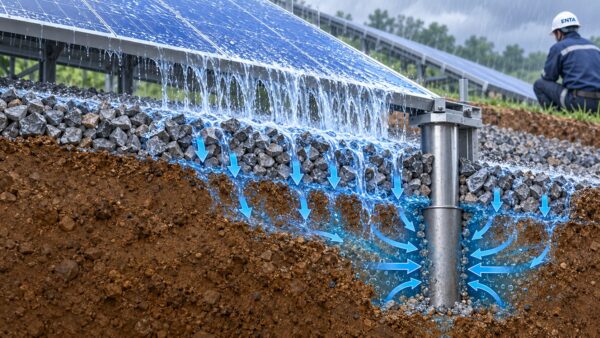
First of all, just because rain doesn’t hit the panels directly from above doesn’t change the total amount of rain falling on the slope. Rain that hits the panels runs off the eaves (the lower edge) onto the ground, where it eventually seeps into the soil.
From the perspective of soil mechanics, soil is stronger when water does not seep into it, and it becomes weaker when water does seep in.
The fact that the area under the panel doesn't get wet easily could be considered a positive aspect, if anything.
Next, the issue of “water pooling at the eaves.”
It’s true that rainwater collects along the bottom edge of the panels. However, at many power plants, crushed stone is laid beneath the panels to catch and disperse any water that falls.
Since crushed stone allows water to pass through much more easily than soil, it’s unlikely that water would get trapped here.
Ultimately, it is the properties of the soil beneath the crushed stone that determine how much water seeps into the ground.
This remains the same whether there are trees or rows of panels.
If the distribution is working properly, the total amount of water across the entire slope should not differ significantly from when it was forested.
Even forest leaf mold has a limit to the amount of rain it can temporarily absorb.
In other words, I honestly don't think the explanation that "the water concentrates because of the panels, causing the structure to collapse all at once" is sufficient on its own.
So what is the cause?
My personal view is that whether a slope slides or not depends not only on the rain that falls in that specific location, but also—and perhaps to a greater extent—on the rise in groundwater flowing in from a wider area further upstream.
This is something that could happen regardless of whether there are solar panels or not, and regardless of whether it's a forest or not.
Actually, the same can be said for the slopes we usually work on.
Slopes constructed using a combination of rebar insertion, sprayed formwork, and sprayed mortar are covered with concrete or mortar on the surface, making them even more impermeable to water than panels.
Surface water collects in the drainage channels of the edging and small steps and flows away.
To prevent the structure from collapsing, we control the groundwater by installing drainage pipes (perforated pipes) to draw out the water or by constructing drainage facilities.
When you think about it that way, it’s not that “it’s dangerous because the surface is covered with panels,” but rather,
I think one could argue that the real issue is whether “sufficient consideration and measures were taken regarding how to manage groundwater, regardless of whether it reaches the surface.”
Of course, we cannot say there are no effects at all—such as localized erosion of the surface caused by water pooling under the eaves, or the loss of surface reinforcement provided by roots due to tree removal.
However, to be honest, it’s impossible to make a blanket statement about the extent to which this contributes to erosion, as it depends on the topography, geology, and drainage plans at each specific site.
The point is that, as just one possibility among others, we need to consider the issue from the perspective of “how groundwater treatment was planned” rather than focusing solely on “the panels or the logging itself.”
The Limits of the "Forests-Are-All-You-Need" Theory and Where the Problem Ultimately Lies
Having thought this through, another point has come to mind. While there’s a strong perception in society that “leaving the forest as it is ensures safety,” the fact is that this isn’t something we can say with absolute certainty.
While opposition campaigns and online sources sometimes portray forests’ disaster-prevention capabilities as if they were absolute, civil engineering design treats them quite differently.
When performing slope stability analyses (such as arc-slide analyses), it is generally not common practice to factor in “the force with which tree roots anchor the soil” or “the water-retention capacity of leaf mold” as values that increase the safety factor (Fs).
This is because the type of tree, its age, the depth of its roots, and the condition of the leaf mold vary from place to place, making it difficult to provide a guaranteed figure.
In fact, even in forested areas that have not been managed by humans, surface and deep landslides commonly occur when record-breaking torrential rains fall.
So, what about slopes where screw piles have been driven? As I mentioned in the previous chapter, it’s merely a matter of them “potentially acting as reinforcement, according to calculations.”
However, this assumes that the pile extends deeper than the anticipated slip surface and that the water within the soil has been properly treated.
To be honest, since the length of the piles for mega-solar plants isn’t determined with slope slippage in mind to begin with, it’s impossible to know for each site whether this requirement is actually met.
As for the issue with the water, the explanation—that the structure collapsed because rainwater pooled due to the solar panels—just didn’t sit right with me the more I thought about it.
As long as the total amount of rainfall remains the same, if it is dispersed by the crushed stone, the impact on the slope as a whole should not differ significantly from when it was forested.
More than that, I think the way groundwater—which flows in from a wide area upstream—is treated likely has a greater impact.
Even for the slopes we construct, when covering the surface with shotcrete or slope reinforcement, it is standard practice to plan drainage measures—such as drainage pipes (perforated pipes) or drainage systems—to allow groundwater to escape as part of the overall design.
I think the same applies to mega-solar projects: how groundwater is managed is more important than what is used to cover the surface.
I’ve also seen reports indicating that, at mega-solar sites in mountainous areas, there are cases where such groundwater assessments are lacking or where the capacity of retention ponds designed to temporarily store rainwater is insufficient.
However, since conditions vary from site to site, this does not apply to all solar panels.
In conclusion, my view this time is that it’s not as simple as saying, “The mountains are collapsing because the forests were cleared to install solar panels.”
That said, I can’t definitively say that “solar panels are safe because they reinforce the slope.” (Though I do get the feeling they’re on the safer side.)
To be honest, the only way to determine the cause of the collapse—whether it was due to logging, the length of the piles, groundwater management, or the geology and topography of the slope itself—is to examine each site individually.
The "conclusion that I don't know" I mentioned at the beginning is exactly what this is lol
It's like, "Don't you get it?!" lol
Rather than emotional environmentalism or the extreme view that “all solar power is bad,” the question is: How does groundwater flow on that slope, and what kind of drainage plan was in place to address that?
As a slope engineer, I think it’s important to first examine that issue from a technical perspective.
In simple terms, if you gradually lengthen the pile in certain sections at a fixed pitch, you can definitely make it stronger.
Maybe make the diameter a little smaller and force the grout in, or something like that.
This means that if we extend the piles from 2 to 3 meters to 5 meters, we can also address slope stability issues.
Also, it would be even better if you added some drainage in certain areas.
If we go that far, solar panels will be less likely to come under criticism, but since those who criticize them on principle assume that they cause environmental damage, that doesn't really matter.
See you later.