Hello, everyone.
This is Enta.
Things are starting to get a little busy!
It feels a little daunting, but let's just take it one step at a time!

But that's beside the point.
Installation of Main and Auxiliary Anchors for Sheet Pile Frames
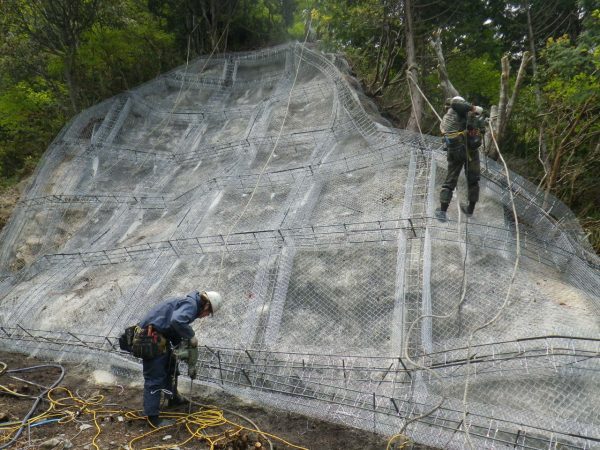
When assembling sheet pile frames, you drive in the main anchors and auxiliary anchors, right?
I'm sure you're generally familiar with the meaning of "main anchor" and "secondary anchor."
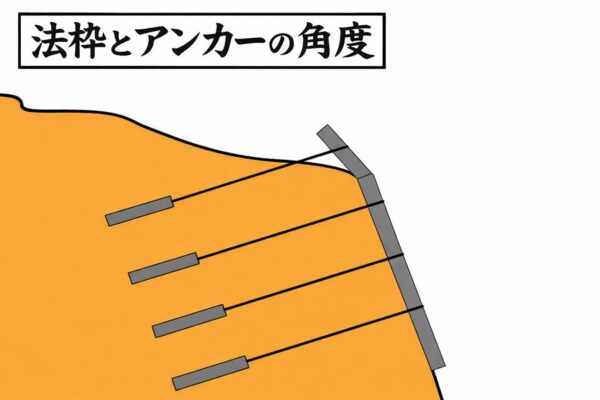
This is what is commonly known as a slip-resistant anchor.
The frame is being assembled downwardMain anchor to prevent shiftingThat's it.
This applies only to the rebar prior to spraying; it has no effect after spraying.
That's because we don't know how much force is being applied to this anchor after the spray-applied frame is completed.
This is strictly just a misalignment stop.
However, for the main anchor, we calculate the shear stress to a certain extent during the design phase and assess whether it can accommodate any displacement.
The auxiliary anchors driven into the side frame are also,A device that prevents the side rails from sagging due to spray application...and it has no strength.
(The statement that it lacks strength is purely theoretical.)
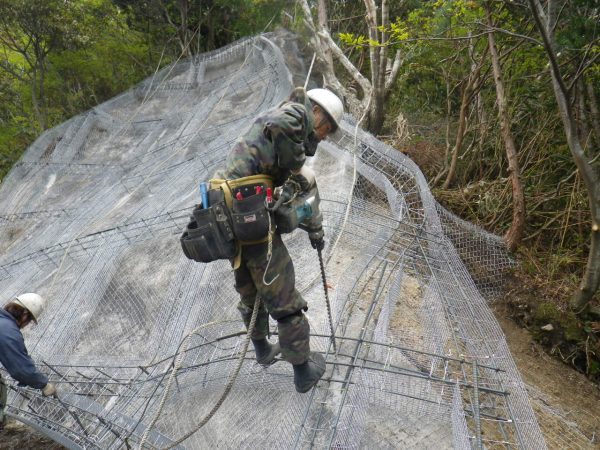
On drawings, you often see notations like “exactly at the center of the intersection,” “at the right edge of the intersection,” or “at the left edge of the intersection.”
To put it simply, as long as you hit the ball somewhere at the intersection, it's fine, so there's no need to worry about it.
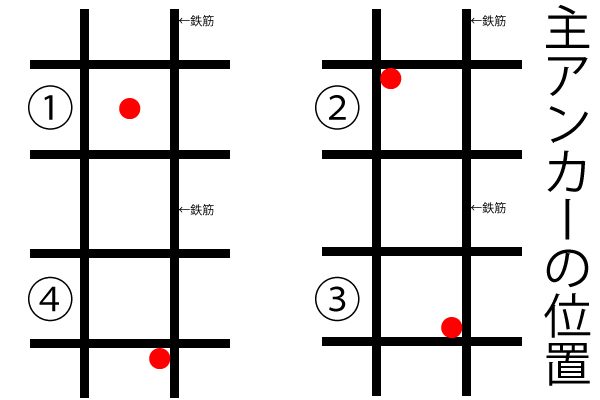
Please look at this diagram. It shows the locations where anchors are to be installed at the intersections of the rebar in the formwork.
① Right in the middle
② Top left
③ Bottom right
④ Out of range
For example, even if the drawing specifies location ①, pouring the concrete at locations ② or ③ would allow the formwork to bear the load from the start.
There are quite a few supervisors who insist, “You should build exactly according to the blueprints!” but it’s preferable to do either option ② or ③ whenever possible.
And thenStaying UnitedPlease do this. It will definitely prevent slippage.
What do you think of No. 4?
Personally, I'm fine with it.
This is because there may be cases where pouring cannot be done at locations ② or ③.
In cases like that, option ④ is also acceptable. There aren't any specific rules. However, there is a rule that requires pouring concrete at the intersections.
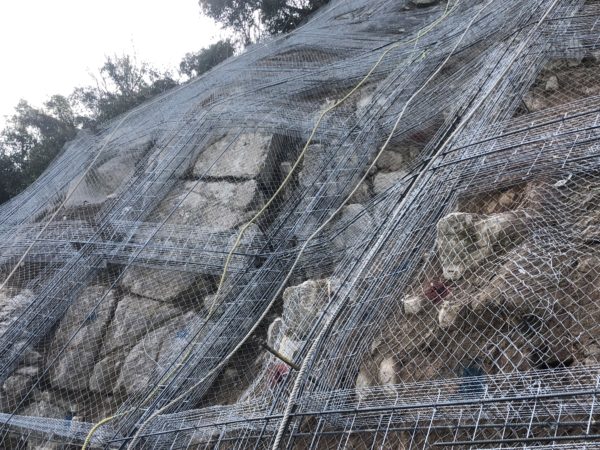
Back in the day, since prices weren't based on market rates, there was a time when having more connection points than shown in the photos of incoming materials was a problem.
The same goes for the auxiliary anchors on the side rails.
For this type of sheet pile frame, the market unit price is based on a configuration of 4 main anchors and 6 auxiliary anchors at each intersection (subject to change depending on the frame size),
Since market unit prices apply, a main anchor is required.
If you absolutely cannot place the stake at the intersection, be sure to place it at a suitable location nearby.
WhyAre we going to drive in the main anchor?Once you understand that, you can apply it in countless ways.
The same applies when cutting out boxes at intersections, such as for voids. (Construction using ground anchors or rebar insertion methods in combination)
If the ball is too big to fit, it’s possible that it might go out of bounds.
Since this is a construction site, there are many instances where we can’t build exactly according to the blueprints.
It is important to adapt as needed during construction to prevent defects.
I think the criteria for evaluation are based on how we handled the situation.
See you later.