Hello, everyone.
This is Enta.
The Iwakura City Summer Festival has been going on for the past few days.
After work, I help out with making yakisoba (though I don't actually do anything here).
Oh, I've turned into the shooting gallery guy. (The main character is the shooting gallery guy.)
I'm helping out as part of an Iwakura City project.
For some reason, I find festivals more fun when I'm on the organizing side than when I'm just participating.
That's because you can really feel the joy of both the children and the adults.
Just watching this person have fun somehow makes me happy, doesn't it?
But man, the sense of exhaustion after it's over is off the charts, lol.

But that's beside the point.
If the ground isn't stable...
You often hear the term “soil bearing capacity” on construction sites, don’t you?
Like, it sinks because the ground isn't stable enough.
This is because, in ground anchor construction, if there is no bearing capacity when the anchors are tensioned, the structures subjected to compression (such as retaining frames, compression plates, and gravity retaining walls)
...sinks.
Even though I say it “sinks,” we’re only talking about a few centimeters, but depending on the situation, problems like tilting may occur.
This is a basic concept, but the solution to sinking is simple: you just need to increase the bearing area.
However, when the pressure-bearing structures are already determined at the design stage, this is not an easy task.
Since the concept behind a frame is to support the entire structure, a slight sagging is not a problem as long as it is not an independent cross-shaped frame.
Gravity retaining walls, for example, hardly ever shift (it would be a huge problem if they moved here, lol).
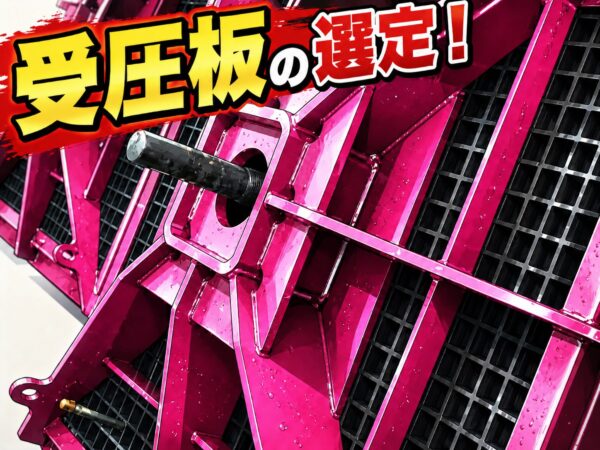
The biggest problem is the pressure plate.
There are various types of bearing plates, but all of them will inevitably sink if there is no bearing capacity of the ground.
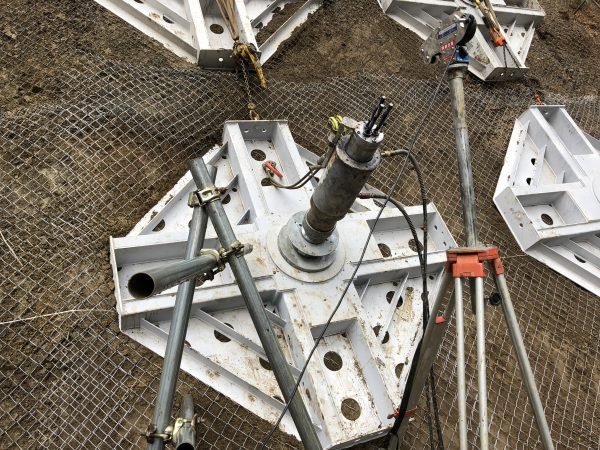
Please take a look at the photo above.
As you can see from the rebar mesh around it, the ground at this site is in very poor condition, and it has subsided by about 3 to 5 cm.
There is clearly an insufficient contact area.
However, I guess I'll just have to accept this as it is.
That's because this is the design. Changes can't be made at the structural design stage—unless something extraordinary happens.
Or rather, you should assume that it’s virtually impossible to modify the load-bearing plate (load-bearing structure).
It is common to switch from formwork to pressure plates before construction begins. (The reason is to shorten the construction schedule.)
I've never heard of changing the size of a pressure plate, nor have I ever done it myself.
As a result, if the ground doesn't have sufficient bearing capacity, partial collapses can occur, which is quite a problem.
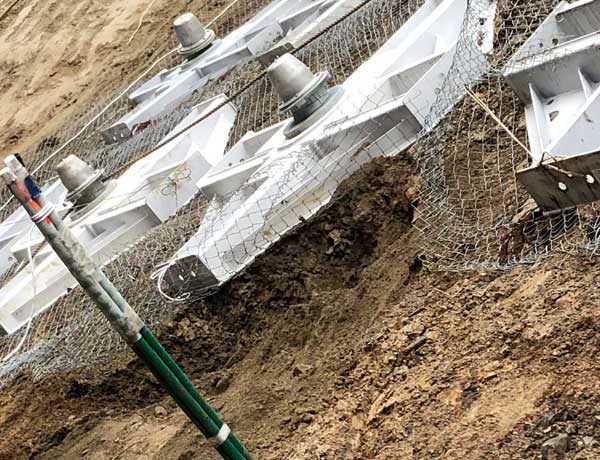
It looks like the back of the pressure plate above is about to come off.
Well, since it's compressed, it's holding up, but if it rains, it's game over in one hit lol.
In such cases, the safest approach is to fill sandbags with stabilized soil (soil mixed with a cement-based stabilizer) and stack them.
If you put them in sandbags, they’ll form a solid mass, making them less likely to collapse. The same applies when reinforcing the area around a load-bearing plate.
A load-bearing plate is installed on top of it and tensioned before the sandbags filled with stabilized soil harden.
Doing so allows the sandbags to settle into the natural ground.
As you can see, without sufficient soil bearing capacity, there’s no way to know how far it will sink.
If the pressure plate continues to sink, there is a possibility that the design anchor force will decrease significantly.
For that reason, with this type of soil, it’s safer to take as much time as possible to allow the foundation to settle properly.
And it’s probably a good idea to take set loss into account as well.
Please be very careful if it sinks too much.
See you later.