Hello, I'm Kamino, a civil engineer and government employee who writes a blog.
If you work in the construction industry, you’ve probably heard of the Construction Workers’ Retirement Fund (Kentai-kyo), right?
Since we civil servants are not enrolled in the Construction Workers' Retirement Allowance Fund, I imagine there are some people who have absolutely no idea what kind of system it is.
Once construction begins, the contractor submits payment receipts and records of work completed—so I imagine there are probably some people who just accept them without giving it much thought and file them away in their ledgers, aren’t there?
To ensure that procedures are not carried out incorrectly, this section is intended for civil engineering officials.Construction Workers' Retirement Fund SystemHere's a simple explanation.
What is the Construction Workers' Retirement Fund?
The Construction Industry Retirement Fund (Kentai-kyo) is a system designed to meet the specific needs of the construction industry,Retirement Benefit Plan for Construction WorkersThat's right! Its official name is the Construction Industry Retirement Allowance Mutual Aid System.
In fact, very few construction companies have their own retirement benefit plans. Although the use of temporary workers is prohibited, this is an industry with unstable demand and high employee turnover, so companies see little benefit in establishing individual retirement benefit plans, and few have been able to maintain the financial stability required to offer generous retirement benefits.
If you don't receive a retirement bonus, you'll find yourself struggling financially when you can no longer work, when you decide to go into business for yourself, or when you want to switch to a different industry.
For this reason, the government established a retirement benefit system for the construction industry under the “Small and Medium-Sized Enterprise Retirement Benefit Mutual Aid Act.”

Regardless of nationality, anyone working on-site—including carpenters, plasterers, scaffolders, laborers, electricians, plumbers, painters, machine operators, and on-site administrative staff—is eligible for coverage.
How the Construction Industry Retirement Fund Works
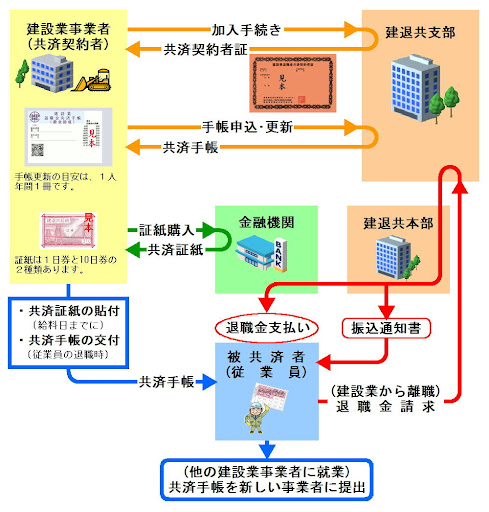
Companies enrolled in the Employees' Retirement Allowance Mutual Aid System pay "contributions" to the Employees' Retirement Allowance Mutual Aid Organization and receive "stamps" as proof of payment. In other words, they purchase these stamps.
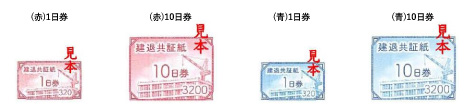
Each month, the company affixes stamps to the employee’s mutual aid handbook corresponding to the number of days worked. One stamp is issued per day (worth 320 yen). *Prior to September 2021, the value was 310 yen.
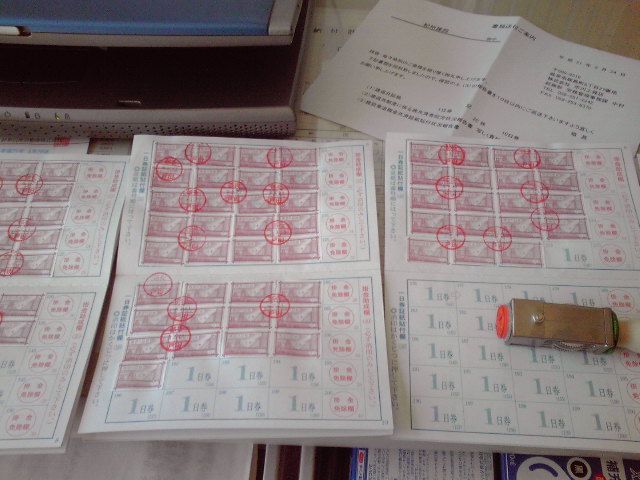
Workers should keep their mutual aid handbooks in a safe place (although they are usually entrusted to their employer), and when they retire from the construction industry, they can receive a “retirement benefit” from the mutual aid organization equal to the value of the “stamps” affixed to their handbook.
It's like making daily contributions to a mutual aid organization.
How much will I receive as a severance payment?
Now, the thing I'm most curious about is: How much will I receive in severance pay?
Here's what the quick reference chart looks like.
| Number of years | Retirement Benefits |
|---|---|
| 1 year | 24,192 yen |
| 2 years | 161,280 yen |
| 5 years | 414,087 yen |
| 10 years | 893,559 yen |
| 15 years | 1,409,319 yen |
| 20 years | 1,933,479 yen |
| 25 years | 2,474,439 yen |
| 30 years | 3,038,919 yen |
| 35 years | 3,641,031 yen |
| 40 years | 4,268,007 yen |
The longer you work, the higher your retirement benefits will be.
Since the current projected return is set at 1.3%, if you work for 40 years, your retirement benefits would be about 4.2 million yen based on a total contribution of 3.2 million yen.
Until September 2021, the yield was 3.0%, so I would have received about 6 million yen after 40 years of service, but it’s dropped sharply, hasn’t it? (;´・ω・)

It is reported that the average payment for fiscal year 2020 was 909,000 yen, and the highest payment was 12,647,000 yen.
Benefits of the Construction Industry Retirement Fund
I’ll also briefly explain the benefits.
- Paid Safely and Securely
- The longer you work, the more you benefit (the higher the investment return)
- I could continue working at another company
- Earns bonus points in the Business Performance Review
From an individual employee’s perspective, there are nothing but benefits—the company covers the contributions, and you receive a lump sum when you retire!
Paid Safely and Securely
Since this system is based on national law, you can be sure that you will receive payment.
That's what matters most.

It’s a little worrisome when it comes to severance pay based on a private company’s employment regulations, isn’t it?
The longer you work, the more you benefit (the higher the investment return)
The longer you work, the more you benefit. From the industry’s perspective, this makes it easier for workers to stay on the job.
I could continue working at another company
Since the Construction Workers' Retirement Fund is not specific to any single company, if you change jobs to a company that participates in the fund, your total years of service will be counted on a full-year basis.
Suppose you worked at Company A for 3 years, Company B for 2 years, and Company C for 5 years—and assuming all three companies were enrolled in the Construction Workers’ Retirement Allowance System—your total service time would be counted as 10 years. Since the return on your retirement benefits increases with the number of years of service, that’s certainly a plus.
From the company's perspective, this means it will be easier for workers to switch jobs.
Earns bonus points in the Business Performance Review
In the business qualification review required to participate in public works bids, companies that are enrolled in the Construction Workers Retirement Allowance System receive bonus points. This seems to be one of the benefits.
I’m not very familiar with the Business Management Review (often called “Yokukei”), so I can’t really say anything about it (;´・ω・)
What the supervisor checks
Now, I will explain the points that civil servants (supervisors or contract officers) must verify.
It also affects the project's performance.
- Retirement benefits are mandatory in public works projects
- Receive a premium payment receipt after signing the contract
- Check the signs at the construction site
- Review the Report on Stamp Affixation

Well, putting aside the completely pointless question of “Why does a single government employee have to check every single severance payment from private companies?”—here’s an explanation of the job as defined by the rules.
Retirement benefits are mandatory in public works projects
When bidding on public works contracts,It is mandatory for the company to have a retirement benefit plan or to be enrolled in one.That is the case.
Most companies are enrolled in the Construction Workers' Retirement and Welfare Fund, aren't they?
There are also other options, such as the Small and Medium-Sized Enterprise Retirement Allowance Mutual Aid Association (Chutai-kyo), the Forestry Retirement Allowance Mutual Aid Association (Rin-taikyo), and your company’s own retirement allowance plan; as long as you are enrolled in one of these, you’re all set.
Receive a premium payment receipt after signing the contract
After the contract is signed, we will ask the contractor to submit a contribution receipt to confirm that they are enrolled in the Construction Workers’ Retirement Fund (or another retirement benefit plan) and have purchased the required revenue stamps.
The key points are:Are you purchasing the correct number of revenue stamps based on the contract amount?is to check that.
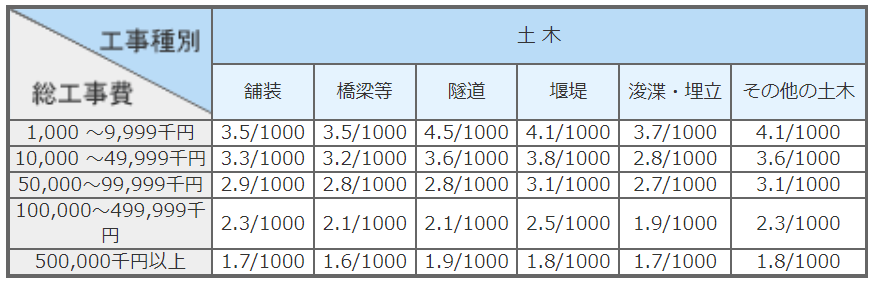
This means that for civil engineering work that does not fall under any of the applicable categories, if the contract amount is 15,000,000 yen, you must purchase revenue stamps (169 stamps) worth at least 54,000 yen, which is 0.36% of the contract amount.
This is just a rough estimate of the purchase amount, but if you haven't actually made the purchase, the government official will likely instruct you to correct it ( ゚Д゚)
We affix the purchased stamps each month based on the number of days worked by each employee, and we also affix these stamps to the work performed by subcontractors.
If the company has its own retirement benefit plan, we will ask you to submit a copy of the employment regulations or supporting documentation.
Check the signs at the construction site
↓The rules require that signs like this be posted.
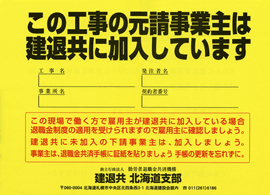
It should be right next to the construction sign. Let's check it out.
Review the Report on Stamp Affixation
We will verify in the report whether the revenue stamps have been properly affixed.
Since we purchase revenue stamps in amounts that provide a margin of safety, there should rarely be a shortage; however, if there is a shortage, please submit the payment receipt showing that you purchased additional stamps along the way. The same applies when increasing the contribution amount.
Since I'm just checking a simple summary table, I don't know for sure if they've actually pasted it.

I think it's a pointless check, but since it's the rule...
In Closing
So, I’ve put together this explanation of the Construction Workers’ Retirement Fund for civil engineers working in public works.
Although this system has absolutely nothing to do with me personally, since I’m in a supervisory role at work, it would be best for me to understand the basics.
All you workers out there, keep in mind that “your mutual aid handbook is absolutely essential!” and make sure your company doesn’t lose it ( ゚Д゚) lol
Well, that's all for today.
See you later (*’ω’*)ノ