

Hello, everyone.
This is Enta.
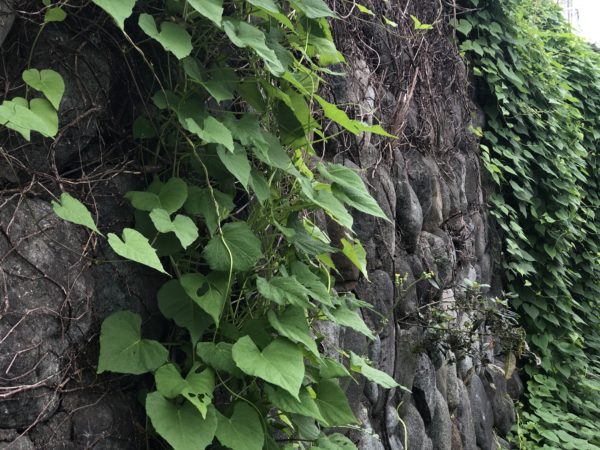
Due to the increase in private construction projects over the past few years, I often find myself conducting surveys of stone walls and narrow slopes behind private homes.
It's basically a smaller-scale version of what we call "slope stability improvement work," lol.
They’re often already crumbling, and cracks and holes in the rock face are quite common.
In the case of old stone walls and masonry, it is common for the interior to be hollow (with the soil and debris inside having been removed), and there are many places where the stones can be pulled out easily.
Although there are already some dangerous spots where the pavement is missing, some people are taking temporary measures to address the problem.
In situations like that, there’s something I’d like you to do, if possible.
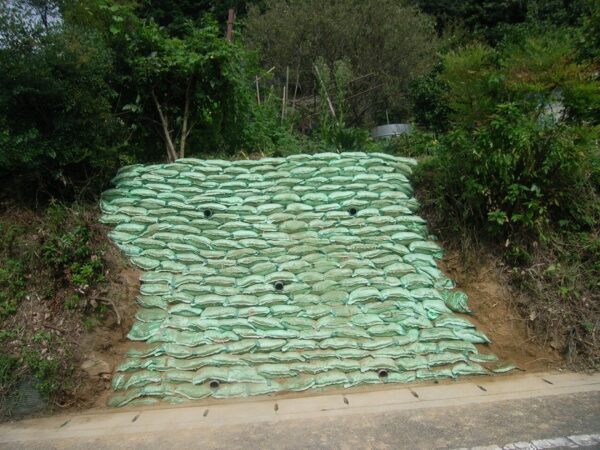
I pulled this photo from Google, but please imagine this is the collapsed slope behind my house. (The green sandbags are for landscaping.)
When it comes to public works projects, the focus is on long-term stability, but in the private sector, temporary fixes are often used as a stopgap measure. So, I’ll show you how to make those temporary fixes last as long as possible.
If you're looking for a simple and inexpensive solution, I think the best option is to stack sandbags in the area where the ground has collapsed.
To be used at that timeBe sure to use UV-resistant sandbagsPlease do so.

This is what a UV sandbag looks like.
Most of them are black. Occasionally, there are some that look transparent.
Standard sandbags usually fall apart after about half a year.
These UV-resistant sandbags will last about 3 years. (If you want them to last longer, using two layers will extend their lifespan a bit.)
I recommend this because the situation will change in the meantime, and I think it will give you a chance to consider various options.
And another thing is thisMix cement into the sand or soil used to fill the sandbags, andI want it.
Considering the boundaries of the site, it would be more practical to build something on top of the sandbags.
For that reason, it’s best to increase the strength of the soil inside the sandbags beforehand.
This is because the base of the cliff generally serves as the boundary, and since the angles are too steep in areas with stone walls or cliffs, it is difficult to use other construction methods.
If the construction work is done improperly, there is a very real possibility that it will encroach on neighboring property.
Even if you put loose soil (which lacks strength) into sandbags, it will just collapse again.
In that case, if you stack sturdy sandbags (or soil) securely to prevent the wall from collapsing, it will definitely be stronger than the original stone wall.
A ratio of about 1:3 or 1:4 is sufficient.
In the civil engineering industry, it is also known as soil-cement.
Stack the sandbags in a staggered pattern, and occasionally drive a drainage pipe into the ground, making sure the opening extends beyond the front edge of the sandbags.
Ideally, you should install a permeable geomembrane, but as long as it’s only a temporary measure, it’s fine.
I think you can see the drain pipe in the photo above.
You can use as many pipes as you like, but one VP50 per 1 m² to 2 m² is sufficient.
Just doing this much makes it quite stable. If I had to be picky, it would be even better if we drove rebar into the hillside in some places so the sandbags would have something to grip onto.
By using sandbags to stabilize the weight of the mountain while draining excess water away, the internal pressure (saturated state) is reduced, making the mountain lighter and thereby preventing a landslide.
Since you’re going to be installing a temporary retaining wall anyway, please implement a solution that allows for some time to consider your options and can also serve as the foundation itself.
In the private sector, there are financial considerations to take into account, so even if you spend a little money on temporary measures, you can significantly reduce the budget for subsequent construction work.
If the cliff on your property looks dangerous—like it’s about to collapse, the stone wall is coming apart, or the inside is hollow—one thing you can do yourself is stack sandbags. (This is just a small amount of backfill to stabilize the area.)
Other than that, I think it would be difficult for an amateur, so you should probably give it a pass.
If the situation is already dangerous, please consult an expert or a professional.
See you later.
How to Secure a Damaged Roof (Sandbags Are Essential) | Ensuring Stability