

Hello, everyone.
This is Enta.
I've been insanely busy lately—I can't take it anymore!
Just when I thought things were suddenly getting hectic, I realized I was already completely swamped and there was nothing I could do about it.
This is a real headache. I really wish they’d think more about balance when placing orders!
But that's beside the point.
Do you use flow meters in ground anchor installation or rebar insertion work?
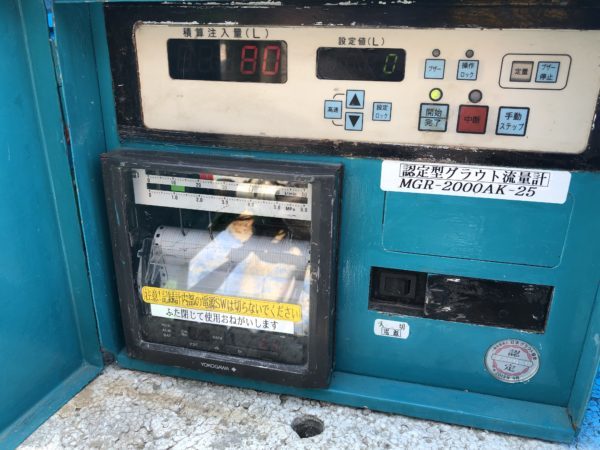
I'll be drilling on site this week, so I'll be in charge of the flow meter during the grouting.
I'll be back on the operating room floor when it's time to drill, lol.
Why do you use a flow meter?
You're probably thinking, "Why go through all this trouble?" lol
I think that too when I use it lol
I think it used to be—or rather, even now—mandatory at sites run by the Ministry of Land, Infrastructure, Transport and Tourism. (Or maybe not everywhere?)
Since it's called a flow meter, it measures the amount that flows through it.
If it were us, we’d be measuring the amount of cement slurry, right?
To determine the amount of cement used relative to the design specifications, an inspection of the empty cement bags is conducted.
And thatVerifying the Accuracy of Empty Bag Inspections Using a Flow MeterThat's how it works.
To put it simply, it means I'm under suspicion, so I'm checking it out, lol.
Before taking measurements, calculate how many liters can be filled with a single injection. (Design specifications and estimated actual quantities)
For example, suppose a ground anchor with a total length of 10 meters has an embedment length of 3 meters.
We will determine that flow rate in advance.
That way, you can see the difference from the design, right?
For example, let's say 100 liters were injected into the anchor mentioned above.
If the design capacity was 95 liters, that means it holds 5 liters more, right?
Since this means it's being used beyond the design specifications, that's fine.
Conversely, if it were 90 liters, that would mean it holds less than specified in the design.
So, since we haven't met the design quantity, that's a problem, isn't it?
By using a flow meter, it is possible to determine the loss rate per bottle to a certain extent.
So, it just means I can predict future cement usage a little more accurately! Haha.
Since the amount of cement used is ultimately the total quantity, looking at the amount per bag doesn't really make much sense, but,
Since the flow meter accumulates the volume per unit, it is ultimately necessary.
Also, if the flow rate for any single flow meter falls below the target, you might get asked, “Why?” So it’s safer to inject as close to the design value as possible. (You get what I mean, right? lol)
Here's a tip: It's easier in the long run if you aim for a little more than what the design calls for lol.
Unless there is a significant increase in flow rate, it shouldn't be a problem as long as it remains close to the design specifications.
It can be said that the results are more reliable when there is not much of a difference between the final empty bag inspection and the flowmeter reading.
Conversely, the greater the difference, the more likely it is to be subject to change.

It’s up to the supervisor to decide which way things will go—or to steer them in a certain direction—but even as a technician, it’s a good idea to keep track of the flow meter readings.
There are some things I can and can't say about flow meters, so please understand lol.
See you later.