Hello, everyone.
This is Enta.
It's suddenly starting to feel like fall—it's really nice!
In an environment like this, work really goes smoothly, doesn't it...
This heat wave is really tough, isn't it?
September is almost over, but let's keep up the good work!
But that's beside the point.
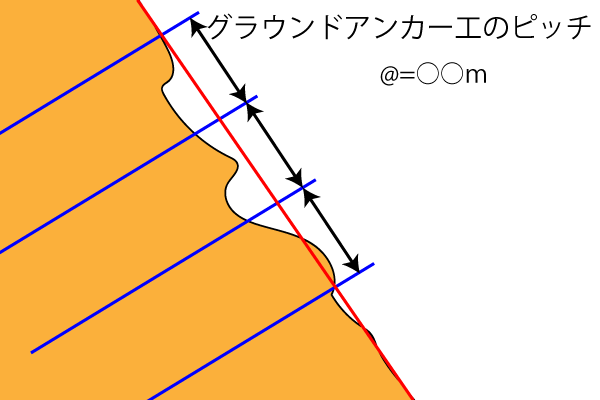
Approaches to Placing Ground Anchors on Undulating Slopes (Part 1)
In this tutorial, let's add a zabuton frame to this painting.
As you all know, when choosing a zabuton frame, you select the height based on the contours of the surface, right?
If the terrain were very uneven, they would have included a deep zabuton frame in the design from the start.
Please take a look at the picture below.
This is what it looks like when you install a zabuton frame on a slope with an average gradient.
I think the drawings are laid out in a similar style.
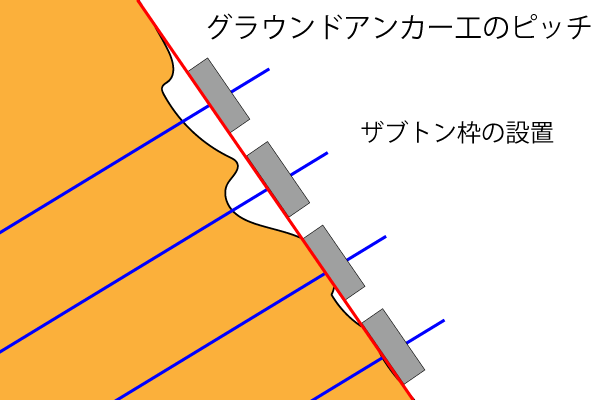
If you simply extend the above and install it, it will look like this, right?
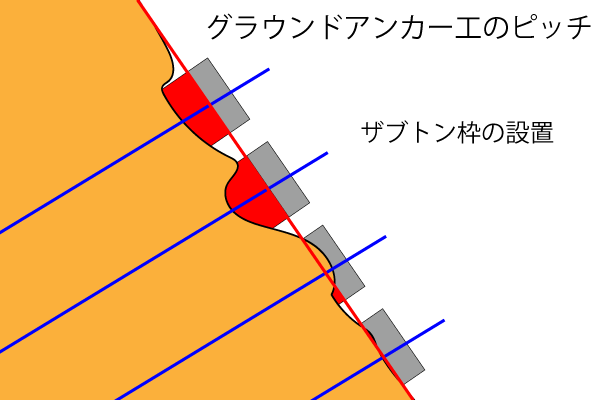
It's fine if this works for you, but the red parts are a waste, aren't they?
I think something about the size of the zabuton frame on the third row from the top would look good.
It's important to level the surface using as little material as possible.
By the way, the area highlighted in red is made of drainage concrete.
That's just under 50,000 per cubic meter, isn't it?
Therefore, under normal circumstances, the installation method described below is the most cost-effective.
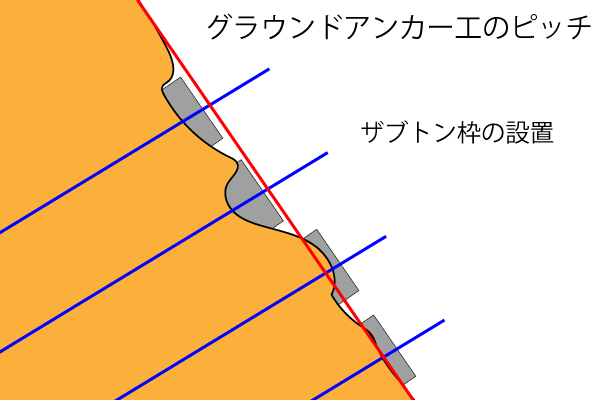
Since this involves the scaffolding, it would be best to align them somewhat, so please make the necessary adjustments on-site.
So, here's where we get to the main point lol
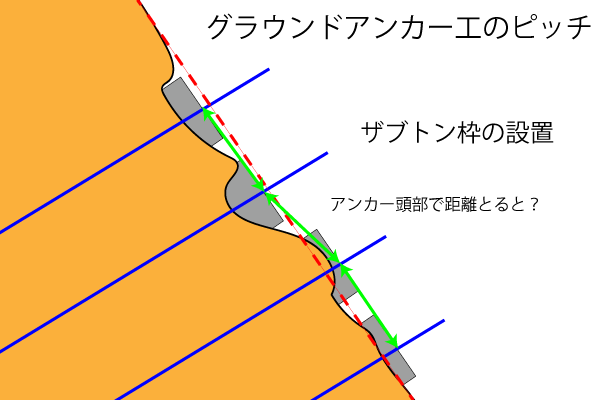
When you measure the distance with the head after installing the ground anchor, it’s only natural that it’ll sometimes be too long or too short, right?
You can see that the green arrows are slanted, right?
The greater the elevation changes, the more the distance at the head changes.
Do not measure the pitch using the anchor heads after placement!!
It’s fine if the slope is smooth and the load-bearing plates are perfectly aligned, but if there are irregularities and differences in the height of the top edges of the load-bearing plates, the design spacing (pitch) cannot be measured.
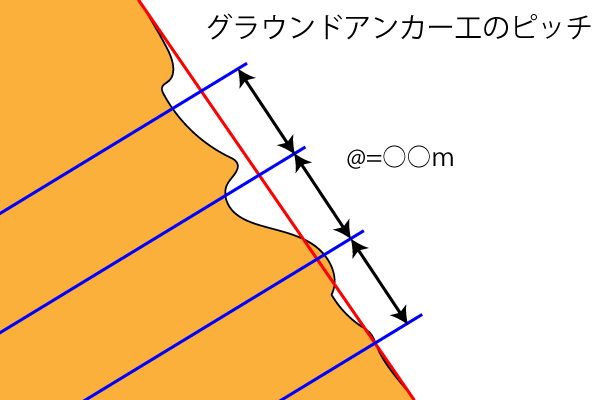
To be clear, the anchor pitch is the length measured when this anchor is extended upward and measured at the same position.
Furthermore, the location specified in the design (on natural ground) differs from the location that is ultimately visible in the finished structure.
Before installation, mark points on the natural ground and extend those lines to determine the installation location.
For that reason, the final position changes, making it even more difficult to measure.
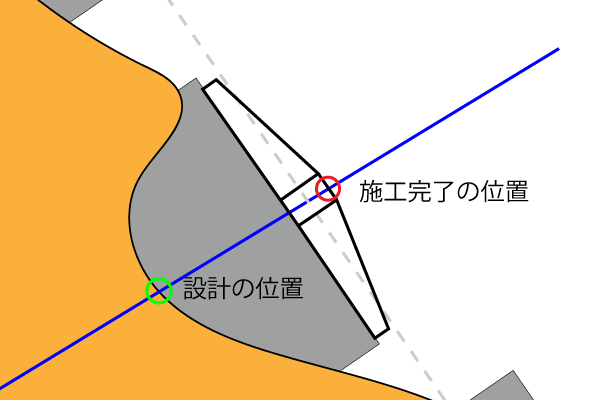
There are occasionally people who don't understand this point.
It's a little complicated, but let's take the time to carefully consider where to place the anchors.
See you later.
Call for Advertisers