



Hello, everyone.
This is Enta.
The other day, I went to a job site to lend a hand.
That is where stress management takes place.
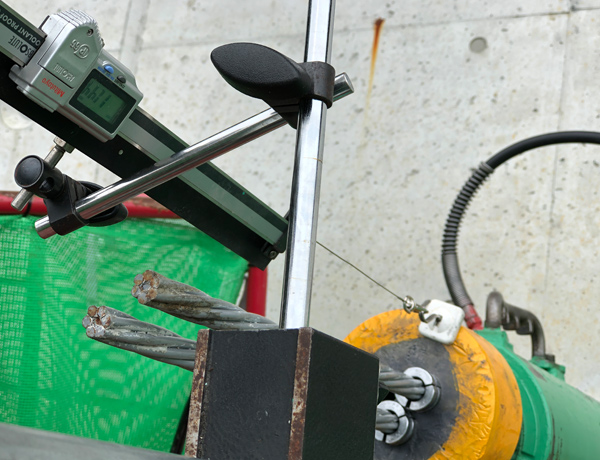
Based on my experience, I’m pretty good at managing stress as an anchor, so I can handle it just fine.
But this time was different.
That's because the test was conducted on the assumption that it would come off. (Adhesion failure)
That’s because more than half of the installed poles were missing, and this time, with the last one being installed, officials from the local government were present.
This exam was administered on the assumption that there was a high likelihood of students failing again this time.
Since the government office also acknowledged that it was a design error, the matter was settled quickly. (This doesn't happen very often.)
The current design embedment length isn't sufficient, so to give you an idea...Basic Survey ExamThat's right.
The exam consists of an aptitude test, and
I went there, but even at the maximum load for the second stage, the load was already starting to drop gradually.
Relaxation creep was slow to stop. (It took about 5 minutes to come to a complete stop.)
If the load is high, the steel wire and the rock will likely settle into place, causing the load to decrease (creep), but,
"I was saying, 'At most, this symptom is at stage 2...' but here we are at stage 3."
At the maximum setting of Stage 3, relaxation creep stops in about 15 minutes.
Just before reaching the maximum load for the fourth stageBoom!...and slipped away.
I found that if I take my time, there are signs before it comes out.
Since I’m usually so tense that I can’t relax, I didn’t really look at it that closely.
Stress tends to decrease even under low loads, and the displacement (settlement) of the natural ground is significant.That's what I thought.
Since there's only one data point, the data is quite inaccurate, but it was a valuable experience for me.
Re-evaluation under test load
Since we carefully tracked the load that caused the pull-out this time, we will use that data as the basis for the redesign.
Based on the pull-out load, borehole diameter, and embedment lengthτWe calculate (Tau: the limit circumferential friction resistance value) by back calculation.
I worked backwardτSo, you're redesigning the anchor body length based on the (Tau: maximum circumferential friction resistance) data, right?
Since I was just helping out, I don't know how things will turn out at this site, but I'll let you know if I hear anything soon.
And, more than anything, there’s a video I really want to post.
Probably a world first?
Here's a video of the moment the anchor comes loose!
I knew it was going to slip out, so I started filming the moment I noticed it was acting weird!
It's a pretty plain video, but there aren't any other clips that captured this!! Right?
But I can't reveal it yet~ lol
I think I'll be able to show you this site once it's completed, so until then...
Wait... just a sec♡
See you later.



Footage of the anchor coming loose...
I want to see it!!!!
I’ve actually missed a few times myself, though.
It never occurred to me to capture it on video.
I'm looking forward to it.
Thank you as always.
But after watching this video...
That's what I think, lol
Because...
I can't say that! LOL
Even though I want to say it, I still can't.
Also, if I have a chance to show it to you sometime, I’ll do so.