



Hello, everyone.
This is Enta.
It's raining today, so we took the day off from slope stabilization work.
The thing is, they came in the other day to level the slope and stripped away the topsoil, so there's nothing I can do today.
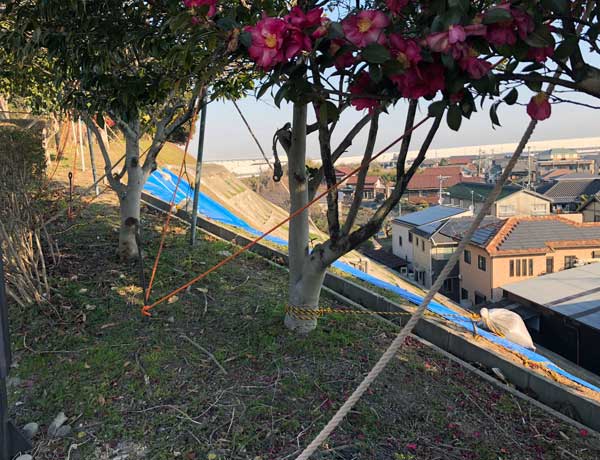
By the way, at our place, we use a climbing rope for our lifeline.
(Even the horse's backup is a climbing rope lol—I forgot the backup rope, so I ended up using a climbing rope...)
Lightweight, durable, and eye-catching!
In the end, it doesn't really matter which one you use. Whether it's a safety block or a regular rope, just use whatever's easiest for you.
The most important thing is not to fall!
But that's beside the point.
A Tutorial on How to Make a Packer
In this post, I'll show you how to make a packer.
Even though they're both called "packers," there are two types: all-purpose packers and fixed packers.
Since the basic method is the same for both, please use this as a reference.
This time, we used temporary anchors for the installation.
Things to keep in mind areDetermine the positions of the fixed length and the free lengthThat's what you need to do.
In the case of temporary anchors, it’s easy to understand because they have a load-bearing element, but,
Some anchors are difficult to identify by appearance, so please check carefully depending on the type.
By the way, this is what’s called a load-bearing element.
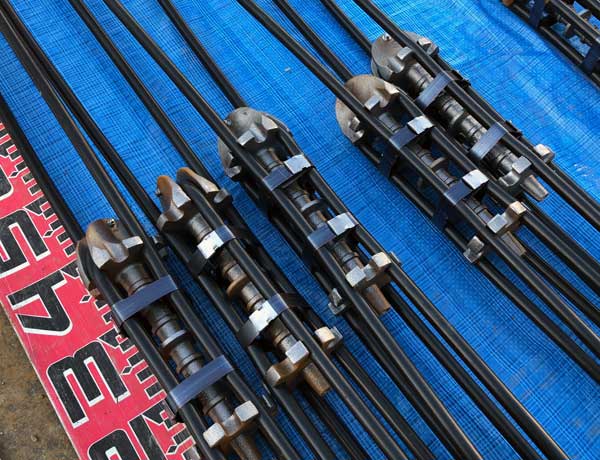
Two or more wires are connected to the load-bearing structure via a U-turn.
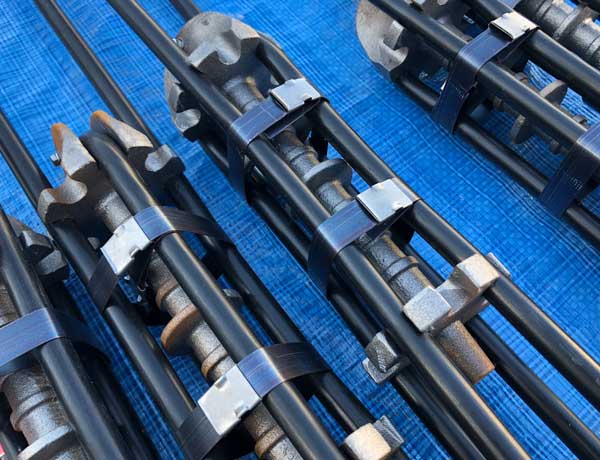
This part will bear the load.
And since these are removable temporary anchors, ultimately thisThe load-bearing structure and the polyethylene hose will remain underground.
The only thing that can be removed is the PC steel wire inside the polyethylene hose.
To remove it, just pull on one side—it’ll make a U-turn and come right out.
I digressed, but the length of the packer's anchoring section is approximately the anchoring length plus 40 centimeters.
This 40-centimeter measurement includes 20 centimeters at the top and 20 centimeters at the bottom of the attachment area.
If the embedment length is 3 meters, the length at which the packer should be cut is 20 centimeters + 3 meters + 20 centimeters, which comes to 3.4 meters.
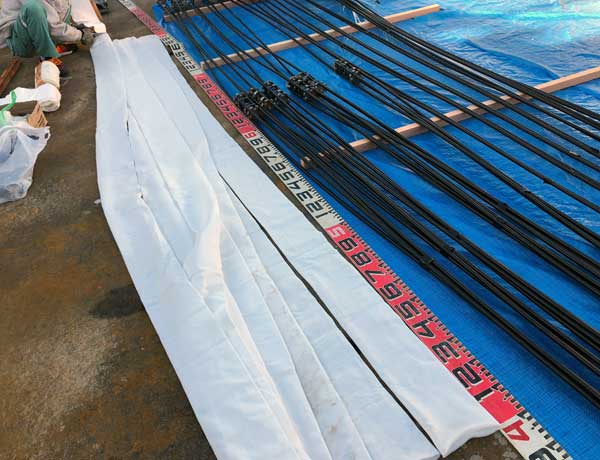
First, cut the required number of packers.
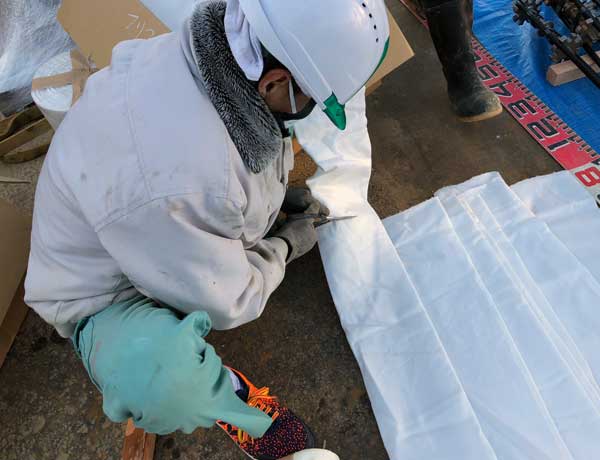
The important thing isMake absolutely sure you don't get the length wrongThat's the thing, lol
It's fine if it's long, but if it's short...
As part of a recent trend, the specifications for fixed-length and free-length packers differ.
The Free Length Division often uses inexpensive packers.
To be continued next time
See you later.

In this case, is it okay to use the calculated fixation length? What about in cases like compression-type fixtures?
We were talking about something similar at work today.
In elastic-plastic calculations for temporary anchors, the length of the free span affects the spring constant, but… (omitted)
Thank you for your hard work.
Thank you as always.
I believe that, generally speaking, an "all-packer" is the standard for packers.
Both compression and tension.
Generally speaking, in tension-type systems, loads tend to concentrate at the boundary between the fixed section and the free length more than in compression-type systems.
I wonder if it’s a problem that the grout—which should normally be a single continuous line—has been cut off by the packer.
With the compression type, since the grout is subjected to compressive load across its entire surface, I wonder if having the edges cut off by the packer might be a problem?
If you are designing a packer based on the above concept, taking both cost-effectiveness and safety into account, I believe it would be best to have a set length of at least 1 meter.
As for temporary stuff, well... it's just temporary, right? lol, so I'll leave it up to you lol.