

Hello, everyone.
This is Enta.
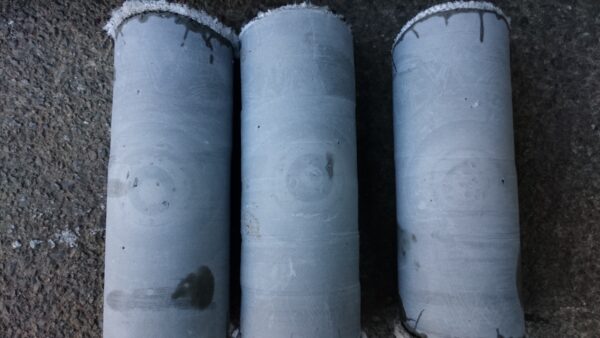
Do you know what this is?
One distinctive feature is that there’s a circular mark leading toward the center, isn’t there?
This is pressure-cured concrete, which was cured under pressure. (I’ve shown this before, lol.)
This is what it looks like after pouring the cement slurry from the packer inside and letting it harden.
On the other hand, if you let it harden without applying pressure,
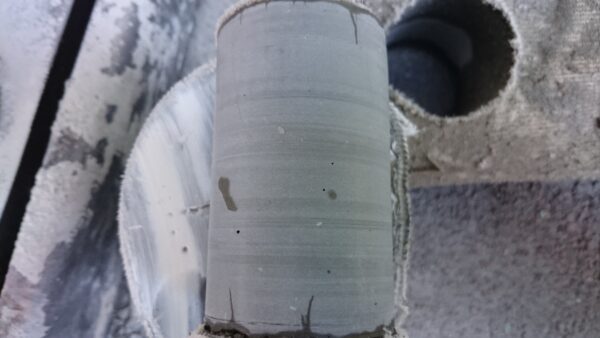
It's layered just like normal.
This is what usually happens when you take test specimens from cement slurry, isn't it?
It’s often said that applying pressure to ground anchors increases their strength.
To be precise, that's actually a lie, lol.
It is known that when concrete is subjected to pressure, it becomes dewatered and its strength increases, but,
If there is no pressure, proceed as usual.
Pressurization in ground anchor construction is temporary and must always be relieved.
However, from the perspective of the lowest section, pressure is applied by the weight of the cement slurry.
And it’s said that when pressure is applied, it seeps into the natural ground!
This is pretty much a lie, too, lol.
It won't seep through unless the soil is sandy and has very loose texture (low N-value)!
Compared to chemicals like water glass used in chemical injection, the specific gravity is too different, and the particle size is different as well.
Besides, it would be unthinkable to place the anchorage point of a permanent anchor in a location (sandy soil) where it would be subjected to that kind of pressure, wouldn't it?
Actually, there are experimental results on this topic in a research paper as well.
Ground Anchor Construction: Pressure Injection
If you search for it, you'll find a research paper.
As for our company's patents, there are some areas where the data has been tweaked to suit our purposes, lol.
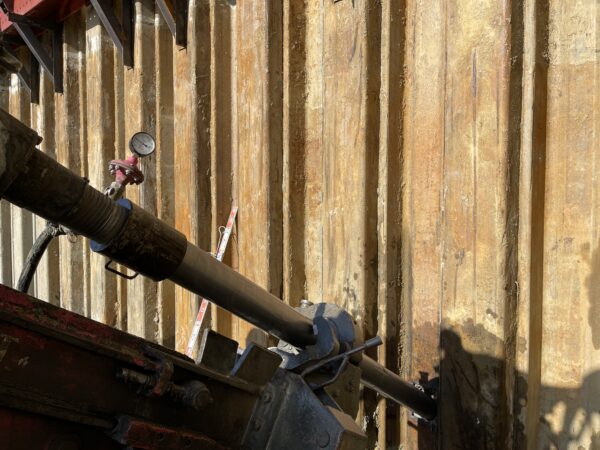
The geological formation described as having a lower water-to-cement ratio in the cement slurry due to dehydration, resulting in high strength, is sandy soil lol.
The idea is that when pressure is applied, water is absorbed into the sandy soil, increasing its strength.
In other words, we should apply pressure to soil that is highly permeable, and
It’s better to apply pressure to the free length section rather than the fixed section, right!?
Isn't that what you mean?
Based on what we discussed the other day, since the free end also bears the friction at the fixed end, isn't that the correct answer?
Is tension control in ground anchor construction really pointless after all!?
Rather than focusing on the anchorage section, how can we ensure that the free-length section is properly grouted?
After all, the anchoring section is definitely going to be filled with cement slurry, right? lol
What do you all think?
See you later.