Hello, everyone.
This is Enta.
I'm so happy to hear that the construction site I worked on as a first-tier subcontractor this spring was recently recognized with an award!!
The general contractor was happy to get in touch.
I'm just so happy!
This is what makes being a subcontractor so rewarding.
The general contractor is recognized by the government agency, and we are recognized by the general contractor.
It's one of those moments that makes me want to try even harder!
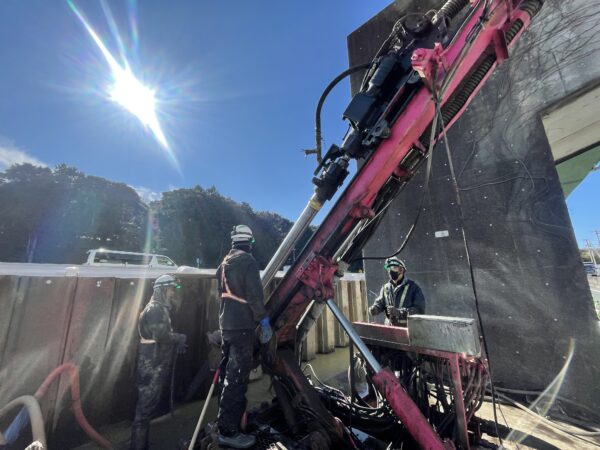
But that's beside the point.
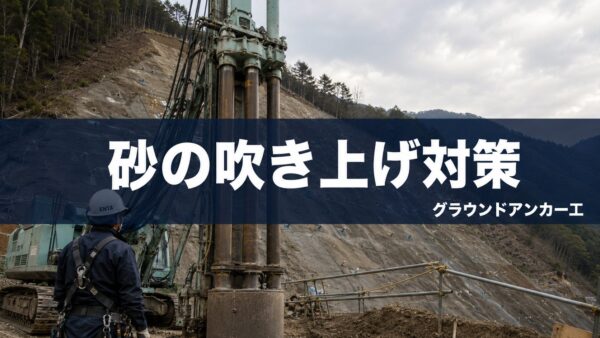
There are times when drilling just doesn't go smoothly during ground anchor construction, aren't there?
Especially in sandy soil where there is groundwater, even though the drilling depth meets the specified requirements, sand keeps coming up and the anchor won’t go in.
This happens quite often, especially when using temporary anchors in urban civil engineering projects.
What do you do in a situation like that?
I've written about this a few times on my blog, but,
Drilling with cement slurry!
That's it.
You can reduce the mix ratio by about half, or you can drill the holes using the grout as is.
If you raise or lower it while the liner is inside, the slime sand will come up with it.
The cement slurry in this video is made with half the usual mix ratio.
Even so, sand gets mixed into the slime, making it all gooey.
However, when drilling with this high-density cement slurry, sand cannot enter the wellbore without casing, so
You can successfully insert an anchor.
In addition, since the cement slurry is thoroughly injected around the outer casing, the area around the borehole wall is also stabilized.
It costs a little money, but it's a method that guarantees the job will be done right.
There is also the option of CB injection using bentonite, but,
I don't think people do it very often because it's not a good strategy when it comes to retention.
I've never done that either.
It happens quite often with chemical injections and the like, though.
The hardest part about this drilling job is definitely the cleanup, lol.
This part is really tough, so I’m selective about where and when I work.
I recommend it if the worksite or situation allows.
See you later.