

Hello, everyone.
This is Enta.
Lately, the weather has been kind of all over the place—one day it's cold, the next it's warm.
Be on the lookout for colds and the flu.
As for masks, I’ve been doing some research, and it seems you should change them at least twice a day.
Actually, it seems germs multiply when you cough or sneeze, but it’s just too wasteful to throw it away in the morning, isn’t it? lol
That said, since they multiply like crazy later on, I guess one a day is the limit, lol.
But that's beside the point.
This will be my last post on landscaping (I'm getting a little tired of it, lol).
It's the season for planting.
The next month will be an ideal time for landscaping in western Japan.
It would be great if we could get the landscaping done before spring, while there’s still no frost.
Basics of Landscaping (Part 1)
Basics of Landscaping (Part 2)
Basics of Landscaping (Part 3)
Basics of Landscaping (Part 4)
Basics of Landscaping (Part 5)
As of the previous episode...
When considering spray thickness, the most important thing is,
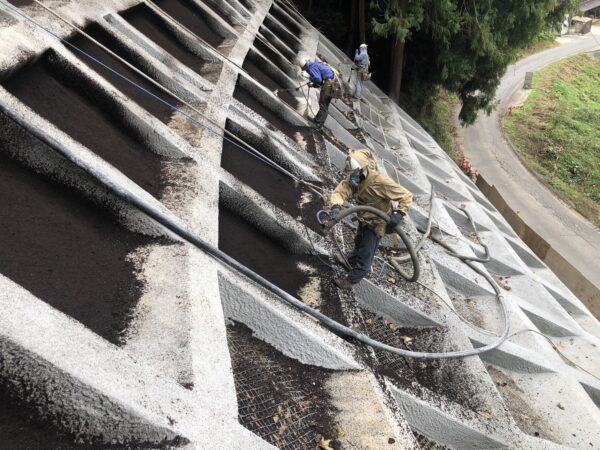
The spray thickness of the growth substrate applied by vegetation substrate sprayers is determined by taking the following factors into account.
- Condition of the subsoil: soil hardness, jointing patterns in rock, soil acidity (pH), soil texture, etc.
- Weather Conditions: Annual precipitation, average annual temperature, snowfall depth, etc.
- Slope Gradient: Classification of Cut and Fill, Slope Irregularities
- Plants to Be Introduced: Definition of target plant communities, plant characteristics, slope orientation, etc.
The six essential conditions for plant growth are water, temperature, oxygen, light, carbon dioxide, and nutrients, and
Of these, the factors that are influenced by the thickness of the growing medium are water and nutrients.
Based on these considerations, the thickness under review was determined to be between ○○ cm and ○○ cm.
For example
Soil Hardness
3–5 cm
Precipitation
3–5 cm
Slope Gradient
4–6 cm
Assuming that...
As a recommendation, it is desirable to encourage the adoption of stricter conditions.
"The standards for sprayed concrete thickness, based on the condition of the underlying rock—which is closely related to the supply of water and nutrients—precipitation, and slope, are set as follows:
"However, if the spray thickness values differ based on the three conditions, the value shall be determined in accordance with the more stringent condition."
Technical Data on Spray-Applied Organic-Based Thick-Layer Substrate Construction, Japan Slope Greening Technology Association, p. 14
Based on our review, a spray thickness of 3 cm to 6 cm is considered appropriate for this location.
That being the case, I think it’s fair to say that 5 cm is a reasonable figure.
See you later.