Hello, everyone.
This is Enta.
In a middle school math problem,
I want to make a 20% saline solution by adding salt to 100 g of water.
How many grams of salt should I add to the water?
That's the problem
It took me 20 minutes lol
Math is hard.
Basics of Landscaping (Part 1)
Basics of Landscaping (Part 2)
But that's beside the point.
What Can We Learn from the Previous Soil Hardness and pH Measurements?
In other words, it comes down to the hardness of the soil—whether the roots can penetrate it or not.
Does the pH level indicate whether the soil is suitable for plant growth?
Other things to look into (in no particular order) are:
- Condition of joints (cracks and fissures in bedrock, etc.)
- Annual Precipitation (Japan Meteorological Agency)
- Annual Average Temperature (Japan Meteorological Agency)
- Snowfall Accumulation (Japan Meteorological Agency)
- Slope Gradient (Drawings and Surveys)
- Cut and Fill (Topographic Maps and Drawings)
- Native Plants (Indigenous Species)
- Soil Hardness (Field Measurement)
- pH Value (On-site)
For now, we’ve reached the stage where the on-site survey mentioned above has been completed.
The essential conditions for plant growth are:
These six factors—water, temperature, oxygen, light, carbon dioxide, and nutrients—are,
Of these, the factors that are influenced by the thickness of the growing medium are water and nutrients.
From here on, we’ll move on to preparing the vegetation engineering study report.
One thing you can easily tell from hardness is, for starters, thickness.
We will determine the thickness based on the condition of the subgrade.
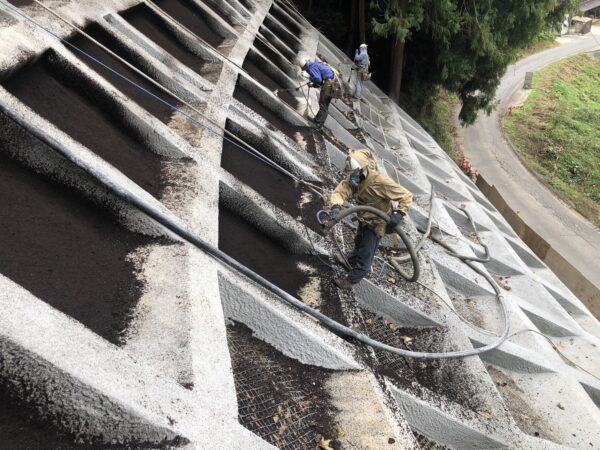
The spray thickness is listed in the book as follows.
Guidelines for the Minimum Spray Thickness of the Growth Substrate Based on Soil Type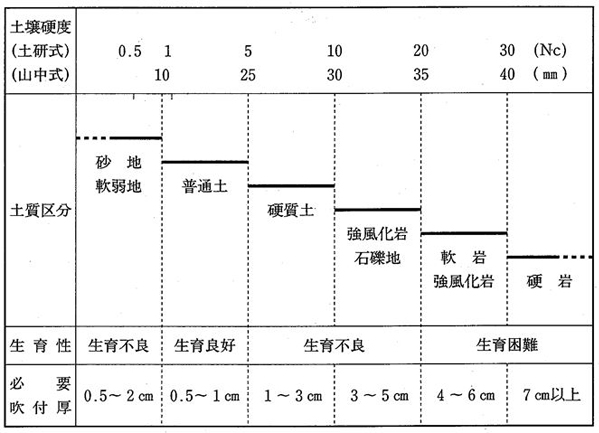
Association of Agricultural Civil Engineering: Green Design for Restoring the Natural Environment, p. 106
You can get a general idea of the thickness by looking at this document.
Next time, we'll be looking at thickness.
Looking back now, I wish I’d titled it “Study on Vegetation Engineering”...
See you later.