Hello, everyone.
This is Enta.
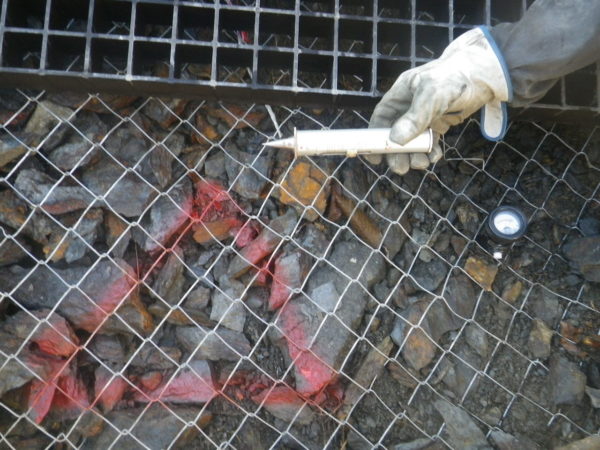
I’m sure you’ve measured soil hardness in vegetation engineering projects before; we use that measurement to determine the spray thickness.
I received a question the other day: Isn't it strange to vary the spray thickness at a single job site based on soil hardness!?
So, apparently, the government says they adjust it based on water hardness.
For example,
The thickness measured at the point specified in the design as 5 cm was found to be greater than that.
The right side of the slope is 5 cm as per the design.
The center of the slope is 7 cm
The left side of the slope is 10 cm
If that happens,
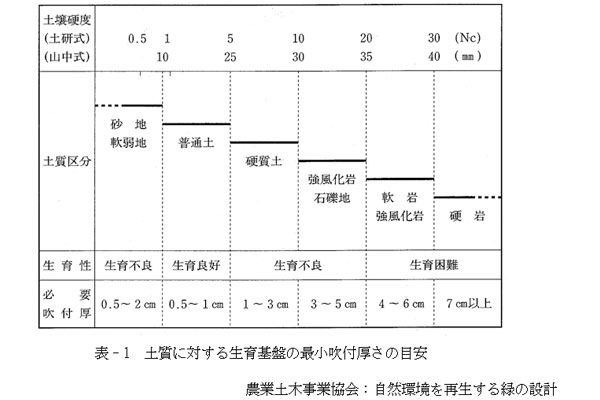
As for what will change, it's the cost estimation.
Since the coefficient changes depending on the quantity, I might be open to considering it if you're willing to adjust it that much.
That said, it's not very realistic, is it?
Well, assuming this were actually the case, with two main steps separated by a small step in between, the first step would be 3 cm and the second step would be 5 cm.
Something like that seems plausible, lol
Even so, the calculation factor changes depending on the quantity, doesn't it?
The standard thickness of the sprayed vegetation is determined based on the worst-case scenario.
It's a simple concept: if it doesn't grow well in certain spots, it'll thrive everywhere else, lol.
---------------
"Among the site conditions, the condition of the underlying rock, which is closely related to the supply of water and nutrients,
The standards for spray thickness based on precipitation and slope are set as follows.
However, if the spray thickness values differ based on these three conditions,
"The decision will be made based on whichever condition is stricter."
Technical Data on Spray-Applied Organic-Based Thick-Layer Substrate Construction, Japan Slope Greening Technology Association, p. 14
---------------
The book says this.
See you later.