

Hello, everyone.
This is Enta.
We recently administered the basic exam for rebar installers.
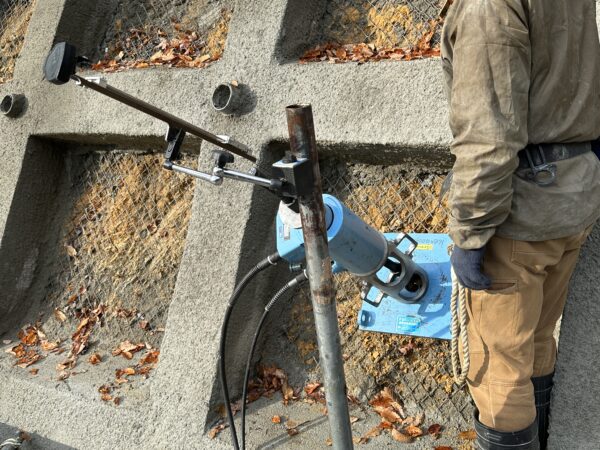
In a test to determine whether the designed circumferential friction can be eliminated,
Since the legal framework is already in place, this is a basic exam conducted within that framework.
Well, since there's no helping it, we'll go ahead with the exam as is, but this has really made me realize the issues involved.
Based on the fundamental premise that it is generally better to conduct basic testing before installing the legal framework as much as possible, I will explain why this is the case.
Some people might think it’s standard practice to do this before construction begins, but that’s not the case nationwide.
We are carrying out construction based on a design that assumes circumferential friction can be eliminated.
Since this is based on sample data (core logs) from the soil investigation tests, the basic tests are strictly for verification purposes.
1. It makes it easier to select the placement locations for rebar during basic testing.
2. While legal frameworks exist, they can sometimes get in the way.
3. If the soil bearing capacity is insufficient, the bearing area can be increased.
4. If there is no circumferential friction, other construction methods can be considered.
1A: Since the exam involves navigating legal boundaries, it’s hard to pinpoint specific areas to focus on, isn’t it?
2A: Even when tightening with a jack, the frame gets in the way more than you'd expect, making it difficult to attach the gauge.
3A: This was the biggest problem I ran into this time—if the ground doesn't have enough bearing capacity, it just keeps sinking.
The pressure plate used during testing is quite thick.
The load-bearing plate shown in the photo above measures 500 × 500, but it weighs nearly 40 kg.
For that reason, I couldn't go any bigger, so I settled on this size.
It wouldn't be a problem if we could use a crane, but,
There's a limit to how much one person can be dragged around.
Also, while the dimensions within the frame are within the standard range, there is some variation, so it’s safer to go with a smaller size to ensure it fits.
(Bearing capacity refers to the ground's supporting force—the force with which it pushes back—when pressure is applied to it with a jack.)
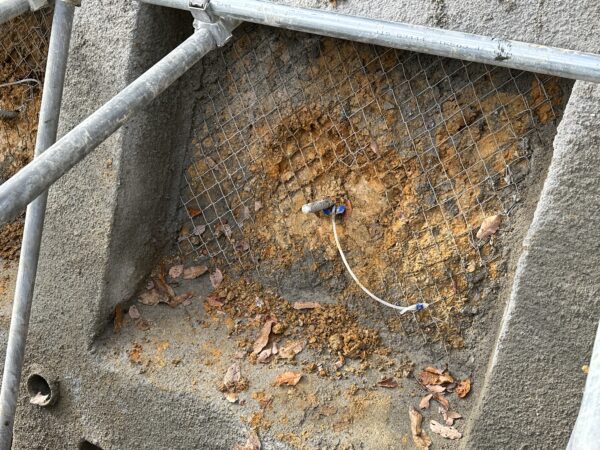
The surface is crumbling due to weathering.
It sank 30 mm, but it stabilized after that, so it turned out okay.
4A: This time, we couldn't eliminate the surface friction and ended up slipping. (Half of the original plan.)
Since I had a larger jack on hand and the cylinder stroke was also quite long,
Fortunately, we were able to pull the load all the way to the limit of the ground bearing capacity, so at least we were able to conduct the test properly.
But since there's no circumferential friction, I have to redesign it lol
Since the legal framework is already in place, I believe the design will be based on that.
Possible methods include increasing the borehole diameter, increasing the borehole length (insertion length), and installing additional ground anchors within the frame.
Anyway, since it’s going back to the design phase, it looks like my work will be pushed back a month, which is terrifying lol.
See you later.