Hello, everyone.
This is Enta.
Have you ever seen something like this on a slope?
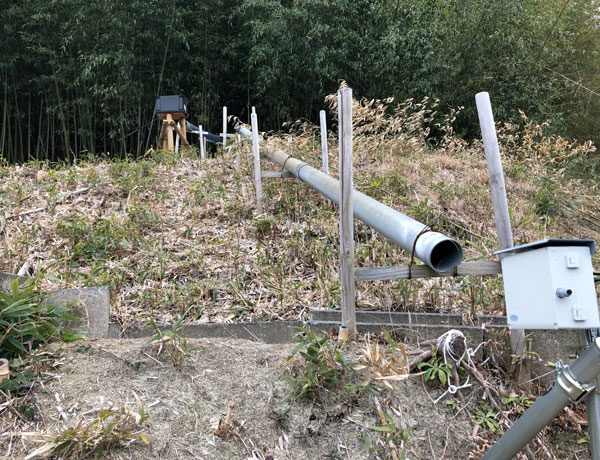
It's just standard practice in our industry, isn't it?
That's right!
It's an extensometer!
We are monitoring landslide activity.
What Is a Ground Deformation Meter?(Association for Slope Disaster Prevention Technologies)
People go to locations where observations can be made easily, insert a device called a data logger, and retrieve the data. (These days, this is often done using SD cards, etc.)
They'll send data to places that would be difficult or time-consuming for people to reach (such as via telephone lines).
Basically, they run on batteries. These days, many people use solar panels to store electricity and power them.
Along national highways, for example, there are devices equipped with cameras and even alarms.
The hard part is that collecting data from this device every day is a real hassle, lol.
A long time ago, this device was installed at a Ministry of Land, Infrastructure, Transport and Tourism site, and it really gave us a hard time.
Back then, there was no way to transfer data, so we not only collected data but also replaced batteries.
Sometimes animals kick these things, so the alarm goes off at night, or it gets shaken by heavy rain and sets off the alarm—it’s really a hassle.
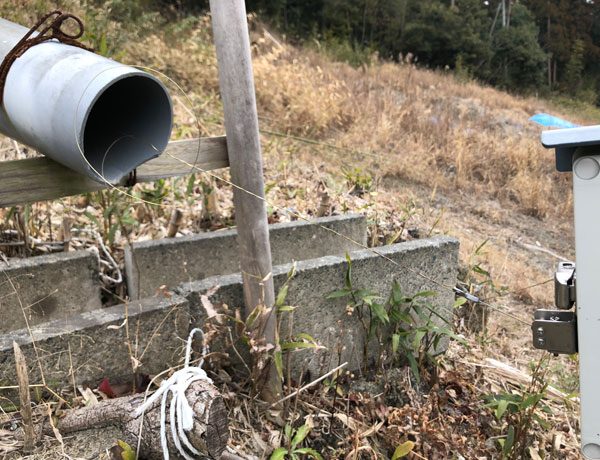
There are lines like this inside the PVC pipe.
When you touch this, the data logger measures the displacement. It makes you want to give it a little tap (but you'll get scolded, won't you?).
Generally speaking, at sites equipped with extensometers, you’ll also find devices like this.
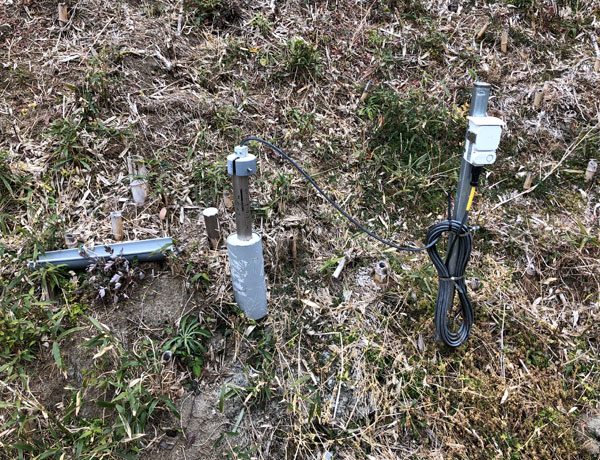
This is a device called a strain gauge.
What Is a Strain Gauge? Japan Meteorological Agency
We are measuring the strain in the ground.
We are measuring the surface layer of the ground with an extensometer while simultaneously measuring the interior of the ground with a strain gauge.
As with the above, data is collected either automatically or manually.
Our slope stabilization company continues to provide ongoing maintenance after construction, including anchor work and horizontal boring.
Once the construction work takes effect, no displacement will be observed on the extensometers and strain gauges.
Conversely, there are cases where displacement appears on the strain gauge.
When tension is applied to an anchor, pressure is exerted on the rock, which can sometimes cause the rock to push back.
Actually, since we can't see what's happening inside the earth, I can only speculate, lol.
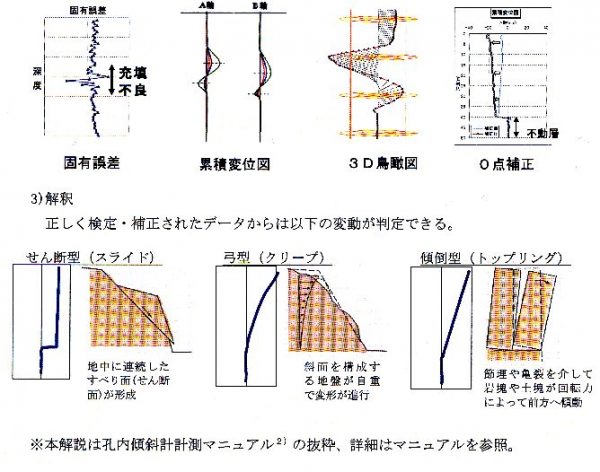
Areas where this equipment is installed are regions prone to landslides.
Also, if you don't take extra care when working near this equipment, it will cause more trouble. (It is necessary to remind the workers of this.)
Be sure to check the instructions for using water, as well as the application methods and sequence.
In particular, great care must be taken regarding the displacement of the mountain during anchor installation.
Just ignore the coach who’s wandering around with a data logger every day—lol.
This equipment is generally managed by a construction consulting firm, but during construction, management may be outsourced to the construction company, and
During construction, they give me a data logger and tell me to send the data every week. Just install an automated system for me!
I think there are plenty of people who feel that way (lol)
It’s easier now, though, since I don’t have to make copies from rolls of paper like I used to. (Are the people who know what this is talking about over 40?)
See you later.
P.S. Tomorrow I'm going to check out a job site in the mountains of Tokyo! lol It's so far away...