Hello, everyone.
This is Enta.
Something I always search for when winter comesTOP 10Introductory text
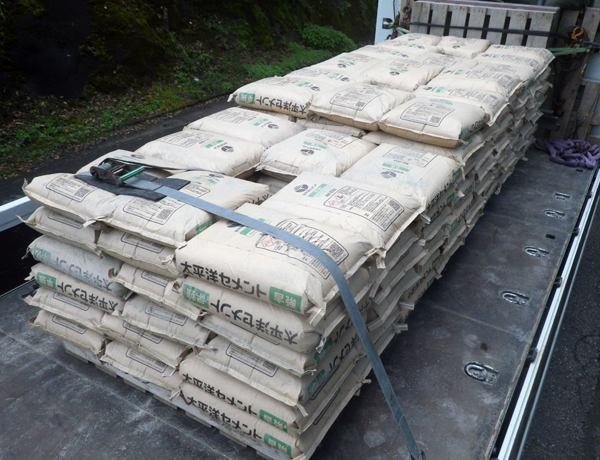
High-early-strength cement
Let's take another look at this, taking into account previous articles as well.
Estimated strength of fast-setting cement that matches the 7-day strength of ordinary cement in 3 days or more
Estimated strength of fast-setting cement that matches the 28-day strength of ordinary cement in 7 days or more
This is merely an estimate.
*Please note that even when using fast-setting cement, there is no guarantee that the specified number of days will result in the development of the specified strength.
This is its most distinctive feature.
There’s an ultra-fast-setting mortar above this, but for now, we won’t be using the slope contractors or anchor contractors.
And the reason it sets quickly is that its particle size is smaller and finer than that of ordinary cement.
When the particles are fine, the surface area in contact with water increases, accelerating the hydration reaction.
In the case of slope stabilization work
For that reason,It also generates more heat, making it suitable for winter construction.
Although the use of fast-setting cement for winter construction is also employed as a creative solution,
The unit price per bag will increase by about 100 yen. This will result in higher costs for operations that use large quantities.
However, since a higher heat output means a higher probability of cracks forming,
It is necessary to give sufficient consideration to curing.
However, I don't think you need to worry about it too much in January and February.
(For spray application)
Next, what about anchors and rock bolts!?
Every now and then, you’ll hear people say that all anchor rock bolts are fast-setting.
The reason I use Hayakyo is simply because...Shorter Construction TimeThat's it.
In the case of anchor rock bolts, there are often situations that require urgent action, and
Since the concrete needs to develop strength immediately after placement, that means it has to be a fast-setting concrete.
You can start using it in as little as 3 to 7 days.
It varies depending on the circumstances, but,
It costs a fair amount, but it’s reasonably effective.
From the perspective of shortening the construction schedule, using fast-setting cement results in lower total costs.
(Unless the loss exceeds the design specifications, lol)
Also, because the particles are small, they tend to adhere easily to anchor points and other attachment areas,
Since that's probably the case, it might be a good idea.
Also, fast-setting cement is especially better for borehole walls with significant deviations.
The reason isThe flow rate for "Early Strong" is higher than normal (in seconds).That's it.
That means it's hard grout.
In purely theoretical terms, the friction between cement slurry and the epoxy coating on prestressed steel strands is
I have a feeling that the "Early-Strong" strategy tends to win more often than usual.
By the way, I hear that the maximum strength of cement milk is 295 N/mm² lol
In fact, during the previous cement slurry pressure test,
When measuring the 4-week strength using fast-setting cement,
After all, it was over 90 N/mm².
Since it is said that cement takes about a year to harden,
I think I might be able to pull it off!? LOL
Particle size, as expressed by specific surface area (pronounced: hi-hyō-men-seki), is
Ordinary cement: Specified value = 2,500 cm²/g or higher; Measured value = 2,800–3,600 cm²/g
High-early-strength cement: Specification value = 3,300 cm²/g or higher; Measured value = 3,600–4,500 cm²/g
By the way, as for why cement hardens...
Mechanismhas not been clarified. I heard about it in my early 20s.
It's been just under 20 years. It still seems like a total mystery—maybe we should call in Conan!?

Well, that's it for now.
"Explaining the Mysteries of Concrete" No. 2, in the Style of Akira Ikegami
If you're using it for creative projects,
I personally find this site very interesting.