Hello, everyone.
This is Enta.
I don't know—I feel kind of busy, but then again, not really...
What could it be?
This feeling of anxiety...

Buying something from a company representative or the CEO just makes you feel anxious, doesn't it? lol
To be honest, I, too, am terrified of the unknown future and am constantly on edge.
Will I have work next year, next month, or next week? I wonder if I'll be okay... I've got to go out and find some work!
That's what I always think.
On top of that, hearing all kinds of rumors and stories just makes me even more anxious lol
There's this really chatty driver at the shipping company I always use, lol.
"That place is really taking off right now, but people are starting to leave—this and that."
That delivery guy comes and goes all the time, so I guess he really does have some inside information.
When I heard that...That makes me a little anxious, lol.
However, while there are rumors, the fact is that it goes without saying that everyone is doing their best.
We don't compete, but,
I think it would be great if we could compete while maintaining a good relationship with each other.
But that's beside the point.
To start with,
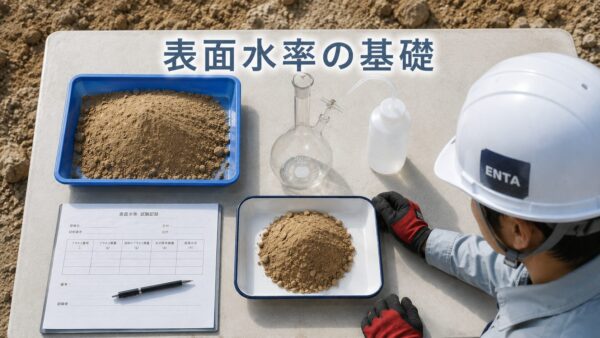
Surface Moisture Content Test for Fine AggregatesWhat on earth is that all about?!
As an administrator, you should know this, right?
See? lol
But hey, I'll forget about it. People forget. That's what makes us human, lol.
To put it simply,
Sand naturally contains moisture.
For example, let’s say the mix design is C:S = 1:4 and W/C = 55%.
| Cement (C) | 1 | 420 kg |
| Sand (S) | 4 | 1,640 kg |
| Water (W) | W/C = 45–55 | 231 kg (551 TP3T) |
This formula serves as the basis, which is then adjusted on-site.
On-site mix designs are created by taking into account the specific gravity of cement, sand, and water.
Among these, the ones that have elements that are constantly changing are,Water in the sandThat's it.
This water level fluctuates slightly every day.
For example, the day after it rains, the moisture content tends to be higher, and
If the following day is a scorching hot day with a temperature of 35 degrees, you’ll lose fluids rapidly.
So, that's why we make on-site adjustments to the mix.
For example, if the sand contains 1 liter more water than it did the other day,
You need to use 1 liter less water than the amount specified in the recipe.
The reason we do this is because,To maintain consistent qualityThat's it.
It’s not okay to say that the intensity was low the other day but high today.
It's important to keep the mixture consistent to ensure consistent strength.
Generally speaking,
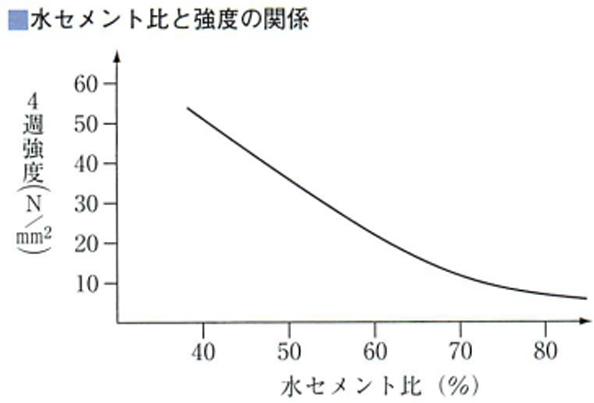
CompressionTo increase strength, reduce the W/C ratio (water-to-cement ratio).That's it.
That means it can be adjusted up or down by changing the water level.
See you later.