Hello, everyone.
This is Enta.
Last month, I had the opportunity to serve as a lecturer at a seminar hosted by Shinken Shimbun.
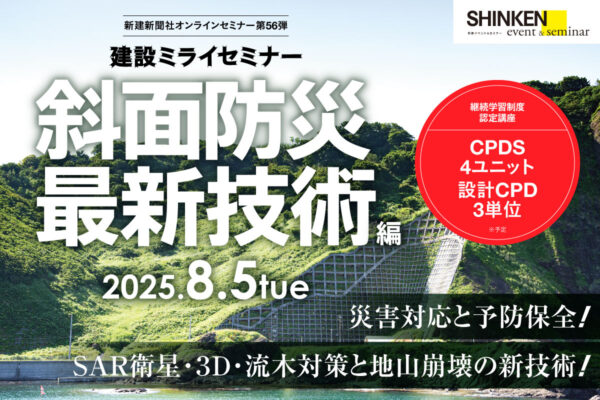
To put it simply, the topic of my seminar is nothing more than “Draining Water from the Mountains!”
The tricky part is how well the consultant can incorporate this into the design and reflect it in the budget, lol (Please do your best!)
Among the questions asked, how does the drilling angle accuracy compare between suspended drilling rigs and skid-mounted drilling rigs?
There was a story about that.
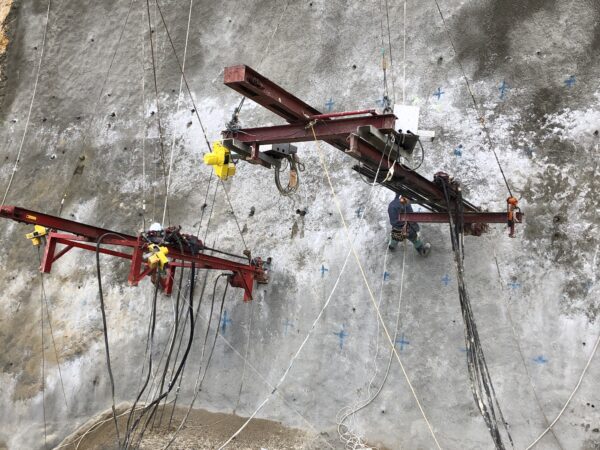
Generally, the angle of a suspended core drill is set while it is suspended.
For example, let's say the drilling angle is 30 degrees.
To suspend the core drill with a crane, using four 4-meter wires (front and back) will keep it level.
So, we’ll set up two 4-meter sections at the back (left and right) and two 5-meter sections at the front (left and right) to align the angles.
In practice, you attach a lever block or similar device to the tip end to make fine adjustments.
Then set it to 30 degrees.
Once you've aligned the design angle, set the bit to the mark that has been pre-marked on the ridge.
Next, pull the winch cable from behind the machine and secure it to a point on the drilling surface.
This is the reaction force used to secure the machine.
Considering the Angle of the Reaction Wire During Suspended Drilling (A Theoretical Exercise)
I think you'll understand if you take a look at this.
Use this to give the reaction force a firm tug upward.
Please be careful not to pull too hard at this point, as doing so may cause the angle to shift.
On the other hand, since the machine weighs about 1 metric ton, its angle doesn't change all that much.
However, it is highly likely that the angle will change by around 0.5 degrees.
But there's nothing I can do about it, so please bear with me lol
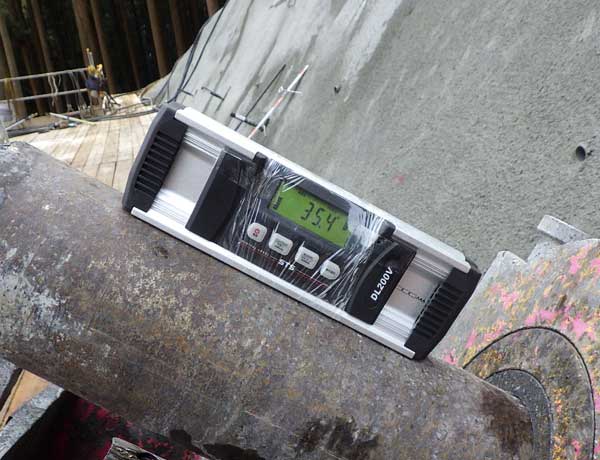
The same applies to the skid-type system; for example, let's say it's set to a drilling angle of 35 degrees.
If you measure this after drilling, there may be a deviation of about 1 degree depending on the machine.
As for the factors that cause the angle to change,
Hydraulic pressure cannot be fixed absolutely; the angle may change slightly over time. (The longer it takes, the more this is the case.)
The impact causes the entire machine to shake, so it moves up and down slightly.
The machine may shift during installation. Although it is secured in place, there may be instances where the machine’s hydraulic adjustments cannot keep up—for example, if the ground suddenly becomes harder or softer.
Since the casing is secured in place, it won't shift much, but there are factors that could cause it to shift to that extent.
It just won't stay in place.
There is a tolerance of ±2.5 degrees for this purpose.
Depending on site conditions, the design angle may be adjusted from the outset during concrete placement (within ±2.5 degrees).
We’ll do our best to follow the design specifications as closely as possible, but given the nature and characteristics of the machinery, achieving accuracy within 0.1 degrees is pretty tough.
I think about 0.5 degrees is the limit. (Though I do worry about it since I use a digital slant, lol.)
See you later.