Hello, everyone.
This is Enta.
It still isn't getting any cooler at all, lol.
It really takes a while to recover from the physical exhaustion caused by the heat, doesn't it?
Summer is really a tough time of year for guys like me!!
And today marks the start of September!
It's already the end of the year lol
For those of you who can't wait, it's already the new year!
Let's keep up our safety awareness for the next four full months! ^^
But that's beside the point.
Hey, everyone!
Resultant Force and Component Forces
Do you remember?
We learned that in middle school math, didn't we!
It's actually used in the workplace more often than you'd think.
We use it frequently for drilling.
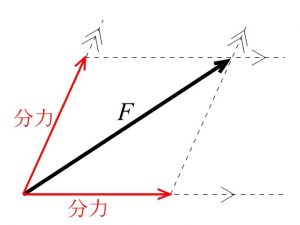
When operating a suspended core drill, we use a winch and a wire to absorb the reaction force.
Depending on how that wire is positioned, it can be the difference between whether or not you can generate a reaction force.
To ensure that the reaction force can be absorbed, it must be installed using the proper method.
It's not as simple as just attaching a wire.
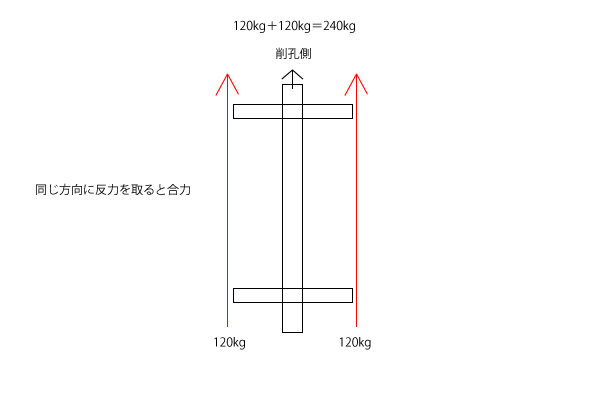
Let's assume that the reaction wire is oriented in the same direction as the drilling direction.
Since our winch is rated for 120 kg, the load required to prevent the machine from lifting off the ground when the core drill begins drilling is 240 kg.
(This is strictly a theoretical discussion.)
This means that the machine will disengage from the rock mass once its feed pressure exceeds 240 kg.
In reality, you remove the counterforce wire like this, right?
I tried writing at 30 degrees.
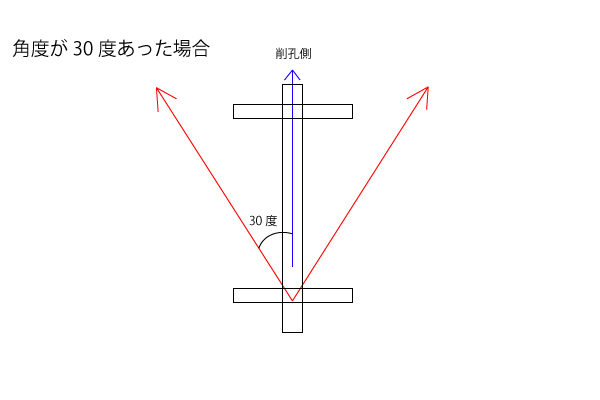
I could calculate this using force decomposition, but I don't know the exact figures for the drilling side lol
SoAssumptionLet's move on from here.
It's 30 degrees on one side, so 60 degrees in total.
Let's calculate the weight (resultant force) that causes the drilling machine to float.
Assume that the tensile load is 120 kg in both cases.
Resultant force = √(120Cos60 + 120)² + (120Sin60)²
Here's the formula. (It's been so long that I've forgotten. I think it's probably right? lol)
The answer is 120 kg.
In reality, even if one side feels narrow and the other slightly narrower, if both angles—measured from the center of the drilling rod—exceed 60 degrees,
This means the resultant force is halved. (Just remember this part, and you'll be fine!)
By routing the wire at a sharp angle, you can provide a firm counterforce.
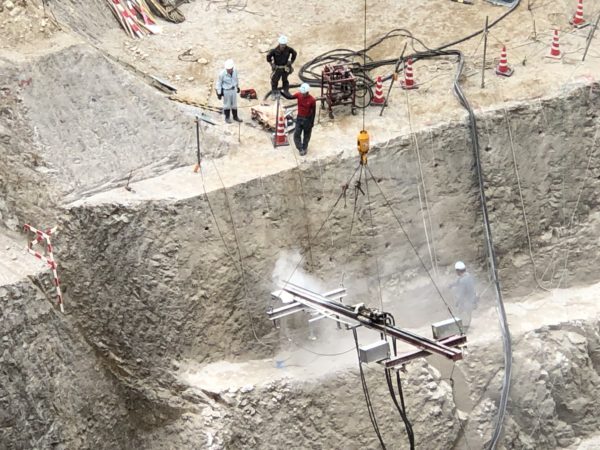
However, this concept applies only to a two-dimensional plane viewed from above.
In fact, there are also angles relative to the cross-section.
I don't really understand mechanics when it comes to three dimensions, but it's kind of fun to know that sort of theory, lol.
That said, wires aren’t just for counterforce—they also serve to prevent wobbling and other purposes.
Also, since the machine weighs around 1 metric ton and we have to secure it against the mountainside to set it up,
I can't say for sure about the finer details, but that's just the general idea, lol.
I guess this is what they call "armchair theory," lol.
If we knew all the forces with certainty, there would be nothing we couldn't calculate, but
It doesn't even make sense lol
See you later.